Watch the story on DeepSwipe
Life may have appeared surprisingly early
Earth formed about 4.54 billion years ago, and some of the earliest evidence of life dates to around 3.8 billion years ago. There is also evidence from ancient rocks in places such as Western Australia, Greenland, and Quebec that pushes the story of life very far back into Earth’s early history. In geological terms, that makes life’s appearance seem relatively rapid.
That does not mean life popped into existence in a single dramatic instant. The leading scientific view is much more gradual and much more interesting: life likely emerged through a long chain of chemical steps, each one adding a little more complexity than the last.
This broad process is called abiogenesis, meaning the origin of life from non-living matter. The idea is that simple chemicals on the early Earth eventually gave rise to systems that could reproduce, vary, and evolve.

Not one miracle, but many chemical steps
Scientists do not picture the origin of life as one “magic moment.” Instead, they investigate a sequence of stages.
Early Earth first had to become habitable, with liquid water and access to minerals and energy sources. Then came prebiotic synthesis, which means the natural formation of organic molecules before life existed. Organic molecules are carbon-containing compounds, and they include many of the building blocks used by living things.
From there, researchers think chemistry had to move through several major transitions:
- the formation of simple organic compounds
- the assembly of those compounds into larger molecules such as proteins or RNA
- self-replication, where a molecule helps make copies of itself
- self-assembly, where structures form spontaneously, such as membrane-like boundaries
- autocatalysis, where a reaction helps drive more of the same reaction
- the appearance of cell-like compartments
Together, these steps could have bridged the gap between non-living chemistry and the first evolving systems.
Why the puzzle is so difficult
The mystery becomes deeper when scientists look at the last universal common ancestor, or LUCA. This is the ancient organism from which all modern life descends. LUCA was not the first life form, but it was already highly complex.
Evidence suggests LUCA had DNA, the genetic code, and ribosomes. DNA stores hereditary information. Ribosomes are molecular structures that translate that information into proteins, which are the working molecules that perform many tasks inside cells. LUCA also appears to have had hundreds of genes and enzymes involved in metabolism.
That creates a difficult question: if even the earliest common ancestor of modern life was already sophisticated, what came before it? Researchers are trying to explain how chemistry could gradually build such an interdependent system.
A modern cell, for example, uses proteins to copy DNA, but the instructions for making those proteins are stored in DNA. That circular dependency is one reason origin-of-life research is so challenging. The answer may lie in earlier systems that were simpler than modern cells but still capable of growth, replication, and selection.
RNA may have come before DNA and proteins
One of the most influential ideas is the RNA world hypothesis. RNA is a nucleic acid, related to DNA, but it can do more than just carry information. Some RNA molecules can also catalyze chemical reactions, acting a bit like enzymes.
That matters because an early world based on RNA could solve part of the chicken-and-egg problem. A single type of molecule might both store information and help copy itself.
Researchers have argued that life may descend from an RNA world, even if something simpler came first. The ribosome itself points in that direction: its central active core is made of RNA, suggesting RNA still sits at the heart of one of life’s most essential processes.
Still, RNA may not have been the very beginning. Some scientists investigate “metabolism-first” ideas, where networks of chemical reactions emerged before genetic systems did.
The ingredients of life can form naturally
A successful theory of abiogenesis has to explain where life’s basic chemical ingredients came from. Living systems rely on four major chemical families:
- lipids, which form membranes
- carbohydrates such as sugars
- amino acids, which are used to build proteins
- nucleic acids such as DNA and RNA, which store hereditary information
Experiments and observations show that some of these ingredients can arise without biology. The famous Miller–Urey experiment in 1952 demonstrated that amino acids could be synthesized from inorganic compounds under conditions intended to resemble the early Earth.
Organic molecules have also been found beyond Earth. Amino acids have been detected in meteorites, comets, asteroids, and star-forming regions of space. Meteorites contain nucleobases, the components used in DNA and RNA. Sugars related to RNA chemistry have also been detected in space and on meteorites.
This means the young Earth may have had multiple sources of raw material: chemistry happening on the planet itself, plus a steady input of carbon-rich compounds from space.
Early Earth was harsh, but chemically active
The early Earth was not a calm blue world. During the Hadean eon, it was shaped by impacts, volcanism, intense ultraviolet radiation, and a very different atmosphere from today’s.
After its formation, Earth likely lost its first atmosphere. Later, it developed an atmosphere dominated by water vapor, nitrogen, and carbon dioxide, with smaller amounts of other gases. Oceans may have formed very early, possibly soon after the Moon-forming impact.
In spite of these harsh conditions, early Earth may have been an enormous natural chemistry lab. Water, minerals, heat, and chemical gradients were all present. Even a world under bombardment still offered protected environments. If early life or pre-life chemistry existed in water deeper than about ten meters, it may have been shielded from ultraviolet radiation and some impact effects.
Where might life have begun?
Scientists do not agree on the exact setting where life began. Several environments are actively discussed.
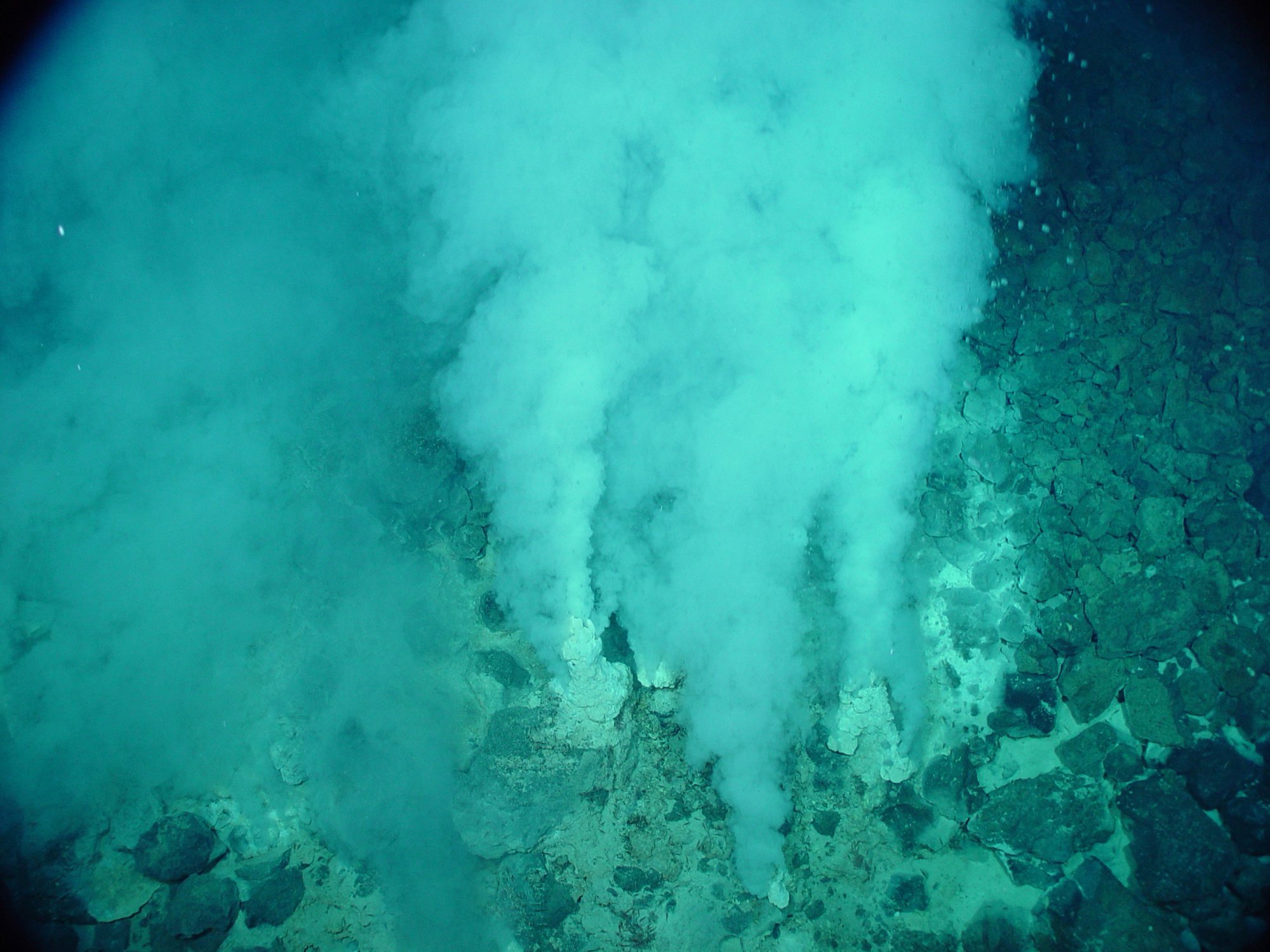
Deep-sea hydrothermal vents are a major candidate. These are places on the ocean floor where hot, chemically reactive fluids emerge from the crust. Such vents can provide steady energy from redox reactions, where one chemical donates electrons and another accepts them. Some researchers think tiny mineral compartments in these settings could have acted as natural precursors to cells.
Hydrothermal vents are also attractive because they can generate proton gradients. In modern life, proton gradients drive chemiosmosis, the process cells use to make ATP, the main energy currency of the cell. If natural gradients existed before cells, they may have powered early chemistry.
But vents are not the only option. Surface pools, lakes, ponds, and hot springs are also compelling. Wet-dry cycles in these places can concentrate molecules and promote condensation reactions that link small building blocks into larger polymers. Surface environments may also have supplied phosphate from continental rocks, an important ingredient in modern biochemistry.
Hot springs are especially interesting because they combine geothermal activity, mineral-rich water, and repeated drying and rewetting. Some researchers argue that their chemical conditions resemble the internal balance found in cells better than seawater does.
Membranes may have been a turning point
For chemistry to become biology, molecules likely needed boundaries. A protocell is a proposed stepping-stone between simple chemistry and true cells: a self-organized lipid-based compartment that could hold molecules together and separate an inside from an outside.
Membranes matter because they allow concentration, storage, and energy differences across a boundary. A membrane can keep large molecules in while letting some smaller molecules move through. That makes metabolism and replication more feasible.
Researchers have shown that vesicles, small membrane-like spheres, can self-assemble. Some theories suggest early vesicles could grow, divide, and compete for materials. Once variation appeared, natural selection could begin acting on these primitive structures.
The key idea: chemistry may organize faster than expected
No one has yet observed the full transition from non-life to life in the lab. The exact path remains unknown. But the evidence so far supports an intriguing possibility: once Earth had liquid water, the right chemicals, and usable energy sources, the steps toward life may not have taken all that long.
That is the real twist in the story of abiogenesis. The first fully cellular life we can infer was already complicated, yet the planet seems to have produced living systems relatively early in its history. That hints that under suitable conditions, matter may be able to self-organize toward life more readily than once imagined.
The origin of life is still one of science’s biggest unsolved problems. But the growing picture is not of a single impossible leap. It is of many smaller transitions, each one chemically plausible, each one nudging a lifeless planet closer to biology.