Full article · 7 min read
Biology, Evolution, and the Diversity of Life
Evolution is one of the biggest ideas in all of biology because it helps explain both the unity of life and its astonishing variety. From bacteria and archaea to plants, fungi, and animals, living things can look radically different, yet biology ties them together through inheritance, shared cellular features, and common ancestry.
This is why evolution is often treated as biology’s master story. It explains how populations change over generations, why organisms fit their environments, how new species arise, and why all known life can still be traced back through deep evolutionary history.
What evolution means in biology
In biology, evolution is the change in heritable characteristics of populations over successive generations. Heritable characteristics are traits that can be passed from parents to offspring. Because populations contain variation, evolution can shift which traits become more common over time.
This idea is central to biology because it connects many other topics that might otherwise seem separate. Genetics explains how traits are inherited. Cells and DNA provide the physical basis for inheritance. Ecology shows how organisms interact with their environments. Evolution ties these together by showing how inherited differences can shape survival and reproduction across generations.
Biology also studies life at many levels, from molecules and cells to organisms, populations, and ecosystems. Evolution matters at all of these levels, but it becomes especially visible in populations, where the frequency of inherited traits can change over time.
Natural selection: when nature does the choosing
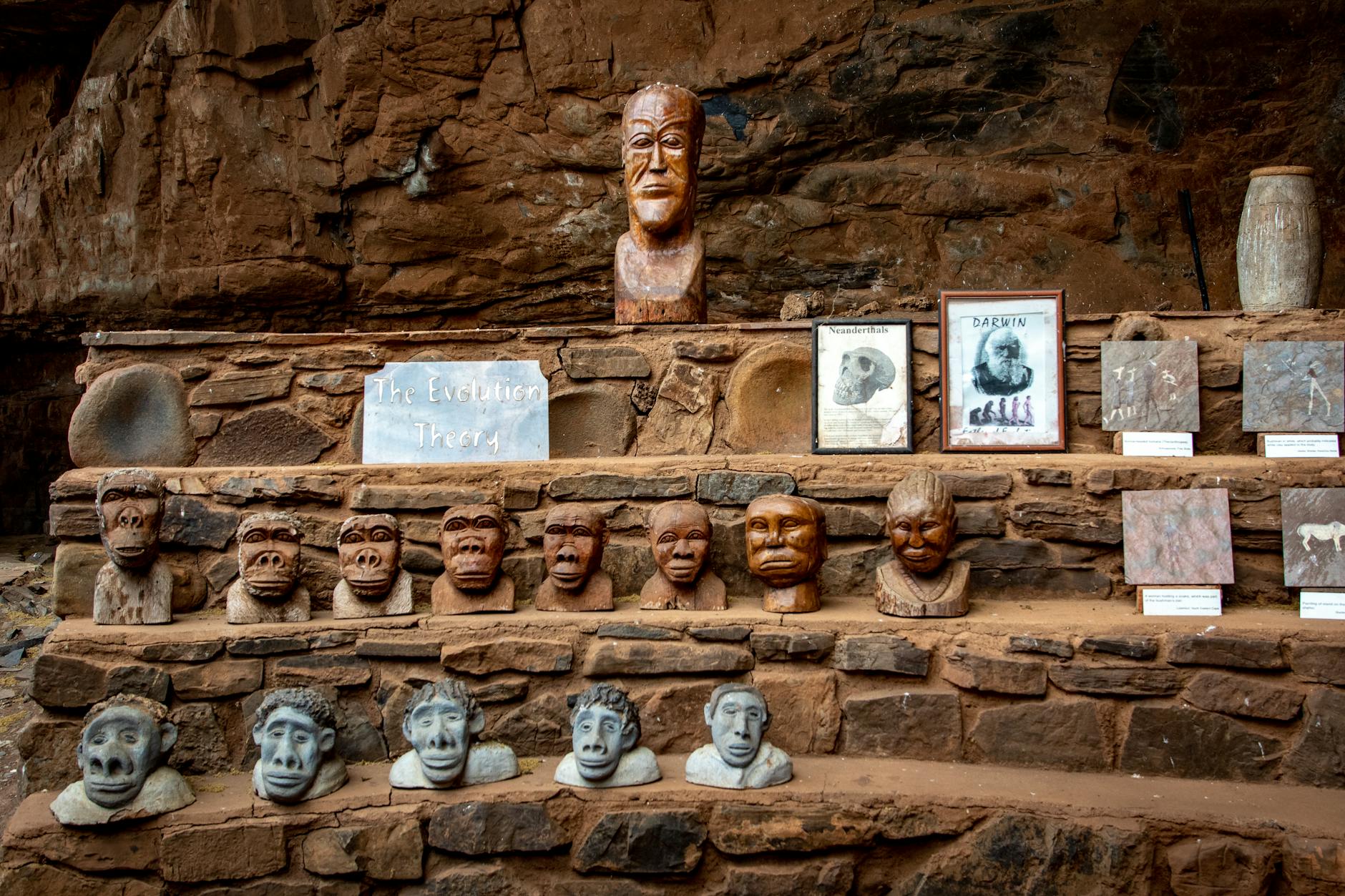
Charles Darwin argued that in the natural world, nature plays the selecting role. Individuals with heritable traits better adapted to their environments are more likely to survive and produce more offspring than others. Over many generations, this can cause favorable traits to accumulate.
This process is called natural selection. It does not mean organisms consciously choose to change. Instead, inherited traits that improve the match between an organism and its environment tend to become more common because the organisms carrying them leave more descendants.
Darwin’s theory was especially powerful because it brought together several lines of thought and observation. It offered a way to explain adaptation, meaning the way organisms appear suited to the conditions in which they live. It also helped explain biological diversity without requiring each form of life to be unrelated to the others.
Natural selection works only because traits are inherited. That is where genetics becomes essential.
Why inherited traits matter
Genetics is the study of inheritance. A gene is a unit of heredity corresponding to a region of DNA that carries genetic information controlling form or function. DNA stores the information that contributes to an organism’s genotype, and through gene expression, that information can give rise to observable traits, or phenotype.
Mutations are heritable changes in DNA. They can arise spontaneously through replication errors or be induced by environmental mutagens such as certain chemicals or radiation. Some mutations are harmful, some are beneficial, and some provide genetic variation that can later matter in evolution.
That variation is crucial. Without inherited differences, natural selection would have nothing to act on. Evolution depends on populations containing a mix of traits. When some of those traits help organisms survive or reproduce more successfully in a given environment, they can spread over generations.
The modern understanding of this process grew when evolution and classical genetics were reconciled in the modern synthesis. That unification helped explain how Darwin’s broad theory of natural selection fits with the molecular and hereditary mechanisms studied in genetics.
How one lineage becomes two
One of the most fascinating outcomes of evolution is speciation, the process by which one lineage splits into two lineages that evolve independently. A lineage is a sequence of populations connected through descent over time.
For speciation to happen, there must be reproductive isolation. That means groups can no longer successfully interbreed. Once gene flow between them is broken or greatly reduced, the two groups can diverge as they evolve separately.
Reproductive isolation can arise from incompatibilities between genes. It also tends to increase with genetic divergence, meaning that as populations become more genetically different, successful interbreeding becomes less likely.
Speciation can also happen when physical barriers divide an ancestral species. This is called allopatric speciation. In simple terms, members of the same species become separated by geography, and over time, independent evolution can push them so far apart that they become distinct species.
This helps explain how the tree of life branches. New species do not simply appear from nowhere. They emerge through divergence from earlier populations.
The tree of life and common ancestry
Biologists use phylogeny to reconstruct the evolutionary history of organisms or their genes. A phylogeny can be shown as a phylogenetic tree, a branching diagram that represents lines of descent. Each branch traces a lineage, and each split marks a point where one lineage divided into two.
These trees help biologists compare species and classify them based on shared ancestry. When different species share a feature inherited from a common ancestor, that feature is considered homologous.
The broadest biological classification places all organisms into three domains: Archaea, Bacteria, and Eukarya. Eukarya includes fungi, plants, and animals. Despite the enormous differences among these groups, biology points to deep connections among them.
One major clue is the ubiquity of the genetic code. Biologists regard this shared code across bacteria, archaea, and eukaryotes as evidence of universal common descent. In other words, all known present-day life shows signs of having diverged from shared ancestral life rather than originating as completely separate systems.
A deep history of life on Earth
Life on Earth is believed to have originated over 3.7 billion years ago. Earth itself formed about 4.5 billion years ago, and all life, living and extinct, is understood to descend from a last universal common ancestor that lived about 3.5 billion years ago.
The earliest life was dominated by microorganisms. Microbial mats made of coexisting bacteria and archaea were a dominant form of life in the early Archean eon, and many major steps in early evolution are thought to have occurred in that environment.
The earliest evidence of eukaryotes dates from 1.85 billion years ago. Around 1.7 billion years ago, multicellular organisms began to appear, with differentiated cells carrying out specialized functions. Much later, vertebrates and many other modern phyla appeared around 525 million years ago during the Cambrian explosion.
Over vast stretches of time, different groups rose, diversified, and sometimes disappeared. During the Jurassic and Cretaceous periods, dinosaurs dominated the land. After the Cretaceous–Paleogene extinction event 66 million years ago eliminated the non-avian dinosaurs, mammals increased rapidly in size and diversity.
Mass extinctions may have accelerated evolution by opening opportunities for surviving groups to diversify. This is a reminder that the history of life is not a straight ladder of progress, but a branching, interrupted, and dynamic process.
Diversity built on shared foundations
Although life is extraordinarily diverse, biology also emphasizes its shared foundations. Cell theory states that cells are the fundamental units of life, all living things are composed of one or more cells, and all cells arise from preexisting cells through cell division.
Organisms differ in whether they are made of prokaryotic cells or eukaryotic cells. Prokaryotes, such as bacteria and archaea, lack a nucleus. Eukaryotes possess one. Yet both still rely on DNA, gene expression, metabolism, and cell division.
At the chemical level, all organisms are built mostly from the same major elements: oxygen, carbon, hydrogen, and nitrogen account for most of the mass of living things. Water remains the most abundant molecule in every organism and is fundamental to life because it is an effective solvent that supports the chemical reactions organisms need.
This combination of shared chemistry, shared cellular organization, shared genetic coding, and evolutionary branching helps explain the paradox of life: everything is connected, yet everything is also different.
Why evolution matters for understanding biology
Modern biology is grounded in evolution by natural selection and in the molecular understanding of genes encoded in DNA. Together, these ideas help explain not only where biological diversity came from, but also how living systems function and change.
Evolution provides the framework for understanding why species resemble one another, why they differ, how new forms arise, and how life has spread across Earth’s many environments. It also helps make sense of classification, ecology, inheritance, and the long history of life.
If biology is the scientific study of life, evolution is the idea that makes the living world readable. It turns a chaotic variety of organisms into a connected story of descent, divergence, and adaptation.
And that story is still unfolding.
Sources
Based on information from Biology.
More like this
Trace the tree of life one swipe at a time — download DeepSwipe and evolve your knowledge daily.