Full article · 7 min read
How Climate Is Classified
Climate maps can make the planet look tidy. One region is labeled dry, another temperate, another tropical. But those neat color blocks hide a messier reality: climate is a long-term pattern, and nature rarely changes in perfectly sharp lines.
Scientists classify climate to make sense of those patterns. By sorting places according to recurring conditions such as temperature and precipitation, they can compare regions, study ecosystems, and track how climate varies over time. But not all classification systems are trying to answer the same question, and that is where things get interesting.
What “climate” actually means
Climate is not the same thing as weather. Weather is what happens from day to day: today’s wind, this week’s rain, tomorrow’s temperature. Climate is the longer-term pattern of those conditions in a place, typically averaged over 30 years.
That 30-year span is useful because it is long enough to smooth out short-term swings and unusual years, while still being short enough to reveal broader trends. Climate also includes more than just averages. It can describe variation too, including how much temperatures or rainfall tend to swing from day to day or year to year.
The variables commonly used to describe climate include temperature, precipitation, wind, humidity, and atmospheric pressure. In broader terms, climate also reflects the state of major parts of the climate system, including the atmosphere, hydrosphere, cryosphere, lithosphere, and biosphere, along with the interactions between them. In simple terms, that means air, water, ice, land, living things, and the way they influence one another.
Why scientists classify climates
Climate classification systems are ways of organizing the world’s climates into categories. Since climate strongly affects life in a region, these systems often overlap with biome patterns. A biome is a large natural region, such as a forest or desert, shaped by climate and the living things adapted to it.
Classification helps turn a huge amount of climate information into something usable. Instead of memorizing the full temperature and rainfall pattern of every place on Earth, scientists can group places with similar conditions into the same climate type.
Still, a climate classification is always a model of reality, not reality itself. It simplifies. That is useful, but it can also create the false impression that one climate abruptly stops where another begins.
The Köppen climate classification
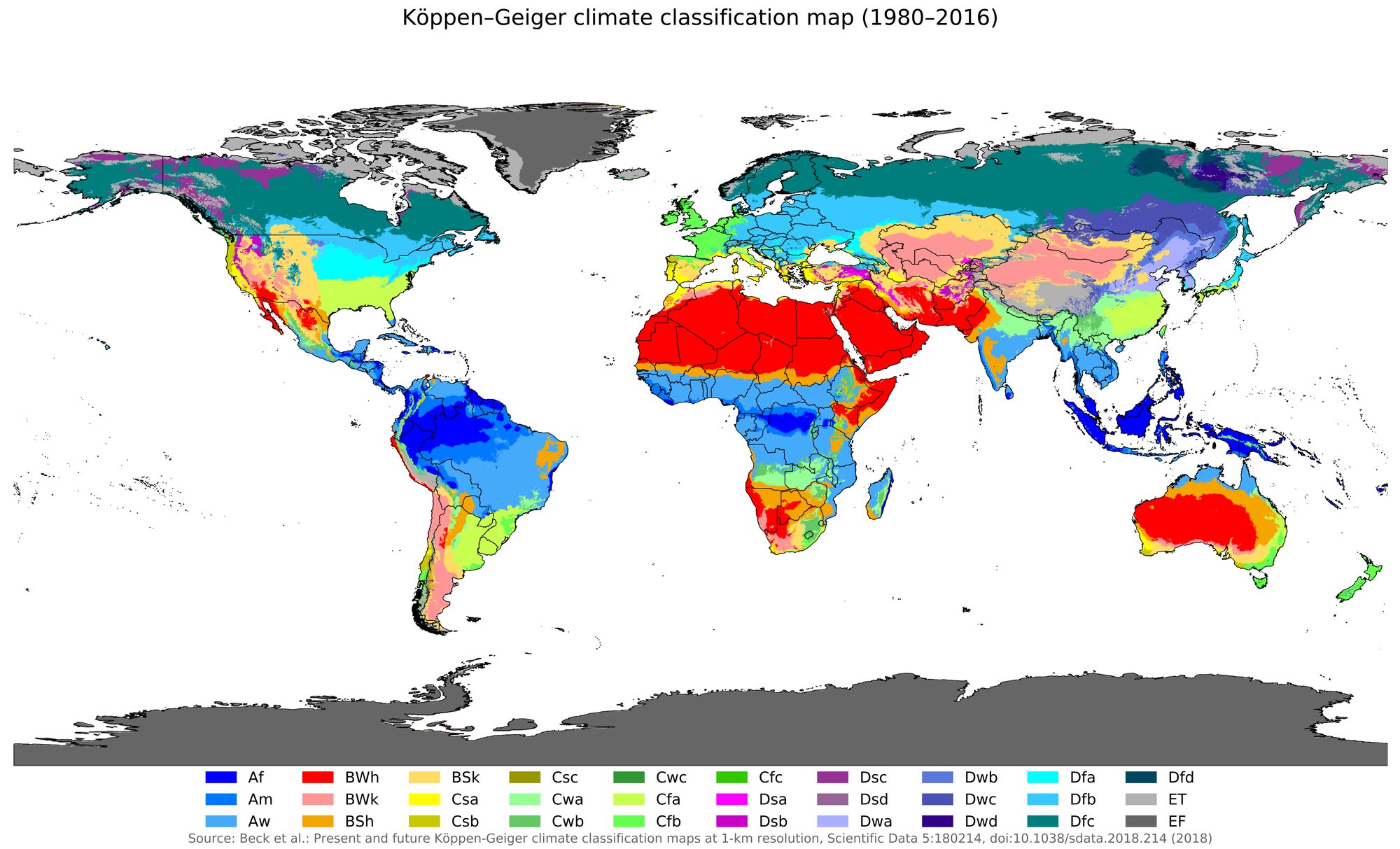
One of the most widely used systems is the Köppen climate classification, first developed in 1899. It groups climates mainly using average patterns of temperature and precipitation, and it was originally designed to identify climates associated with certain biomes.
That makes it especially practical. If a region tends to have a particular combination of warmth and rainfall, it often supports a certain broad pattern of plant life as well. This is one reason Köppen-style climate maps are so common: they connect climate data to landscapes people can recognize.
The appeal of the Köppen system is its clarity. It gives researchers and readers a straightforward way to compare places across the globe. But that same clarity is also one of its limitations. Like many classification systems, it creates distinct boundaries between climate zones even though climate properties usually change more gradually in nature.
Why climate borders look sharper than they really are
On a map, climate zones often appear as bold areas with exact edges. In the real world, those edges are often fuzzy.
A region’s climate is shaped by many factors, including latitude, longitude, altitude, terrain, land use, nearby water bodies, and ocean currents. Because these influences do not switch on and off at a border, climate often shifts step by step across space.
For example, changes in elevation can alter climate over relatively short distances. Nearby oceans can also change local conditions by redistributing heat between land and water. Mountains, vegetation, and the proportion of land to water can all affect how much solar heat is absorbed, how much water is retained, and how much rainfall falls in a region.
So while a map may draw a crisp line, the actual experience on the ground may be one of transition. One area may become slightly cooler, slightly drier, or slightly windier as you move across it, rather than suddenly transforming into a whole new climate.
Different systems ask different questions
Not every climate classification system is built the same way. Broadly, modern methods can be divided into genetic methods and empiric methods.
Genetic methods focus on the causes of climate. These systems look at what is producing the climate of a region. One example is a classification based on the origin or frequency of air masses. Air masses are large bodies of air with broadly similar characteristics, such as temperature and moisture. The Bergeron and Spatial Synoptic Classification systems focus on the origin of the air masses that define a region’s climate.
Empiric methods focus on the effects of climate. Instead of asking what causes a climate, they sort places according to what climate conditions are like or what those conditions support. The Köppen system is a classic example. Other empiric approaches may use plant hardiness, climate zones linked to biomes, or evapotranspiration.
Evapotranspiration is the combined loss of water from soil and from plants into the air. It is a useful concept because it connects temperature and moisture to how water actually moves through a landscape.
The Thornthwaite system and evapotranspiration
Another climate classification system, in use since 1948, is the Thornthwaite system. It includes evapotranspiration along with temperature and precipitation information.
That matters because two places with similar rainfall totals may still behave differently if water is lost to the air at different rates. By taking evapotranspiration into account, the Thornthwaite system can be useful for studying biological diversity and for understanding how climate change affects living systems.
Its major climate classifications are microthermal, mesothermal, and megathermal. Even without unpacking every category, the names point to an emphasis on thermal conditions, or how warm or cool a place tends to be over time.
Ancient ideas, modern methods
Climate classification has very old roots. In Ancient Greece, climes were defined to describe weather according to latitude. Modern systems are much more detailed, but the basic goal is familiar: to sort different parts of the world according to recurring environmental patterns.
Today’s classifications can draw on many variables beyond temperature and precipitation. Climate records may also include humidity, visibility, cloud amount, solar radiation, soil temperature, pan evaporation rate, days with thunder, and days with hail. The more detail available, the more precisely scientists can compare regions and examine change.
Why classification matters beyond the map
Climate classification is not just about labeling places. It helps scientists study climate variability and climate change as well.
Climate variability refers to variations in the average state or other characteristics of climate across time and space beyond individual weather events. Some variability appears random, while some occurs more regularly in distinct patterns. Classification systems can help organize those patterns and show how regions compare.
They also matter when climates begin to shift. A change in average temperature can move climate zones across latitude or elevation. As climate zones shift, species may move upward in elevation or toward the poles in latitude in response.
That means climate classification is connected to ecology, biodiversity, and long-term environmental change. A colored map of climate zones may look static, but the patterns it represents can move.
The big limitation to remember
The most important caution is simple: classification is a tool, not a perfect mirror of nature.
A useful system groups similar climates together, but every system emphasizes some features more than others. One may be best for linking climate to plant life. Another may be better for tracking water balance through evapotranspiration. Another may focus on the air masses that create local weather patterns.
And nearly all of them share a common shortcoming: they tend to create distinct boundaries between zones, while nature usually works through gradual transition.
That does not make the systems wrong. It makes them purposeful simplifications. They are maps of a complex reality, built to answer specific questions.
Reading climate maps more wisely
The next time you see a world climate map, it helps to read it with two ideas in mind at once. First, the categories are useful summaries of long-term patterns in temperature, precipitation, and related variables. Second, the planet itself is more continuous than the map suggests.
That tension is what makes climate classification so fascinating. It sits between order and complexity: clear enough to teach, compare, and analyze, but always pointing back to a world where air, water, land, altitude, and life interact in endlessly blended ways.
Climate zones may look neat on maps. The real Earth is rarely so tidy.
Sources
Based on information from Climate.
More like this
Swipe through climate zones without getting lost at the border — download DeepSwipe and explore knowledge one smooth transition at a time.