Full article · 7 min read
Comets: How the Kuiper Belt and Oort Cloud Send Icy Visitors Our Way
Comets can look like sudden intruders in the night sky, but their journeys usually begin in two distant reservoirs at the edge of the Solar System. Some return often enough to become familiar to astronomers. Others spend thousands, millions, or even more years on stretched-out paths before diving sunward. And a few may pass through only once.
Understanding where comets come from helps explain why some are predictable while others seem to appear out of nowhere. It also reveals that the Solar System is surrounded by enormous stores of icy bodies, most of them too far away and too faint to see directly.
Two distant comet reservoirs
The main sources of comets are the Kuiper belt and the Oort cloud.
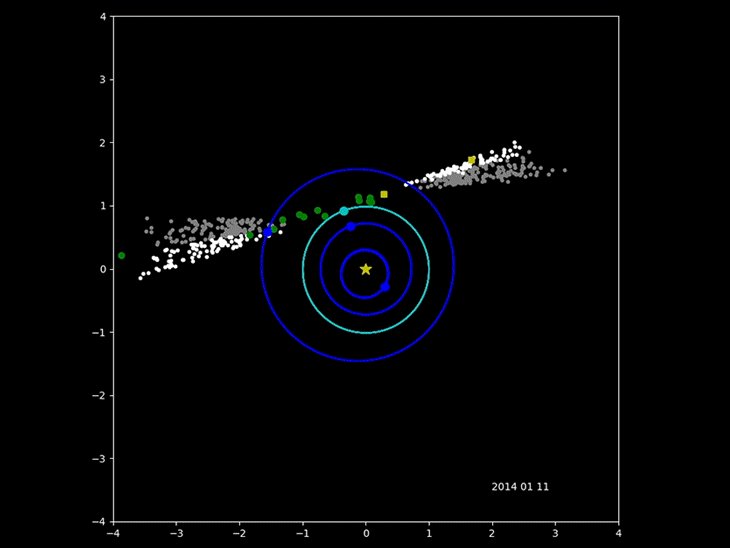
Short-period comets are thought to come from the Kuiper belt and its associated scattered disc. The Kuiper belt is a distant region beyond Neptune filled with icy bodies. The scattered disc is related to it, but contains objects on more stretched and tilted orbits. These are important sources for comets that loop around the Sun relatively often.
Long-period comets are thought to come from the Oort cloud, a vast spherical cloud of icy bodies extending from beyond the Kuiper belt to enormous distances from the Sun. Estimates in the article place the Oort cloud from roughly 2,000 to as far as 50,000 astronomical units from the Sun, with some outer-edge estimates reaching 100,000 to 200,000 astronomical units.
An astronomical unit, or AU, is the average distance between Earth and the Sun. Using that yardstick makes it easier to describe the immense scale of the Solar System. When distances are measured in tens of thousands of AU, it means these comet reservoirs are truly remote.
Why short-period and long-period comets behave so differently
Comets are often grouped by orbital period, meaning how long they take to go around the Sun once.
Short-period comets generally have orbital periods of less than 200 years. They often travel more or less in the same plane as the planets. Their orbits can take them out toward the giant planets and then back inward toward the Sun. Because they return on repeat schedules, they are the easiest comets to predict.
Long-period comets are different. Their orbits are highly eccentric, meaning extremely elongated rather than nearly circular. Their periods range from 200 years to thousands, millions, or even more years. When one of these comets enters the inner Solar System, it may be the first time any human has ever seen it.
This difference in orbit is tied directly to origin. Short-period comets are linked to nearer outer-Solar-System populations such as the Kuiper belt and scattered disc. Long-period comets are linked to the much farther Oort cloud.
The Oort cloud: a hidden spherical swarm
The Oort cloud is one of the most dramatic ideas in comet science. Rather than being a flat ring, it is thought to be a spherical swarm surrounding the Solar System. That means long-period comets can arrive from almost any direction.
The article also describes a possible inner region called the Hills cloud, named after Jack G. Hills. This inner cloud is doughnut-shaped and lies closer in than the outer Oort cloud. Models suggest it may contain tens or hundreds of times as many cometary nuclei as the outer halo. It may help resupply the outer Oort cloud over billions of years.
This matters because the outer Oort cloud is only weakly bound to the Sun. In other words, its objects can be disturbed more easily than bodies orbiting closer in.
What sends a comet inward?
Long-period comets do not simply decide to fall toward the Sun. They are thought to be nudged inward by gravitational perturbations.
A gravitational perturbation is a change in an object's orbit caused by the gravity of something else. For Oort cloud comets, the main triggers mentioned are passing stars and the galactic tide.
The galactic tide is the gentle gravitational influence of the Milky Way acting over huge distances. Even a weak pull can matter when an icy body is extremely far from the Sun. Over time, these nudges can shift an object's orbit enough that it begins a plunge into the inner Solar System.
For Kuiper belt and scattered disc objects, the outer planets can also disturb their orbits and send them inward. Jupiter is especially important because it is more than twice as massive as all the other planets combined. Its gravity can strongly reshape comet paths, including deflecting long-period comets into shorter-period orbits.
Hyperbolic and one-time visitors
Not every comet is coming back.
Some comets follow hyperbolic paths. A hyperbolic orbit is an open path, not a closed loop, meaning the object escapes the Sun’s gravity rather than staying bound to it. These comets may pass through the inner Solar System once and then leave forever.
A comet can end up on a hyperbolic path after gravitational interactions inside the Solar System. One example given is Comet C/1980 E1, which had its path changed after a close pass by Jupiter.
There are also interstellar visitors, objects that originated outside the Solar System entirely. Three such objects listed are 1I/ʻOumuamua, 2I/Borisov, and 3I/ATLAS. Of these, 2I/Borisov was observed to have a coma, the fuzzy cloud of gas and dust around a comet’s nucleus, and is considered the first detected interstellar comet. 3I/ATLAS also has a coma, indicating it too is a comet.
ʻOumuamua did not show optical signs of cometary activity during its passage through the inner Solar System, but changes to its trajectory suggested outgassing, which is the release of gas as a comet warms.
What makes new comets so unpredictable?
Periodic comets can be forecast because their orbits have already been measured. If a comet has been seen before and remains on a stable enough path, astronomers can calculate when it should return.
Brand-new comets are different. A comet newly sent inward from the Oort cloud arrives by a process that is not easy to predict in detail. The gravitational influence of nearby stars or the galactic tide can disturb distant bodies long before they become visible. By the time one appears in the inner Solar System, it may feel like a surprise.
That is why some apparitions are expected while others seem to emerge from nowhere. The next striking comet in the sky may already be inbound, still far too distant to notice.
A vast population, only partly known
As of November 2021, 4,584 comets were known. That sounds like a lot, but it is tiny compared with the estimated total population. The reservoir of comet-like bodies in the outer Solar System, specifically the Oort cloud, is estimated at about one trillion.
That contrast is one of the most astonishing facts about comets. The objects humans have cataloged are only a very small sample of what may exist. Most remain unseen because they are too far away, inactive, or too faint.
Roughly one comet per year becomes visible to the naked eye, though many are faint and unspectacular. The especially bright ones are called great comets.
From frozen body to glowing spectacle
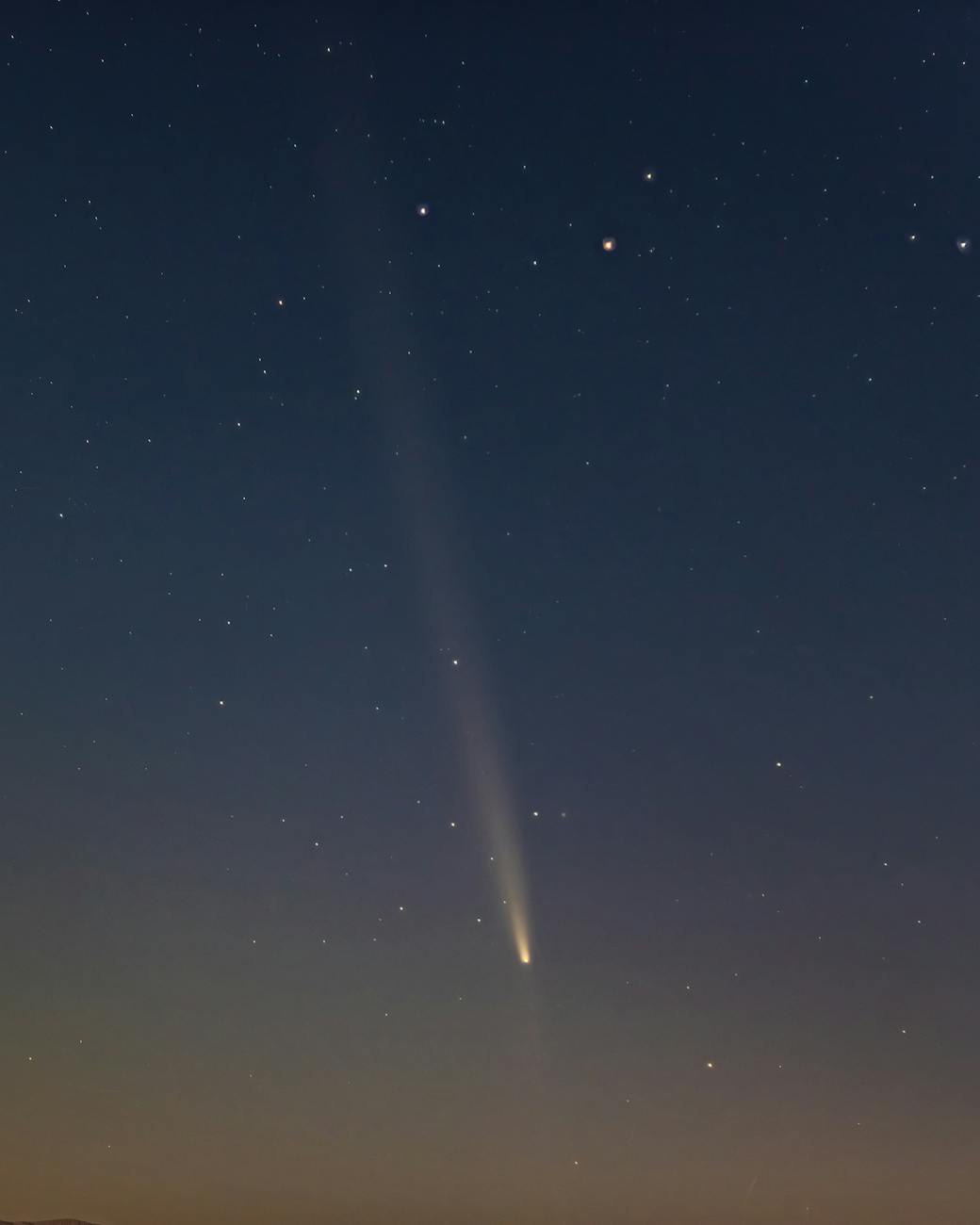
A comet in deep space is usually frozen and inactive. As it approaches the Sun, solar radiation causes volatile materials inside it to vaporize and stream out from the nucleus. This release of gas is called outgassing.
The solid center of the comet is the nucleus, made from rock, dust, water ice, and frozen substances such as carbon dioxide, carbon monoxide, methane, and ammonia. When outgassing begins, the comet develops a coma, a huge and extremely thin atmosphere of gas and dust surrounding the nucleus.
The Sun’s radiation pressure and the solar wind then help produce tails. Dust and ionized gas form distinct tails that point in somewhat different directions. The ion tail points directly away from the Sun, while the dust tail often curves along the comet’s orbital path.
These features are why a comet can transform from a small icy body into one of the most dramatic sights in the sky.
Why origin matters
Knowing whether a comet comes from the Kuiper belt, scattered disc, or Oort cloud tells astronomers a great deal about its likely orbit and behavior. A short-period comet suggests a closer outer-Solar-System source and a repeat visitor. A long-period comet points to the distant spherical cloud around the Solar System. A hyperbolic or interstellar object may be a one-time traveler.
Comets are not just pretty objects with tails. They are messengers from the Solar System’s farthest regions, and sometimes from beyond it. Their origins explain why some become familiar returnees while others arrive as complete surprises.
And because the hidden comet population is so enormous, the sky may still have many unexpected visitors left to reveal.
Sources
Based on information from Comet.
More like this
Take the scenic route through the Solar System — download DeepSwipe and let new knowledge swing into view like a comet from the Oort cloud.