Full article · 7 min read
Supernova: the two main ways stars explode
A supernova is one of the most dramatic events in the universe: a star detonates so powerfully that, for a time, its visible brightness can rival that of an entire galaxy. But that cosmic finale can begin in two very different ways.
One route starts with a white dwarf, the compact burned-out core left behind by a Sun-like star. The other begins with a massive star whose core can no longer hold itself up against gravity. In both cases, the result is a brilliant explosion, a violent shock wave racing into space, and a huge release of matter that helps shape the surrounding galaxy.
Two triggers, one spectacular outcome
Astronomers group the main supernova triggers into two broad mechanisms.
The first is the sudden re-ignition of nuclear fusion in a white dwarf. Fusion is the process in which atomic nuclei combine and release energy. In normal stars, fusion powers the star steadily. In a white dwarf supernova, that process can restart in a runaway way, meaning the nuclear burning spirals out of control instead of remaining stable. When that happens, the star can be completely disrupted.
The second is the sudden gravitational collapse of a massive star’s core. A stellar core is the dense central region where fusion takes place. Massive stars spend their lives fusing progressively heavier elements, but eventually the core reaches a point where fusion no longer provides enough energy to push back against the star’s own gravity. The center then collapses inward extremely fast, triggering the explosion.
Even though these beginnings are very different, both kinds of supernova create a short-lived but astonishingly bright event that can remain visible for weeks or months before fading.
White dwarf supernovae: when a dead star reignites
A white dwarf is a small, dense stellar remnant, roughly Earth-sized, formed after a less massive star has exhausted its fuel. On its own, a white dwarf is stable. Trouble begins when it gains extra matter.
One common setup involves a binary system, where two stars orbit each other. If the white dwarf has a companion star nearby, it can accrete material from it. Accretion simply means pulling in gas from the neighboring star. As more matter piles on, the white dwarf’s temperature can rise enough to ignite carbon fusion.
At that point, the fusion does not settle into a calm balance. Instead, it becomes runaway nuclear fusion. In plain terms, the reactions release energy so quickly that they trigger even more reactions, and the process accelerates catastrophically. Rather than leaving behind a compact remnant, this kind of explosion completely disrupts the white dwarf.
A second possible route is a merger between stars involving white dwarfs. The important point is the same: the white dwarf is pushed into conditions where fusion re-ignites violently.
This mechanism is associated with Type Ia supernovae, which are famous because their peak brightness is very consistent. That consistency made them useful as standard candles, meaning astronomers can compare how bright they appear to how bright they are known to be and estimate cosmic distances.
Core-collapse supernovae: when gravity wins
The other great supernova route belongs to massive stars. These stars can fuse heavier and heavier elements in their cores as they age. Eventually, the core can no longer generate enough energy from fusion to resist the inward pull of gravity. The article notes that this must happen once the star begins fusing iron, though collapse may occur during an earlier stage of metal fusion.
Once support fails, the core implodes. An implosion is an inward collapse rather than an outward blast. This collapse happens at tremendous speed and leads to a violent rebound and shock wave. That shock wave helps blow off the star’s outer layers, producing the visible supernova.
The crushed remnant left behind depends on the conditions in the core. It may become a neutron star, an ultra-dense compact object, or it may collapse further into a black hole. In some cases, there may be little radiated energy if the collapse does not produce a successful visible explosion.
Core collapse is responsible for the families of supernovae known as Type II and also Type Ib and Ic, depending on what remains in the outer layers of the star before it explodes. If hydrogen is still present, the event is classified as Type II. If the star has lost most of its outer hydrogen envelope, the result can be Type Ib or Ic.
Why iron matters
A key idea in the collapse story is that fusion must produce enough energy to counter gravity. Earlier in a star’s life, fusion does exactly that. But once the star reaches advanced burning stages, the balance becomes fragile.
The article highlights iron as a turning point. When a massive star begins fusing iron, the core is at the end of the line for maintaining support through ordinary fusion. At that stage, gravity can take over, and collapse follows.
This is why a massive star’s supernova is often described as the moment when fusion can no longer resist gravity. The star does not simply burn out quietly. Its own weight crushes the center, and that collapse helps launch one of nature’s most violent explosions.
What gets blasted into space
A supernova does more than flash brightly. It ejects enormous quantities of matter into the surrounding interstellar medium, the gas and dust that fill the space between stars.
The amount can be several solar masses, meaning several times the mass of our Sun. That material can be flung outward at speeds reaching several percent of the speed of light. When ejecta this fast slam into surrounding gas and dust, they drive an expanding shock wave.
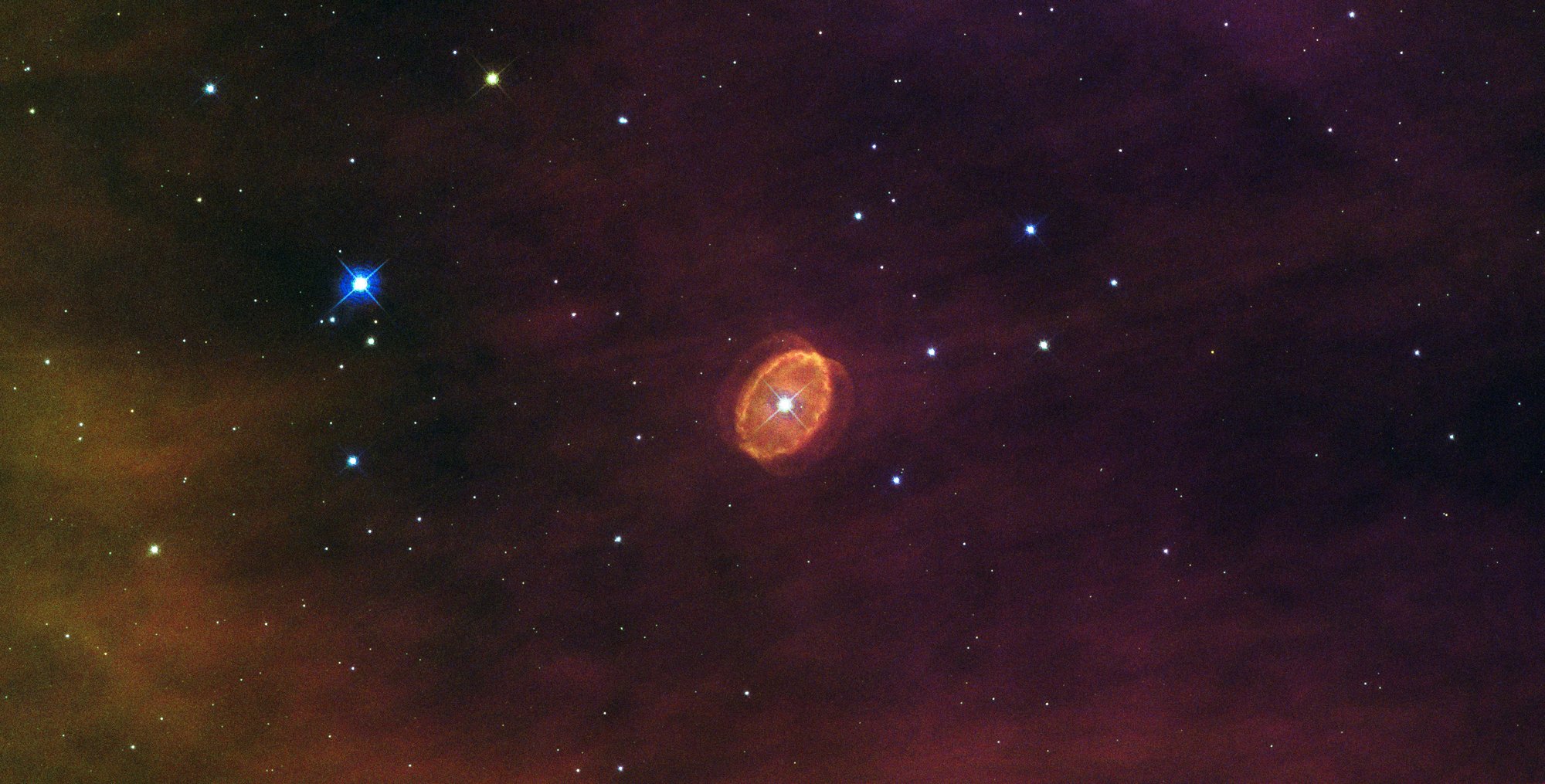
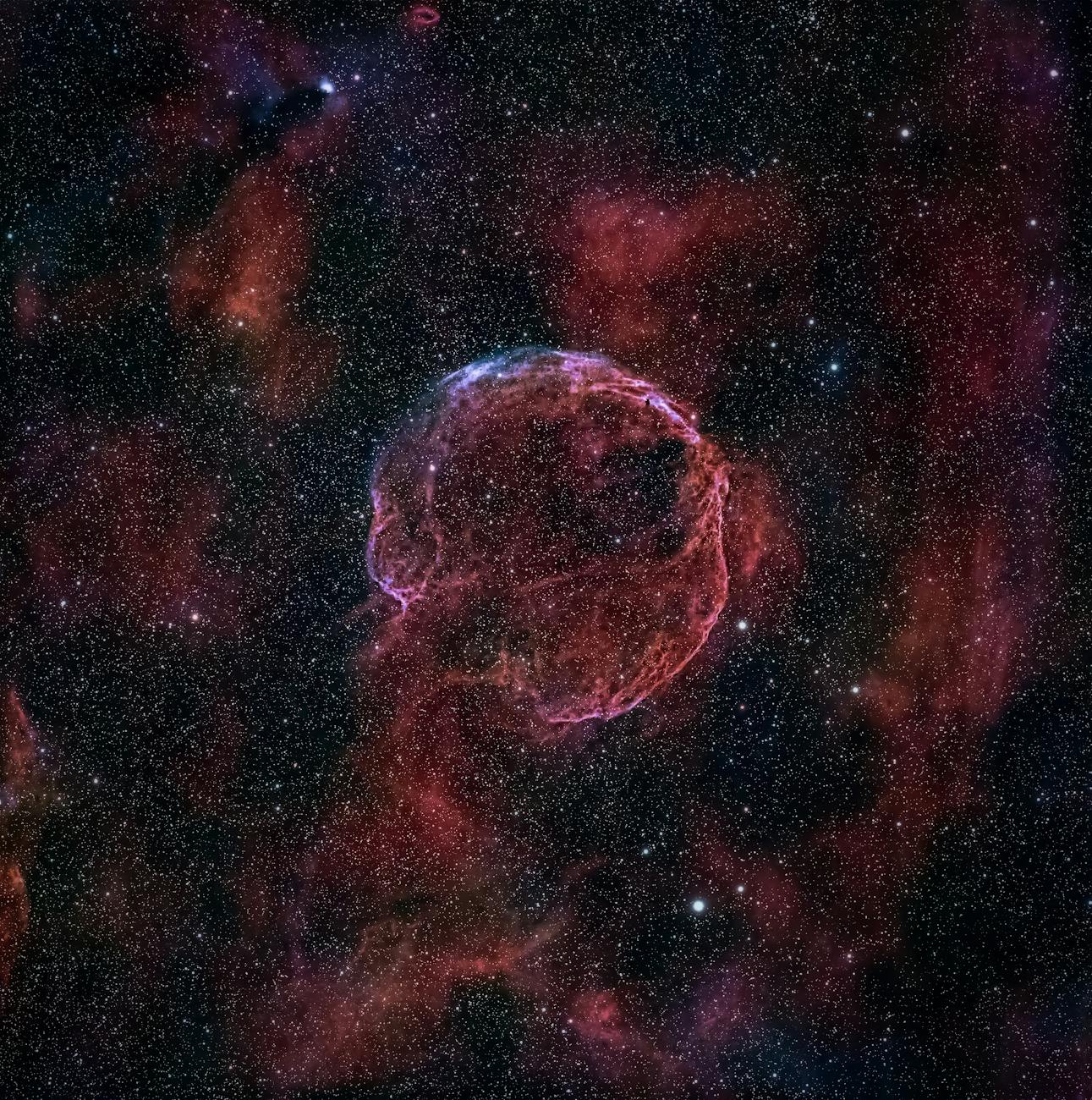
A shock wave is a fast-moving, high-pressure front. As it plows through space, it sweeps up shells of gas and dust and creates what astronomers call a supernova remnant. These remnants can persist long after the original flash has faded.
The element factories of space
Supernovae are also major contributors to the chemical enrichment of galaxies. They supply elements to the interstellar medium from oxygen to rubidium. Type Ia supernovae mainly produce silicon and iron-peak elements such as nickel and iron, while core-collapse supernovae eject larger amounts of lighter alpha elements such as oxygen and neon.
That matters because the early universe contained mostly hydrogen, helium, and traces of lithium. Heavier elements had to be made later inside stars and in explosive events. Supernovae are one of the dominant ways those heavier elements get scattered back into space.
In other words, a supernova is not just an ending. It is also a redistribution event. Material forged in stars is blown outward, mixed into molecular clouds, and becomes part of later generations of stars.
Shock waves that can help make new stars
The blast from a supernova does not only spread elements. Its expanding shock wave can also trigger the formation of new stars by compressing nearby dense molecular clouds.
This makes supernovae an important part of the life cycle of galaxies. A star explodes, and the outward-moving pressure can help set the stage for future stars to form. The same event that destroys one star can help begin the next round of stellar birth.
Famous observed supernovae
Although supernovae are expected to occur in the Milky Way on average once every 61 years, very few have been seen with the naked eye in recorded history. Among the most famous are Tycho’s Supernova in 1572 and Kepler’s Supernova in 1604.
Another landmark event was SN 1987A in the Large Magellanic Cloud, a satellite galaxy of the Milky Way. It became one of the most closely studied supernovae ever observed and was linked to the explosion of a blue supergiant star. It also provided the only measurements of astronomical neutrinos besides those from the Sun.
Neutrinos are subatomic particles produced in huge numbers during some supernovae. They barely interact with matter, which means they can escape dense stellar interiors and race across space carrying information about what happened deep inside the explosion.
A cosmic flash with lasting consequences
From far away, a supernova may look like a sudden new star appearing in the sky. In reality, it is the catastrophic death of a star by one of two main paths: a white dwarf pushed into runaway fusion, or a massive star whose core collapses under gravity.
Both routes unleash extraordinary brightness. Both hurl matter across space at enormous speed. And both leave consequences that last far beyond the fading light: compact remnants such as neutron stars or black holes, vast expanding remnants of gas and dust, and a galaxy enriched with the ingredients for future stars.
That is the strange beauty of a supernova. It is destruction on a colossal scale, but also part of the process that keeps the universe changing.
Sources
Based on information from Supernova.
More like this
Go out with a bang, not a whimper — download DeepSwipe and let your curiosity explode supernova-style.