Full article · 7 min read
Supernovae: The Element Factories That Seed Future Worlds
We really are made of stellar debris. When a star explodes as a supernova, it does far more than create a dramatic flash in the sky. It becomes a cosmic factory and delivery system, forging elements and blasting them into space. Those ingredients then mix into the interstellar medium, the thin gas and dust between stars, where they can help build new stars, planets, and eventually the chemistry that makes worlds possible.
Supernovae are major sources of elements in space from oxygen through rubidium. They also launch shock waves that can compress nearby gas clouds and trigger the birth of new stars. In other words, a supernova is both an ending and a beginning: a dead star enriching the raw material for future solar systems.
How a supernova becomes an element factory
Not all supernovae happen the same way, but two broad mechanisms dominate.
One path begins with a white dwarf, the dense remnant of a star like the Sun. If it is triggered into runaway nuclear fusion, the star is completely disrupted. These explosions are associated with Type Ia supernovae.
The other path is core collapse. In a massive star, fusion in the core eventually can no longer provide enough energy to support the star against its own gravity. The core collapses, and the star may explode as a core-collapse supernova. Depending on the details, the remnant can become a neutron star or black hole.
These different kinds of explosions do not all make the same mix of elements. That is what makes supernovae especially important in cosmic chemistry: different stellar deaths contribute different products to the universe.
Two cosmic forges, two different chemical outputs
White-dwarf supernovae and core-collapse supernovae each play a distinct role in enriching space.
Type Ia supernovae, which come from exploding white dwarfs, produce mainly silicon and iron-peak elements. Iron-peak elements are the group of elements clustered around iron in the periodic table, including metals such as nickel and iron. In these events, a large amount of radioactive nickel-56 can be created, and its decay helps power the visible brightness of the explosion.
Core-collapse supernovae eject a different chemical mix. Compared with Type Ia events, they produce much smaller quantities of iron-peak elements, but much larger amounts of lighter alpha elements such as oxygen and neon. They can also contribute elements heavier than zinc, with electron-capture supernovae being especially significant in that heavier-element production.
Type II supernovae, one major class of core-collapse event, throw off large amounts of hydrogen and helium as well. So when astronomers say supernovae enrich the interstellar medium, they are talking about a layered and varied contribution, not one standard recipe.
From oxygen to rubidium
One of the most striking facts about supernovae is the breadth of the periodic table they help populate. They are major sources of elements in the interstellar medium from oxygen to rubidium.
That matters because the universe began with a much simpler chemical inventory. The Big Bang produced hydrogen, helium, and traces of lithium. Heavier elements were made later in stars, supernovae, and collisions between neutron stars. Supernovae are one of the main ways those newly made elements get scattered into surrounding space.
Astronomers often call all elements heavier than helium “metals.” That definition is broader than everyday chemistry. In astronomy, oxygen, neon, silicon, iron, and many other elements all count as metals. Each supernova enriches nearby gas with more of these metals, so the next generation of stars forms from material that is chemically richer than the last.
The r-process: a sprint to heavy elements
Some of the most fascinating element-making in a supernova happens under extreme conditions during collapse. One key pathway is the r-process, short for rapid neutron capture process.
In this process, atomic nuclei capture neutrons very quickly, building up extremely neutron-rich, unstable nuclei. Those nuclei then rapidly undergo beta decay, transforming into more stable forms. In supernovae, these r-process reactions are responsible for about half of all the isotopes of elements beyond iron.
An isotope is a version of an element with the same number of protons but a different number of neutrons. So when astronomers say “about half the isotopes beyond iron,” they are talking about a huge share of the possible nuclear forms of heavy elements.
There is an important nuance here: neutron star mergers may be the main astrophysical source for many of these heavy elements. But supernovae still play a major role in r-process production and in the broader enrichment of galaxies.
Shock waves that do more than destroy
A supernova does not just release matter. It also drives a powerful shock wave into the surrounding interstellar medium.
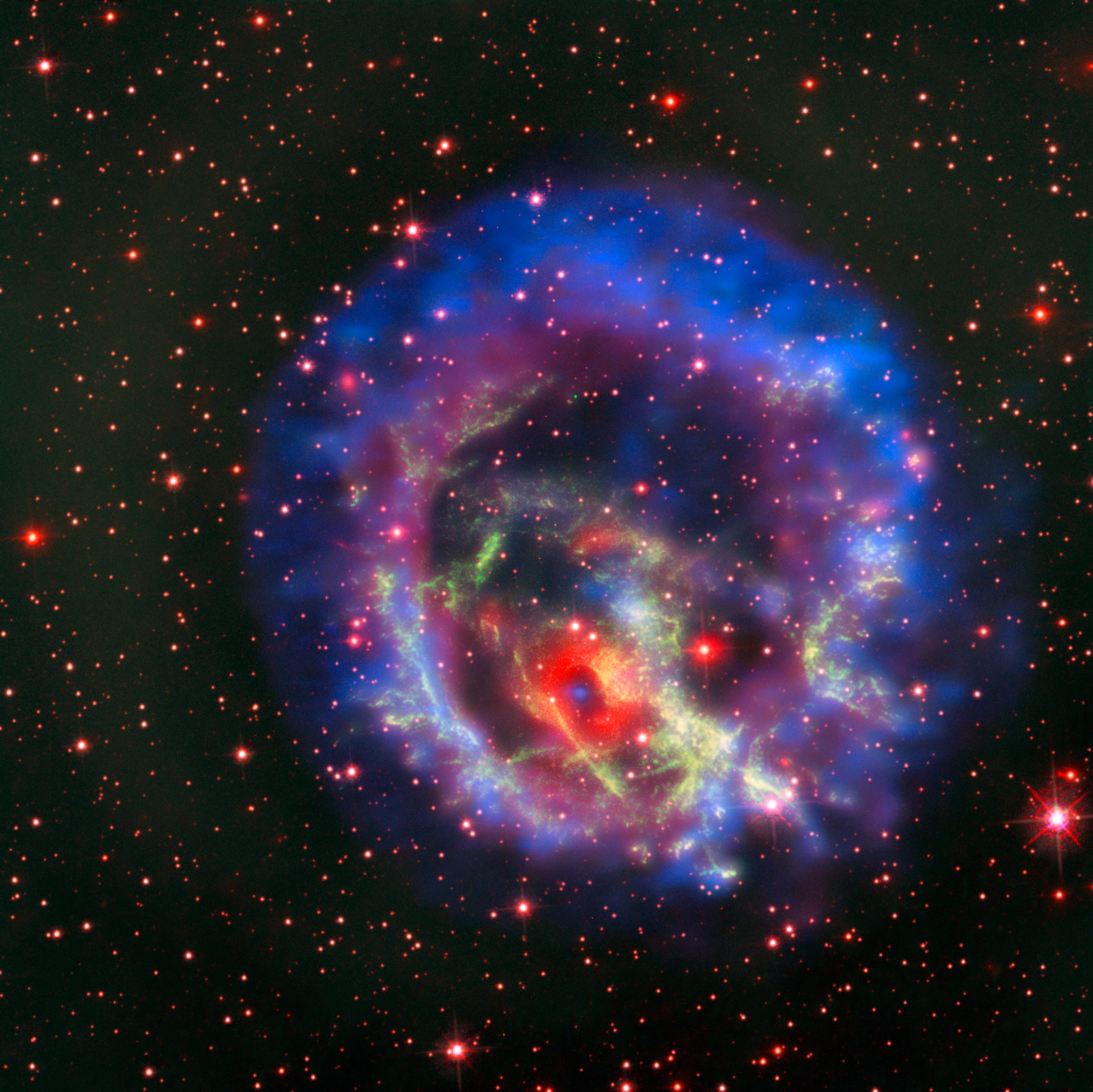
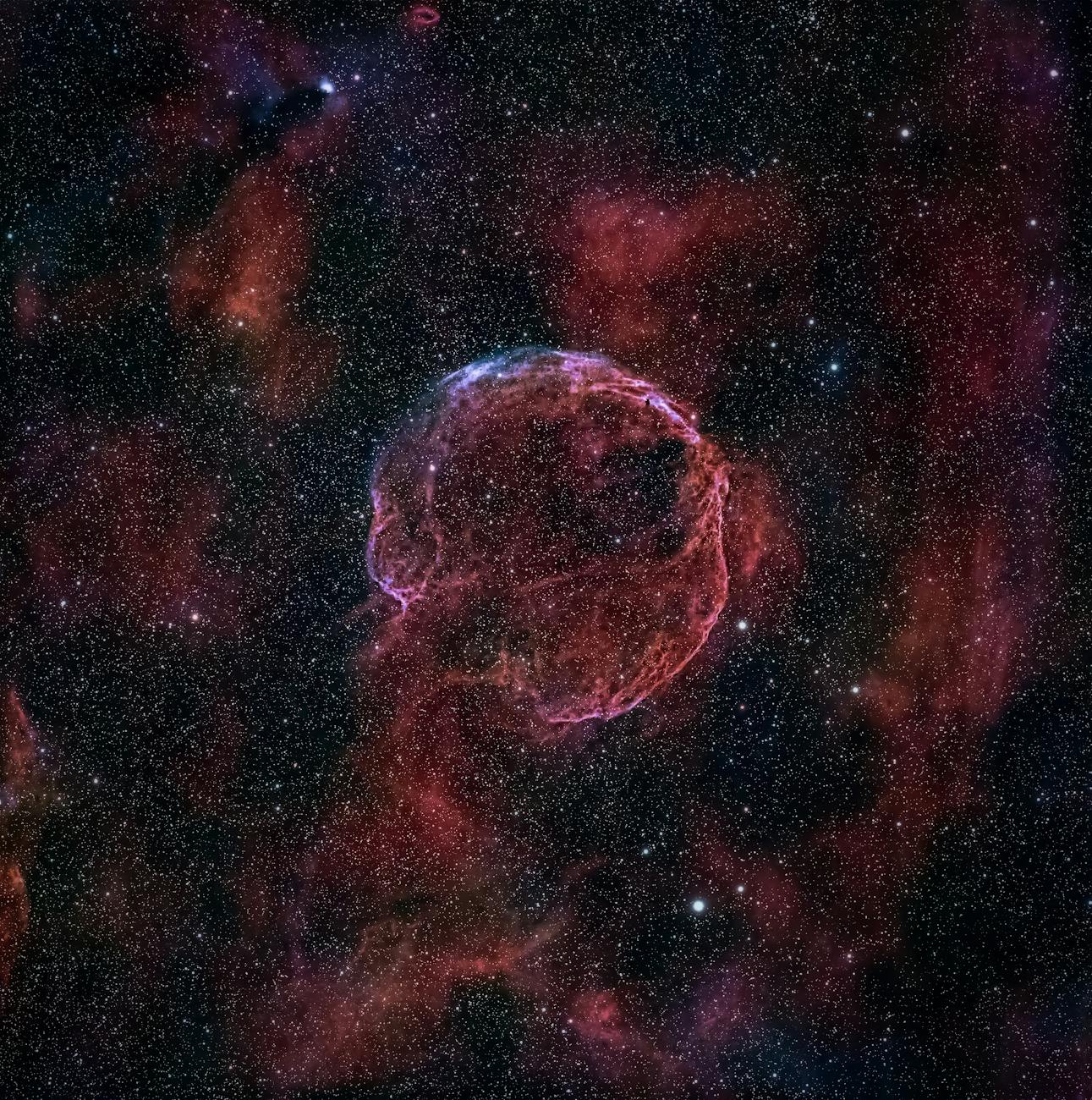
A shock wave is a fast, high-pressure front that moves through gas and dust. As it expands, it sweeps up surrounding material into a growing shell known as a supernova remnant. This process can last for a very long time. After an initial free-expansion phase that can continue for up to two centuries, the remnant gradually cools and mixes with surrounding space over about 10,000 years.
These shock waves can trigger star formation by compressing nearby dense molecular clouds. Molecular clouds are the cold, dense regions of gas and dust where stars form. When a shock wave squeezes such a cloud, it can help push parts of it toward collapse, starting the birth of new stars.
That means the debris of one exploded star can help set off the formation of the next stellar generation.
Why this changes future planets
As supernovae enrich the gas between stars, they change what future stars and planetary systems are made from. Each stellar generation forms from material that is slightly more metal-rich than the one before.
That changing composition matters. The abundances of elements in star-forming material influence how a star lives and evolves. They may also affect whether planets form around it. More giant planets form around stars of higher metallicity.
So when a supernova injects oxygen, neon, silicon, iron, and other heavy elements into nearby clouds, it is not just decorating space with ash. It is altering the ingredients available for future solar systems. Over cosmic time, that gradual chemical enrichment shapes how planetary systems grow.
There is even evidence that a nearby supernova may have helped determine the composition of the Solar System 4.5 billion years ago, and may even have triggered its formation.
Supernovae as recyclers of the galaxy
Supernova remnants are part of a larger cycle of stellar evolution. A star fuses elements in its interior over its lifetime. Then, if it dies in a supernova, some of those elements are ejected back into space. The remnant expands, shocks the surrounding gas, and eventually mixes its contents into the interstellar medium.
Those enriched clouds later form new stars. This is one reason stars born at different times can have different chemical compositions. It is also why the universe became chemically complex enough to support rocky planets and rich chemistry.
In the modern universe, old asymptotic giant branch stars are the dominant source of dust from oxides, carbon, and s-process elements. But in the early universe, before those stars had formed, supernovae may have been the main source of dust.
So supernovae are not only explosive endpoints. They are recyclers, distributors, and in some eras even major dust makers.
More than light: energy that reshapes space
The visible flash of a supernova is only part of the story. These explosions can expel several solar masses of material at speeds up to several percent of the speed of light. That kinetic energy helps carve expanding bubbles into space, stir the surrounding medium, and drive the shock waves that sweep and compress interstellar gas.
Supernovae are also major sources of cosmic rays. These are high-energy particles moving through space. Direct evidence for cosmic ray production has been found in some supernova remnants, where gamma rays from pion decay have been detected after accelerated protons hit interstellar material.
So the influence of supernovae extends far beyond the immediate blast zone. They chemically enrich galaxies, dynamically reshape gas clouds, and energize space with high-speed particles.
The big picture: death that builds the future
A supernova looks like destruction, but its long-term role is creative. White-dwarf explosions supply silicon and iron-peak metals. Core-collapse explosions throw out oxygen, neon, and, in many cases, material linked to the creation of elements heavier than zinc. Rapid neutron capture during collapse helps make about half the isotopes beyond iron. And the blast wave itself can compress clouds, helping launch another round of star birth.
That is why supernovae deserve to be called element factories. They manufacture, redistribute, and recycle the raw ingredients of cosmic history. Every enriched cloud, every later generation of stars, and every metal-rich planetary system carries some inheritance from these stellar cataclysms.
In the deepest sense, star shrapnel is not just wreckage. It is the raw material of what comes next.
Sources
Based on information from Supernova.
More like this
Get your daily dose of star shrapnel — download DeepSwipe and let your brain go supernova.