Full article · 8 min read
Why Comets Glow in X-Rays
Comets seem like the last objects that should shine in X-rays. They are icy, dusty bodies from the outer Solar System, not blazing hot stars or violent black holes. That is exactly why astronomers were so surprised when comets were found to emit X-rays in 1996.
The explanation turned out to be one of the most fascinating examples of space weather in action. A comet does not need to be extremely hot to produce X-rays. Instead, the glow comes from an interaction between the comet’s huge cloud of gas and dust and the solar wind, the stream of charged particles flowing outward from the Sun.
This strange light show reveals that a comet is not just a frozen lump of ice and rock. As it approaches the Sun, it becomes an active object surrounded by an enormous atmosphere and shaped by invisible flows of plasma and radiation.
A comet becomes active near the Sun
A comet begins as a small Solar System body made from loose collections of ice, dust, and small rocky particles. Its solid core is called the nucleus. Although the nucleus itself may be only a few hundred meters to tens of kilometers across, the visible structures around it can become vastly larger.
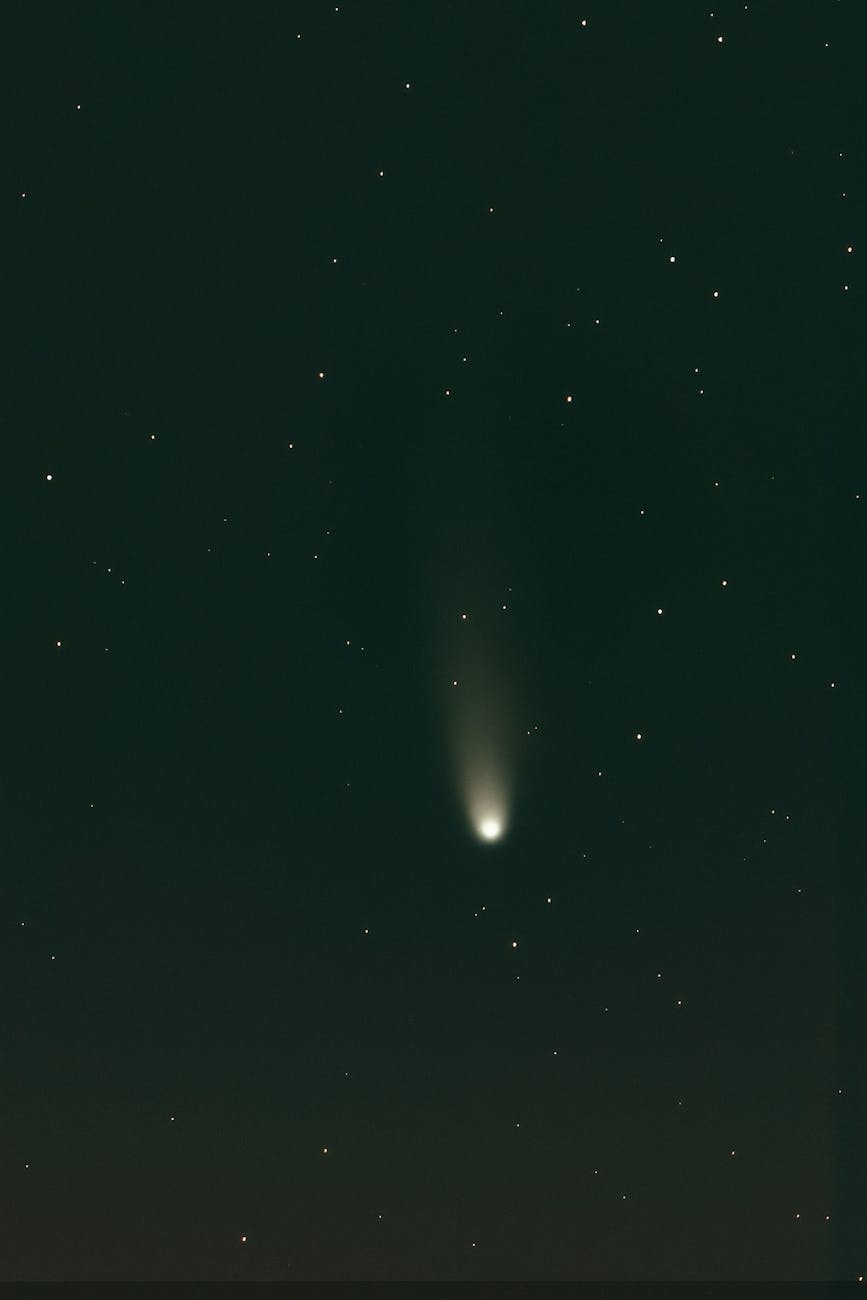
When a comet passes close to the Sun, it warms up and starts releasing gas. This process is called outgassing. The escaping material forms a huge, thin atmosphere around the nucleus known as the coma. The coma can become enormous, sometimes thousands or even millions of kilometers across. In some cases, it can briefly grow larger than the Sun.
This matters for the X-ray mystery because the coma provides the material needed for the interaction. It is generally made of water and dust, with water making up as much as 90% of the volatile material flowing out from the nucleus when the comet is within 3 to 4 astronomical units of the Sun. An astronomical unit is the average distance between Earth and the Sun.
The solar wind is the key player
The Sun does more than provide heat and light. It also sends out the solar wind, a flow of charged particles known as plasma. Plasma is a gas in which particles carry electric charge, so it behaves differently from ordinary neutral gas.
As a comet approaches the inner Solar System, sunlight ionizes some of the gases in the coma. Ionization means atoms or molecules gain or lose electrons and become electrically charged. This creates a cometary ionosphere, a region of charged gas around the comet.
Now the stage is set: a giant cloud of comet gas is sitting in the path of the solar wind.
The surprise mechanism: charge exchange
The main reason comets emit X-rays is a process called charge exchange. This is the heart of the mystery.
Highly charged ions in the solar wind rush into the comet’s atmosphere. When they collide with atoms and molecules in the coma, they can steal one or more electrons. That theft is charge exchange.
After grabbing electrons, the solar wind ions do not stay in that excited state. They relax, or de-excite, down to lower-energy states. As they do, they emit X-rays and far ultraviolet light.
So the comet itself is not acting like a hot X-ray furnace. Instead, it is serving as a meeting place where solar wind ions and neutral comet gas interact. The X-rays are a product of that collision zone.
This explanation was proposed in early 1997 by Thomas E. Cravens, after the discovery had surprised astronomers. It solved the puzzle of how such cold objects could produce such energetic radiation.
Why astronomers were shocked
Before this discovery, X-ray emission was usually associated with very high-temperature bodies. Comets did not seem to belong in that category at all. They were known for ice, dust, tails, and dramatic appearances in the night sky, not for high-energy radiation.
That is why the 1996 discovery was so striking. It showed that X-rays do not always require an object itself to be intensely hot. Under the right conditions, X-rays can be produced by interactions between charged particles and a neutral atmosphere.
In the case of comets, the Sun provides both ingredients: the sunlight that helps shape the coma and the solar wind that powers the charge-exchange glow.
The coma is bigger and more important than it looks
To understand comet X-rays, it helps to appreciate how huge and delicate the coma really is. Even though a comet’s nucleus is usually less than 60 kilometers across, the coma may be vast. It is extremely thin, but it spreads over an enormous region of space.
This is why the coma is such a good target for the solar wind. The comet may be physically small, but its cloud of gas creates a large interaction zone. The more active the comet becomes, the more material is available for collisions with solar wind ions.
The coma and tail are both illuminated by the Sun. Dust reflects sunlight directly, while gases can glow due to ionization. X-rays add another layer to this picture: they reveal invisible atomic-scale encounters happening within that giant cloud.
A comet’s tail is only part of the story
Most people think of a comet mainly in terms of its tail, but the X-ray story is even more connected to the coma and the charged environment around it.
Comets can develop distinct tails of dust and gas. The dust tail tends to curve and stay near the comet’s orbital path, while the ion tail points directly away from the Sun because charged gas is strongly affected by the solar wind and magnetic field lines.
The ion tail itself is formed after particles in the coma are ionized by solar ultraviolet radiation. Once ionized, they become part of an electrically active environment around the comet. This can produce an induced magnetosphere, meaning the comet creates an obstacle in the flowing solar wind even though the nucleus of comet 67P/Churyumov–Gerasimenko was found to have no magnetic field.
That distinction matters. A comet does not need an intrinsic magnetic field to create complex interactions with the solar wind. Its escaping gases, once ionized, are enough to shape the plasma flow around it.
Bow shocks, plasma, and a moving obstacle in space
When the solar wind encounters a comet’s ionized coma, a bow shock can form. A bow shock is similar in concept to the wave that builds up in front of a moving boat, except here it forms in plasma.
As the comet gets closer to the Sun, outgassing increases, the coma expands, and more gas becomes ionized. This strengthens the interaction with the solar wind. Spacecraft observations in the 1980s and 1990s showed that bow shocks at comets are wider and more gradual than the sharper bow shocks seen at planets such as Earth.
Rosetta even observed an early-stage “infant bow shock” at comet 67P/Churyumov–Gerasimenko as outgassing increased during its trip toward the Sun.
All of this helps explain why comet X-rays are scientifically valuable. They are not just a curiosity. They trace the collision between a comet’s atmosphere and the solar wind, revealing the behavior of plasma in a natural laboratory.
Why the X-ray glow matters
The glow tells astronomers about the solar wind itself and about the structure of the comet’s coma. Because the X-rays come from interactions between solar wind ions and comet gas, they can be used to study how energy and charged particles flow through the region around the comet.
In other words, a comet becomes a visible marker of otherwise invisible solar activity. The X-ray emission maps where the clash is happening.
That is what makes the phenomenon so powerful. A comet is often described as an icy wanderer, but near the Sun it becomes an active plasma environment. X-rays reveal the interface between cold comet material and energetic solar particles.
Comets are more dynamic than they appear
The X-ray story also fits into a broader truth about comets: they are surprisingly complex objects.
Their nuclei are dark and weakly reflective. Their surfaces are often dry, dusty, or rocky, with ices hidden below a crust. Jets can erupt from weak spots, carrying gas and dust into space and sometimes causing the nucleus to spin or even split apart. Outbursts can suddenly enlarge the coma. Tails can disconnect when magnetic reconnection occurs in the ion tail.
So even though a comet may look like a simple fuzzy object in the sky, it is really a shifting system shaped by sunlight, evaporation, ionization, magnetic effects, and the solar wind.
The discovery of cometary X-rays made that complexity impossible to ignore.
A cold object with a high-energy message
The idea still sounds almost contradictory: a cold comet glowing in X-rays. But that contradiction is exactly what makes it memorable.
The comet brings the neutral gas. The Sun provides the fast, highly charged ions. Charge exchange does the rest.
What seems at first like an impossible glow turns out to be a brilliant sign of interaction between two very different parts of the Solar System: an icy body from the outer regions and the constant outward blast of the Sun.
That is why comet X-rays are more than a weird fact. They are a vivid demonstration that space is not empty and quiet. It is active, dynamic, and full of hidden processes that only reveal themselves when the right objects pass through the right conditions.
Sources
Based on information from Comet.
More like this
Catch more cosmic plot twists — download DeepSwipe and let your brain glow brighter than a comet in X-rays.