

Full article · 7 min read
Saturn’s Rings: Razor-Thin Giants
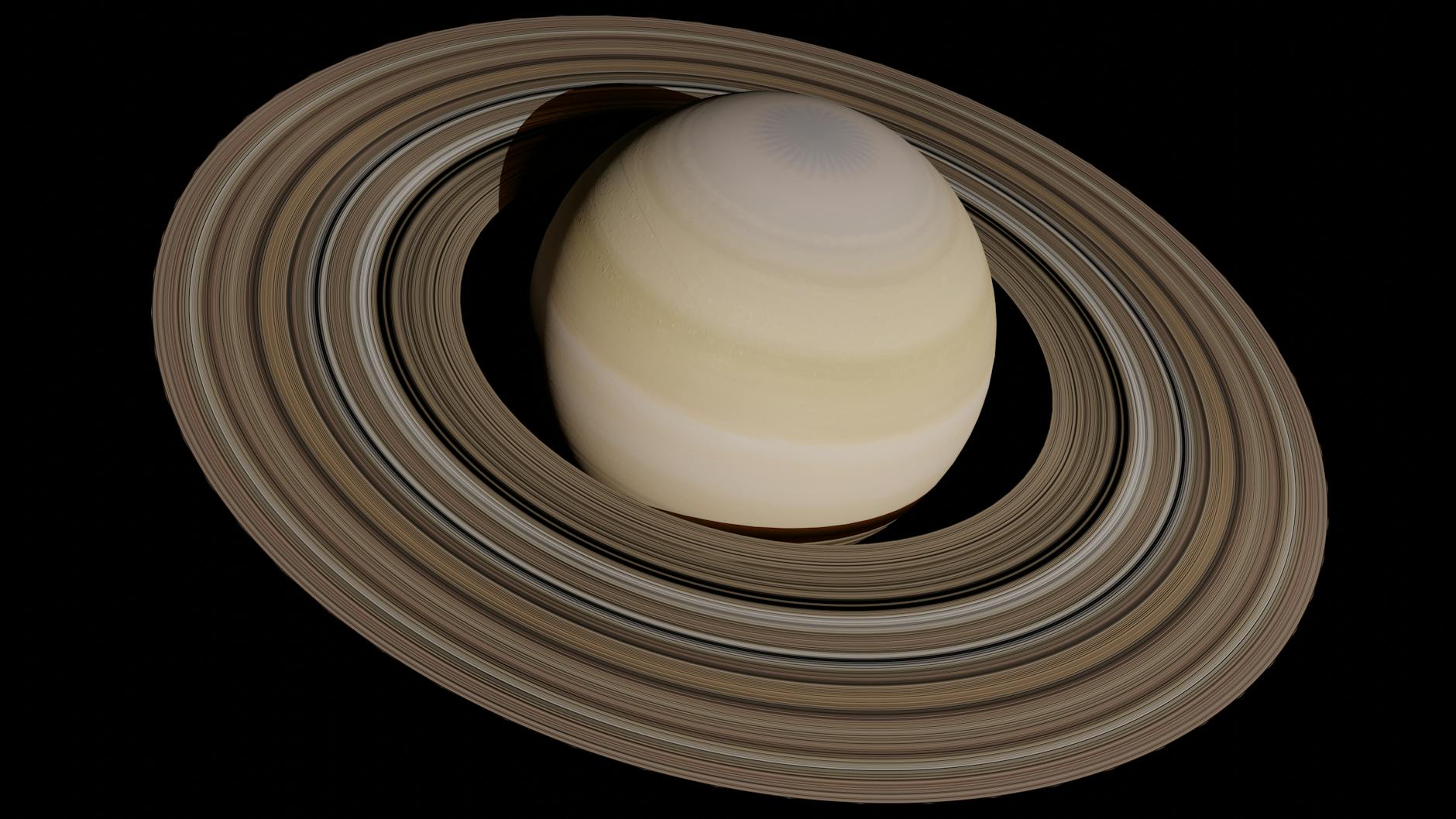
Saturn’s rings are one of the most striking sights in the Solar System. They look enormous—and they are—but one of their most surprising features is how unbelievably thin they are. On average, the main ring system is only about 20 metres thick, yet it stretches from 6,630 to 120,700 kilometres outward from Saturn’s equator. That means a structure wider than a planet can still be thinner than a building.
This strange combination of scale and delicacy is part of what makes Saturn visually unique. Other gas giants have rings too, but Saturn’s are the largest and most visible. They glow so brightly because they are made predominantly of water ice, mixed with smaller amounts of rocky debris, dust, and dark impurities.
A giant ring system made of ice, dust, and dark material
The particles in Saturn’s rings are not all the same size. Some are tiny specks of dust, while others are chunks up to 10 metres across. Together, these countless particles create the broad, bright bands that are visible through telescopes from Earth.
Most of the ring material is water ice. Mixed into that ice are trace amounts of tholin impurities and a peppered coating of about 7% amorphous carbon. Tholins are complex reddish organic substances produced when sunlight or radiation alters simple icy materials. Amorphous carbon is a non-crystalline form of carbon, more like soot than a gemstone. These darker ingredients help explain why the rings are not made of perfectly pure, sparkling ice.
Even with all this material spread across such an enormous area, the rings remain astonishingly thin. That thinness is why they can briefly seem to vanish from Earth when our planet passes through the ring plane. Because the rings are so flat, they become hard to see edge-on.
Wider than you expect, thinner than seems possible
The scale of Saturn’s ring system is difficult to picture. The main rings reach out more than 120,000 kilometres from the equator of the planet. Yet the average thickness is only around 20 metres. In everyday terms, that is like stretching a sheet across an immense cosmic distance while keeping it thinner than many buildings are tall.
This flatness is one reason the rings appear so elegant and sharply defined. From Earth, their brightness changes depending on how tilted they are toward us and the Sun. When the ring plane is highly inclined, Saturn appears brighter. When the rings are angled so that we see them almost edge-on, the planet looks dimmer and the rings can nearly disappear from view.
To see the rings clearly, most people need optical aid such as a small telescope or very large binoculars with enough magnification. Once resolved, they reveal why Saturn has fascinated skywatchers for centuries.
The moons that sculpt the rings
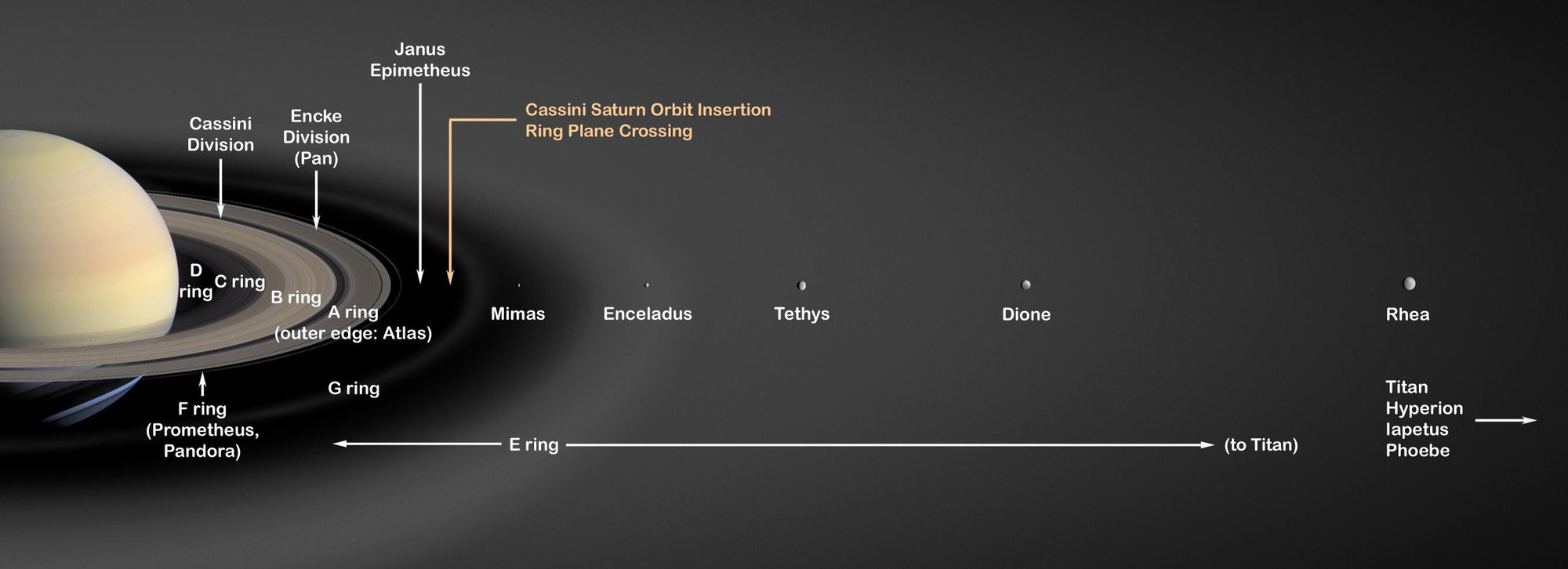
Saturn’s rings are not just passive bands of orbiting debris. They are actively shaped by nearby moons. Some of these moons act as shepherd moons, bodies whose gravity helps confine ring particles and keep ring edges from spreading out.
Pandora and Prometheus are two of the moons known to play this role. Their gravitational nudges help maintain the structure of the rings. Other small moons also influence the system. Pan and Atlas create weak, linear density waves in the rings. A density wave is a pattern where particles bunch up slightly in some regions and spread out in others, creating ripple-like structures.
These gravitational interactions help explain why the rings contain sharp edges, gaps, and wave patterns instead of just forming a smooth, featureless disk. Saturn’s ring system is dynamic—a place where ice particles and moon gravity are constantly interacting.
Gaps, divisions, and fine structure
The rings are not a single solid sheet. They contain multiple divisions and gaps. One of the most famous is the Cassini Division, discovered in 1675 by Giovanni Domenico Cassini. Later spacecraft observations also identified features such as the Maxwell Gap in the C Ring and the Keeler gap in the A Ring.
These dark-looking gaps are not always simple empty spaces. Pioneer 11 found that some dark gaps appear bright when viewed toward the Sun at a high phase angle, showing that they contain fine light-scattering material. In other words, some areas that look empty in one viewing geometry may still contain lots of tiny particles.
This makes Saturn’s rings more complicated than a simple set of bright bands with blank spaces in between. Their appearance depends on particle size, density, lighting, and angle of view.
Ancient relic or recent wreckage?
One of the biggest mysteries surrounding Saturn’s rings is their age. Scientists debate whether the rings are ancient—formed alongside Saturn from original nebular material, or shortly after the Late Heavy Bombardment—or whether they are much younger, perhaps only around 100 million years old.
One proposal supporting the younger age suggests that the rings could be the remains of a destroyed moon named Chrysalis. In that idea, the ring system is leftover debris from a shattered satellite rather than primordial material surviving since the earliest days of the Solar System.
That uncertainty makes Saturn’s rings even more intriguing. They may be among the oldest visible structures in the Solar System—or the aftermath of a comparatively recent catastrophe.
Beyond the bright main rings: the ghostly Phoebe ring
The famous bright rings are not the whole story. Far beyond the main ring system lies the sparse Phoebe ring. It sits about 12 million kilometres from Saturn, making it vastly more distant than the bright inner rings.
The Phoebe ring is tilted by 27° relative to Saturn’s other rings, and it orbits in retrograde fashion, meaning it moves backward compared with the direction followed by the main rings. It is a faint, dusty structure associated with Phoebe, one of Saturn’s moons.
This outer ring is easy to miss in popular images because it is so diffuse. But its existence shows that Saturn’s ring system is not just a neat set of bright bands hugging the planet. It includes a much larger, more complex family of structures extending deep into surrounding space.
How we learned so much about the rings
For ancient observers, Saturn was just a bright yellowish point of light in the sky. Its rings remained unknown until telescopes became good enough to reveal them. Galileo, using a primitive telescope in 1610, saw that Saturn did not look quite round, but he mistakenly interpreted the strange appearance as two moons on either side of the planet.
In 1655, Christiaan Huygens correctly resolved Saturn’s rings, and in 1659 he published his observations. Later astronomers identified more structure, including the Cassini Division.
Spacecraft transformed ring science even further. Pioneer 11 revealed the thin F-ring and studied how light behaves in the darker gaps. Voyager 1 and Voyager 2 returned much higher-resolution images and confirmed additional satellites orbiting near or within the rings. Cassini, which entered orbit around Saturn in 2004, provided years of close observation and revealed even more detail, including a previously undiscovered ring outside the brighter main rings and inside the G and E rings.
Why Saturn’s rings matter
Saturn’s rings are beautiful, but they are also scientifically important. They offer a natural laboratory for studying how particles orbit, collide, clump, and respond to gravity. Watching moons shape ring edges and generate waves helps reveal the same kinds of gravitational effects that operate elsewhere in planetary systems.
They also remind us that dramatic structures in space do not need to be solid or permanent. Saturn’s rings are broad but fragile, bright but dusty, orderly but constantly influenced by nearby moons. Whether they are ancient survivors or the debris of a lost moon, they are one of the Solar System’s most extraordinary features.
A ring system only about 20 metres thick should not dominate the appearance of a giant planet. And yet Saturn’s does exactly that—turning a gas giant nearly 10 times Earth’s radius into the most iconic world in the night sky.
Sources
Based on information from Saturn.
More like this
Saturn’s rings prove the thinnest things can hold giant wonders—download DeepSwipe and stack up cosmic facts daily.