Full article · 7 min read
Saturn’s Polar Mysteries: the Hexagon and the Hurricane
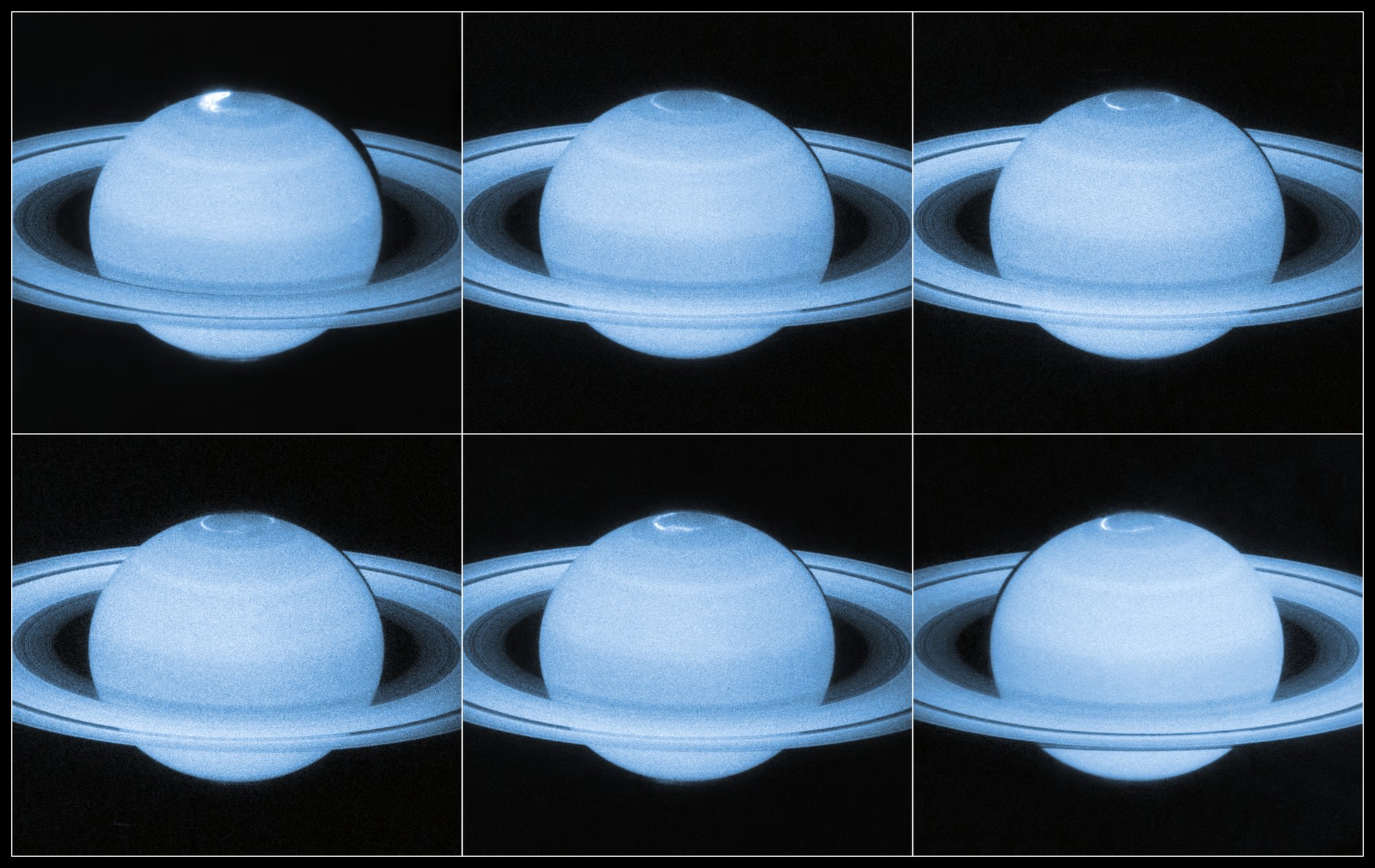
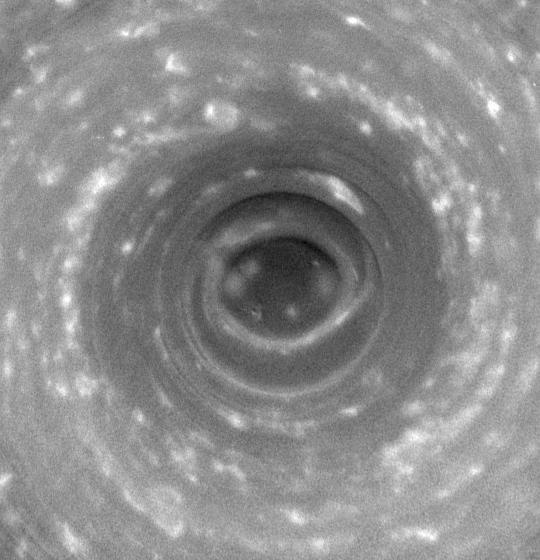
Saturn is famous for its bright rings, but some of its strangest sights are found far above the planet’s poles. At the north pole, a giant six-sided pattern circles the planet like a geometric puzzle drawn in cloud tops. At the south pole, a powerful hurricane-like storm spins around a warm polar vortex, complete with an eyewall like the ones seen in cyclones on Earth.
These features are remarkable not just because they are visually dramatic, but because they are unusual even by the standards of the Solar System’s giant planets. Saturn’s outer atmosphere is often described as bland compared with Jupiter’s, yet its poles reveal some of the most distinctive weather anywhere around the Sun.
A giant hexagon over the north pole
The best-known of Saturn’s polar features is the hexagon around the north polar vortex. This persistent hexagonal wave pattern lies at about 78° north latitude. It was first noticed in images taken by Voyager.
Its scale is astonishing. Each side of the hexagon is about 14,500 kilometers long—longer than Earth’s diameter. Rather than being a small cloud shape or a temporary storm, it is an enormous atmospheric structure wrapped around the pole.
What makes it especially intriguing is that it does not drift in longitude the way many visible cloud features do. In simple terms, longitude is a way of measuring position around the planet, and Saturn’s hexagon keeps its place instead of wandering around like ordinary cloud bands and storms. The entire structure rotates with a period of 10 hours, 39 minutes, and 24 seconds, matching the same period as Saturn’s radio emissions, which is thought to reflect the rotation of the planet’s interior.
That connection gives the hexagon an added mystery: it appears tied not just to shallow weather, but to deeper planetary motion.
What is a standing wave?
The hexagon is widely thought to be a standing wave pattern in the atmosphere. A standing wave is a wave that stays in place instead of traveling onward. On Saturn, that means the pattern holds its overall position while the atmosphere moves within and around it.
Scientists have not fully settled the origin of the hexagon, and its formation remains the subject of much speculation. Still, many researchers think this standing-wave explanation is the most likely. Polygonal shapes have even been reproduced in laboratory experiments through the differential rotation of fluids, meaning fluids turning at different speeds in different regions. That matters on Saturn, where atmospheric motion varies with latitude and can create unusual large-scale patterns.
So the hexagon is not thought to be a solid object or a wall of clouds in a literal geometric shape. It is better understood as an organized pattern in the flow of Saturn’s atmosphere.
Saturn’s atmosphere sets the stage
To appreciate why these polar structures are so striking, it helps to know a little about Saturn’s atmosphere. The outer atmosphere is made mostly of molecular hydrogen, with helium making up a smaller fraction. Trace amounts of ammonia, acetylene, ethane, propane, phosphine, and methane are also present.
The upper clouds are composed of ammonia crystals, which help give Saturn its pale yellow hue. Beneath those are deeper cloud layers that likely include ammonium hydrosulfide and water. Saturn also shows a banded pattern similar to Jupiter’s, though its bands are generally fainter and wider near the equator.
Despite this often subdued appearance, Saturn can produce extreme weather. Wind speeds can reach 1,800 kilometers per hour, making them the second fastest among the planets, after Neptune. Long-lived ovals and massive storms have also appeared, including the giant Great White Spot events that occur roughly once every Saturnian year, or about every 30 Earth years.
Against that backdrop of fast winds and layered clouds, the polar hexagon stands out as something especially organized and persistent.
The south pole’s hurricane-like storm
If the north pole looks geometric, the south pole looks violent.
Observations reported in 2006 showed that Saturn’s south pole hosted a hurricane-like storm locked to the pole. What made this discovery especially important was the presence of a clearly defined eyewall. An eyewall is the ring of tall clouds that surrounds the calmer center, or eye, of a cyclone. Before this, eyewall clouds had not been seen on any planet other than Earth.
That makes Saturn’s south polar storm one of the most Earth-like cyclone structures known beyond our planet, even though it exists in an alien environment of hydrogen, helium, and freezing temperatures.
The storm is enormous, comparable in size to Earth, and its winds reach about 550 kilometers per hour. This is not a small weather system drifting across the atmosphere. It is a huge, powerful vortex anchored at the pole.
The only known warm polar vortex in the Solar System
Saturn’s south pole is not just stormy. It is also unusually warm.
Thermography, which measures temperature patterns, has shown that Saturn’s south pole contains a warm polar vortex. A polar vortex is a tight circulation centered on a pole, and in this case it is warmer than the surrounding atmosphere. This is the only known example of such a warm polar vortex in the Solar System.
Typical temperatures on Saturn are around −185 °C. But temperatures in the vortex often rise as high as −122 °C, making it suspected to be the warmest spot on the planet.
That may sound incredibly cold by Earth standards, and it is. But on Saturn, where most of the atmosphere is even colder, this makes the south polar vortex a notable thermal anomaly. In other words, it is a place that stands out dramatically from its surroundings.
North and south: similar poles, very different behavior
Saturn’s poles are not mirror images of each other.
At the north pole, the signature feature is the hexagonal wave wrapped around the polar region. At the south pole, observations indicate a jet stream and a hurricane-like vortex with an eyewall. However, no strong polar vortex matching the north’s hexagonal standing wave has been observed there.
This contrast is part of what makes Saturn’s polar weather so interesting. Both poles are dynamic, but they organize themselves in different ways. One pole displays a giant geometric wave pattern; the other shows a powerful cyclone and the Solar System’s only known warm polar vortex.
How we saw these phenomena
Much of what is known about Saturn’s poles came from spacecraft observations.
Voyager images first revealed the hexagonal pattern around the north pole. Later, the Cassini spacecraft transformed understanding of Saturn’s atmosphere. In 2006, NASA reported Cassini’s observations of the south polar hurricane-like storm with its distinct eyewall. In 2007, images from Cassini also showed Saturn’s northern hemisphere with a bright blue hue, likely caused by Rayleigh scattering, a process in which light is scattered by small particles or molecules.
Cassini continued to reveal Saturn as a world of active and complex weather. In 2013, it returned images of a hurricane at the north pole 20 times larger than those found on Earth, with winds faster than 530 kilometers per hour.
These missions showed that Saturn is far more than a ringed ornament in the sky. It is a planet with deep atmospheric dynamics, extreme winds, and polar systems unlike anything once expected.
Why Saturn’s polar storms matter
Saturn’s hexagon and polar hurricane are not just curiosities. They show that planetary atmospheres can create stable, long-lived structures on scales far larger than anything on Earth. They also reveal that giant planets can host organized weather systems shaped by rotation, fluid motion, and atmospheric layering.
The hexagon is a vivid example of how a standing wave can become a planet-sized feature. The south polar storm demonstrates that cyclone-like structures with eyewalls are not limited to Earth. And the warm south polar vortex shows that even in a frigid gas giant atmosphere, certain regions can become unexpectedly warmer than their surroundings.
Taken together, these features make Saturn’s poles some of the most extraordinary weather laboratories in the Solar System.
A planet of quiet color and hidden drama
To the naked eye, Saturn appears as a bright, yellowish point of light. Through a telescope, its rings make it unforgettable. But hidden behind that calm beauty is a world of atmospheric extremes: giant storms, intense winds, unusual vortices, and a six-sided polar wave that seems almost too precise to be natural.
That contrast is part of Saturn’s appeal. It can look serene from afar, yet at its poles it hosts some of the strangest and most dramatic meteorology known.
The next time Saturn is described as the ringed planet, it is worth remembering that its poles are just as astonishing as its rings. One holds a hexagon larger than a world. The other spins with a hurricane-like storm around the warmest place on the planet.
Sources
Based on information from Saturn.
More like this
Chase Saturn’s strangest storms and swipe deeper into the cosmos — download DeepSwipe and orbit something amazing every day.