Full article · 8 min read
Comets: Tiny Nuclei, Colossal Comas
A comet can begin as something surprisingly small: a dark, irregular nucleus made of ice, dust, rock, and frozen gases. Some are only a few hundred meters across, while even larger ones are usually only tens of kilometers wide. Yet when one of these small bodies swings in toward the Sun, it can transform into one of the grandest sights in the Solar System.
That dramatic change is what makes comets so captivating. A compact core can generate a vast, diffuse atmosphere called a coma, and from that coma can emerge tails that stretch for distances almost hard to imagine. In the right conditions, a comet seen from Earth can spread across a huge part of the sky, becoming visible even without a telescope.
The tiny nucleus behind the spectacle
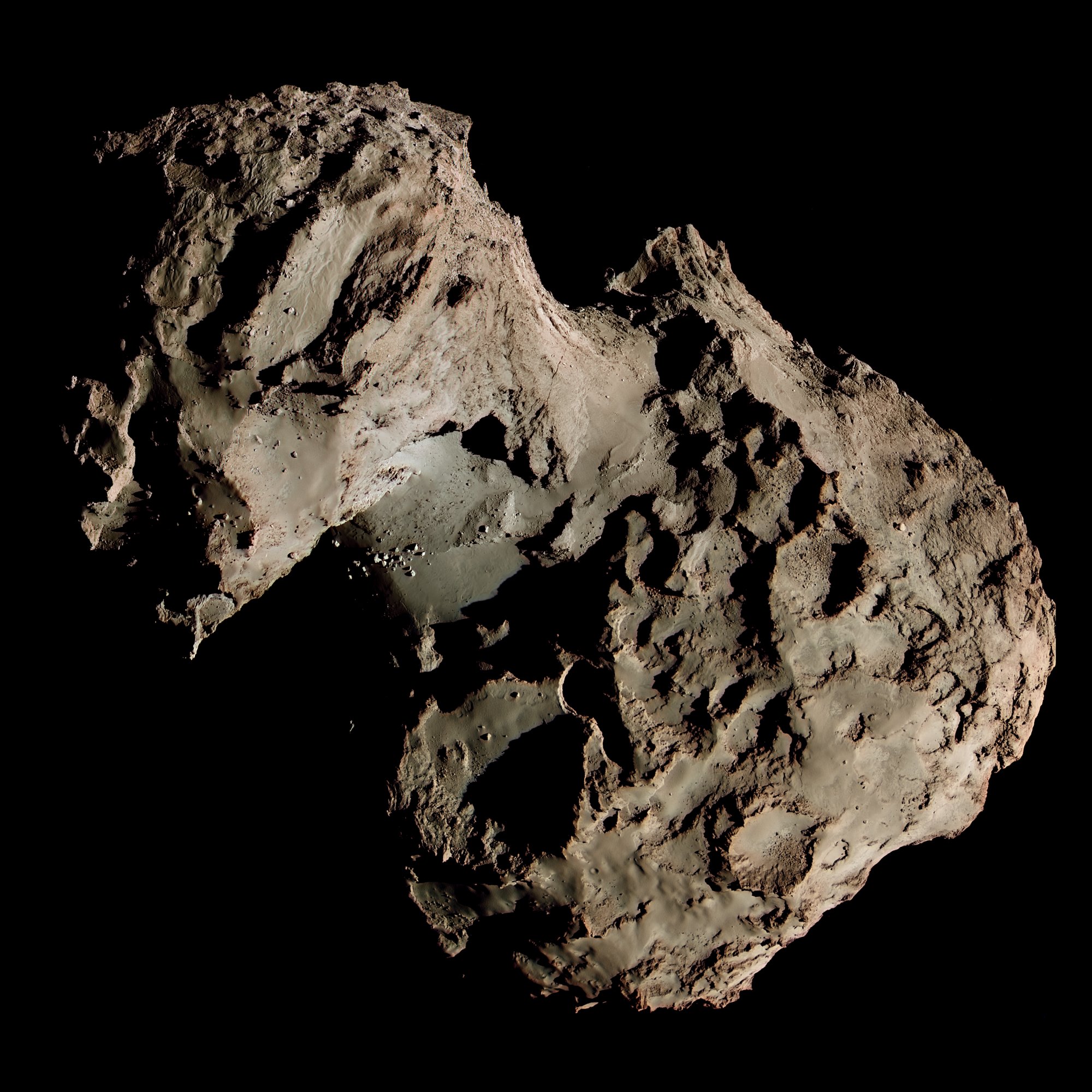
The nucleus is the solid heart of a comet. It is not a smooth little snowball, but a loose mixture of water ice, dust, rock, and frozen compounds such as carbon dioxide, carbon monoxide, methane, and ammonia. Because of this mix, comet nuclei have famously been described as “dirty snowballs,” though some observations have also inspired the phrase “icy dirtballs.”
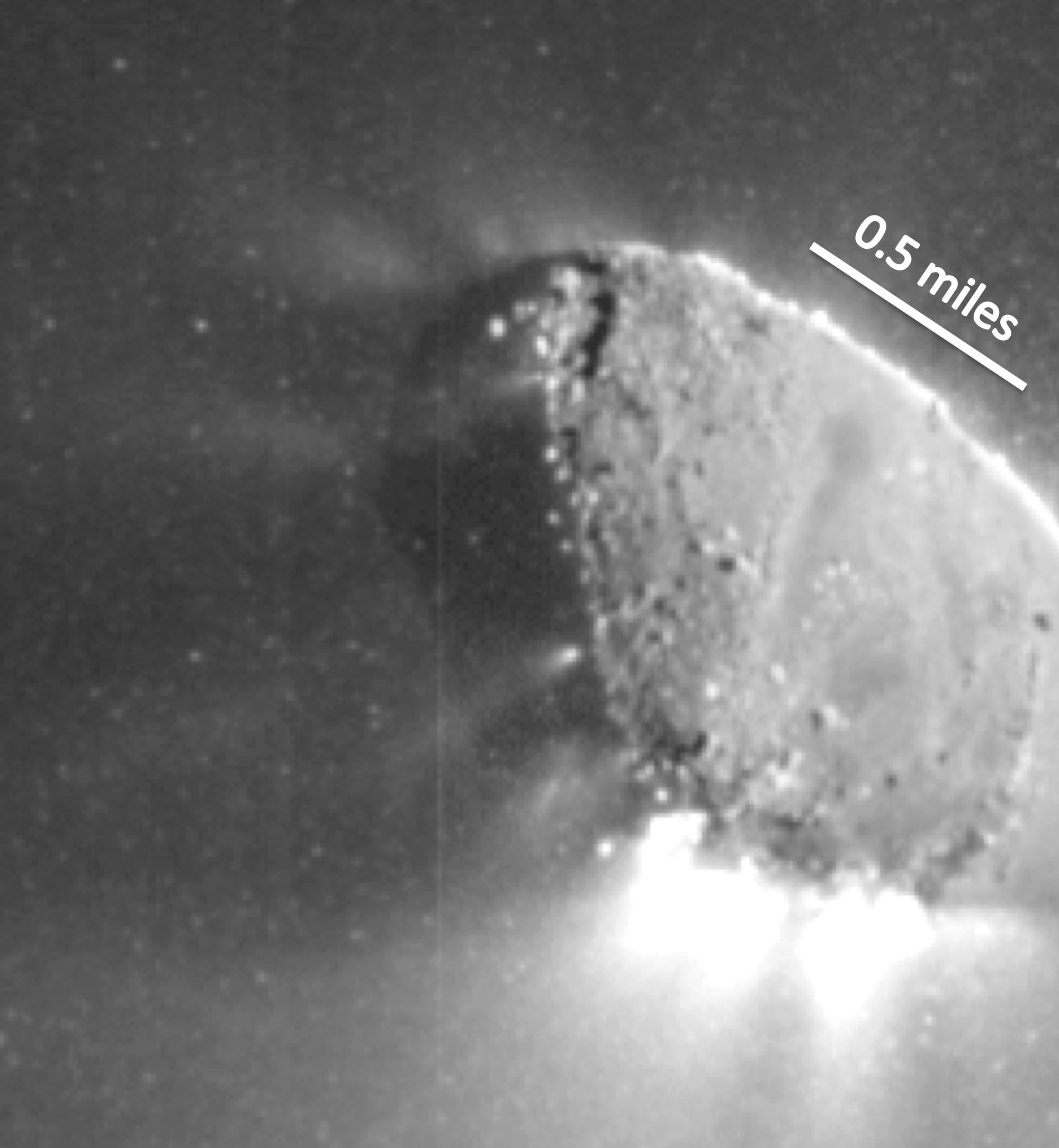
These nuclei are among the darkest objects in the Solar System. Their surfaces reflect very little sunlight. Halley’s Comet reflects about four percent of the light that falls on it, and Comet Borrelly’s surface reflects even less than three percent. For comparison, asphalt reflects more. That darkness matters: low reflectivity means a comet absorbs heat efficiently, and that absorbed solar heat helps drive the activity that creates the coma and tails.
Although comet nuclei can be up to about 30 kilometers in radius, they are often much smaller, and their weak gravity means they do not pull themselves into neat spheres. Instead, they tend to have irregular shapes. Their surfaces are usually dry, dusty, or rocky in appearance, suggesting that much of their ice lies hidden below a crust several meters thick.
What outgassing really means
The dazzling display of a comet begins with outgassing. This happens when a comet approaches the Sun and solar heating causes volatile materials—substances that evaporate easily—to turn into gas and escape from the nucleus.
As gas streams outward, it drags dust with it. Together, these escaping materials build the coma, a huge but extremely thin atmosphere around the nucleus. Even though the nucleus itself may be less than 60 kilometers across, the coma can expand to thousands or even millions of kilometers across.
Water is usually the dominant volatile in the coma when a comet is within about 3 to 4 astronomical units of the Sun. An astronomical unit, or AU, is the average distance between Earth and the Sun, about 150 million kilometers. Dust is also a major component. Sunlight and the solar wind then act on this material and shape it into the comet’s familiar extended features.
A coma that can dwarf planets
The scale of a comet’s coma is one of the most astonishing facts about these objects. A coma may grow to as much as 15 times Earth’s diameter. That means a comet with a comparatively tiny nucleus can surround itself with an atmosphere far larger than any terrestrial planet.
This huge envelope is not like a thick planetary atmosphere. It is extremely tenuous—more like an enormous cloud of gas and dust than a dense blanket of air. But despite being thin, it can still become visible because the dust reflects sunlight and the gases can glow through ionization, a process in which atoms or molecules gain or lose electrons.
As comets move through the inner Solar System, their comas can brighten dramatically. Sometimes they even experience outbursts, sudden surges of gas and dust release that make the coma swell and the comet brighten rapidly.
Bigger than the Sun? Yes, sometimes
In especially dramatic cases, a comet’s dust atmosphere can become larger than the Sun.
That happened in 2007, when Comet 17P/Holmes underwent an outburst. For a short time, it developed a tenuous dust atmosphere larger than the Sun itself. Another famous example was the Great Comet of 1811, whose coma was roughly the diameter of the Sun.
This sounds almost impossible at first. How can something with a nucleus so small produce something larger than a star? The key is that the coma is incredibly diffuse. It is not a solid object and not remotely as massive as the Sun. It is a vast, sparse cloud spread over an enormous volume.
Still, the visual and physical scale is extraordinary. Few sights in astronomy better capture the contrast between small beginnings and enormous effects.
Tails that stretch beyond 1 AU
Comets often form not one tail, but distinct tails of different material.
The dust tail is made of small solid particles carried away from the nucleus. These particles are influenced by light pressure from the Sun and often trail in a curved shape along the comet’s orbital path.
The ion tail, also called the type I tail, is made of gas that has been ionized by solar ultraviolet radiation. Because this gas is strongly affected by the solar wind and magnetic field lines, the ion tail points directly away from the Sun.
These tails can reach extraordinary lengths. Ion tails have been observed extending one astronomical unit or more. In other words, a comet’s tail can stretch a distance comparable to the full average separation between Earth and the Sun.
That helps explain why comets can dominate the sky even though their nuclei are so small. The visible structure is not the core itself, but the immense cloud and tail created by solar heating and solar wind interactions.
Why the tail always points away from the Sun
A common intuition is that a comet’s tail should stream behind it like smoke behind a moving car. But comet tails are shaped more by the Sun than by the comet’s direction of travel.
The solar wind is a stream of particles flowing outward from the Sun. Radiation pressure from sunlight also pushes on dust. Together, these effects drive the tail away from the Sun, not simply behind the comet along its orbit.
That is why the ion tail always points directly away from the Sun. The dust tail can be more curved, because the dust particles are also influenced by the comet’s motion around the Sun. On rare occasions, observers can even see an antitail, which appears to point in the opposite direction due to viewing geometry when Earth passes through the comet’s orbital plane.
How a comet can span 30 degrees in the sky
A bright comet seen from Earth can subtend an arc of up to 30 degrees across the sky. That is about the apparent width of 60 full Moons lined up side by side.
This does not mean the comet’s nucleus looks huge. The visible span comes from the coma and tail spreading across a large portion of the sky. If a comet is bright enough and well placed, no telescope is needed to appreciate its scale.
In fact, roughly one comet per year becomes visible to the naked eye, although many of these are faint and not especially spectacular. Particularly bright and impressive examples are known as great comets. Predicting which comet will become a great comet is notoriously difficult, because brightness depends on several factors including the comet’s activity, its path near the Sun, and how it appears from Earth.
Sudden outbursts and explosive-looking change
Not all comet growth is smooth and gradual. Some comets undergo outbursts, abrupt increases in gas and dust release that rapidly enlarge the coma. Comet Holmes in 2007 is a famous case.
Comets can also produce jets, localized streams of gas and dust erupting from weak spots on the nucleus. Uneven heating can trigger these jets, almost like a geyser. Infrared imaging of Hartley 2 showed jets powered by sublimation of frozen carbon dioxide, also called dry ice. Sublimation means a substance changes directly from solid to gas.
These jets can do more than create beautiful structures. They can alter a comet’s spin and may even contribute to a comet splitting apart.
A giant cloud born from a dark little world
One of the strangest things about comets is the contrast between the appearance of the nucleus and the grandeur of the coma. The nucleus is dark, dry-looking, and often crusted over. The coma is bright, expansive, and can become larger than the Sun. The nucleus is only a small body. The visible comet can become a sky-spanning event.
That transformation is driven by a simple cosmic setup: sunlight, volatile ices, and a body that spends most of its time frozen in the outer Solar System before making a dramatic entrance into the inner regions.
Comets usually follow highly elongated elliptical orbits. Short-period comets are thought to come from the Kuiper belt or scattered disc beyond Neptune, while long-period comets are thought to originate in the distant Oort cloud. When one is nudged inward and begins to warm, a once-inconspicuous object can suddenly bloom into one of the largest visible structures associated with any small body in the Solar System.
Why comets have fascinated people for millennia
Comets have been observed and recorded since ancient times by many cultures and religions. That is not surprising. Few celestial sights are as dramatic as a fuzzy, luminous object with a tail stretching across the heavens.
Even today, comets still have the power to surprise astronomers. They emit X-rays through interactions with the solar wind. They can produce bow shocks where the solar wind meets the ionized coma. They can split apart, flare up unexpectedly, or fade into dark, inactive remnants after repeated passes near the Sun.
But for many observers, the most unforgettable fact remains this one: a comet’s active core may be tiny on planetary scales, yet the structures it creates can become colossal—planet-dwarfing, Sun-sized, and sometimes vast enough to stretch across a huge fraction of Earth’s sky.
Sources
Based on information from Comet.
More like this
Chase big cosmic tails from a tiny screen tap — download DeepSwipe and let your curiosity grow comet-sized.