Full article · 8 min read
Why a Comet’s Tail Always Points Away From the Sun
Comets are some of the most striking objects in the sky, but their most famous feature is also one of the most misunderstood. Many people imagine a comet’s tail trailing behind it like smoke behind a speeding train. In reality, a comet’s tail is shaped mainly by the Sun. That is why comet tails point away from the Sun, not simply behind the comet’s direction of travel.
This behavior comes from a combination of sunlight, solar radiation, and the solar wind acting on material released from the comet’s nucleus. The result can be beautiful, strange, and sometimes dramatic: curved dust tails, straight ion tails, apparent “antitails,” and even sudden tail breakups.
A comet starts as a small icy body
A comet is a small icy body in the Solar System that begins releasing gas when it passes close to the Sun. This process is called outgassing. As the comet warms up, frozen materials in and around the nucleus are driven off into space.
The nucleus is the comet’s solid core. It is made of a loose mixture of ice, dust, and rocky material. Although the nucleus is usually small compared with the structures around it, it is the source of everything that makes a comet visible. Once gas and dust stream outward, they form a huge, very thin atmosphere around the nucleus called the coma.
The coma can grow enormous, sometimes reaching thousands or even millions of kilometers across. In some cases it can even become larger than the Sun. From this coma, the comet’s tails develop.
The Sun is the real sculptor of comet tails
A comet’s tail forms because the material in the coma does not just sit still. The Sun pushes on it in two major ways.
First, solar radiation exerts pressure on dust. In simple terms, sunlight can push tiny dust particles away from the Sun.
Second, the solar wind acts strongly on gas that has become ionized. The solar wind is a flow of charged particles streaming outward from the Sun. When gas in a comet’s coma is ionized, meaning its atoms or molecules have lost or gained electrons and now carry an electric charge, it becomes much more responsive to the solar wind and the magnetic field carried with it.
Because both of these effects push material away from the Sun, comet tails point away from the Sun. This is true regardless of whether the comet is moving toward the Sun, away from it, or across our view.
Two tails, not one
Comets often develop two distinct tails, and they do not behave the same way.
The dust tail
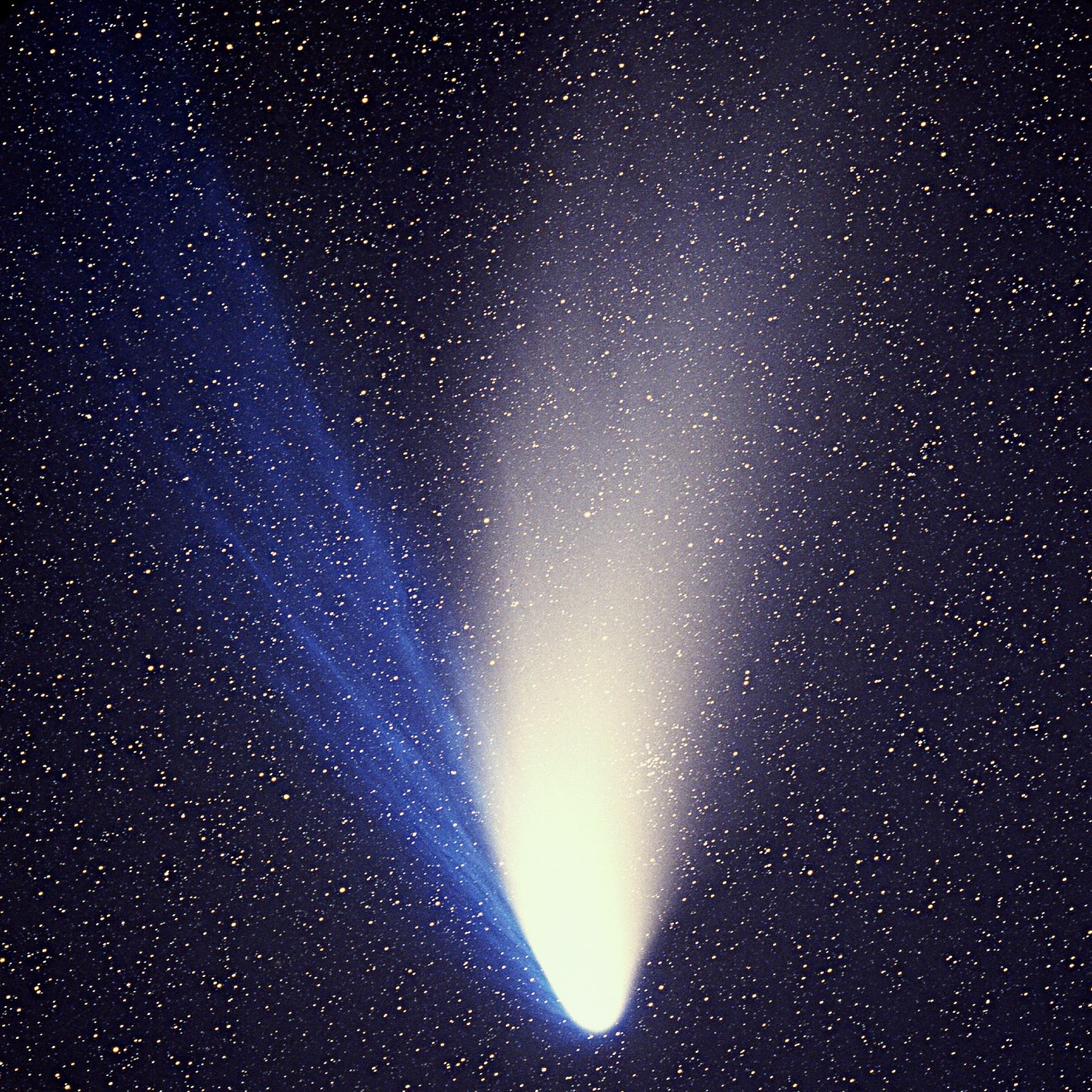
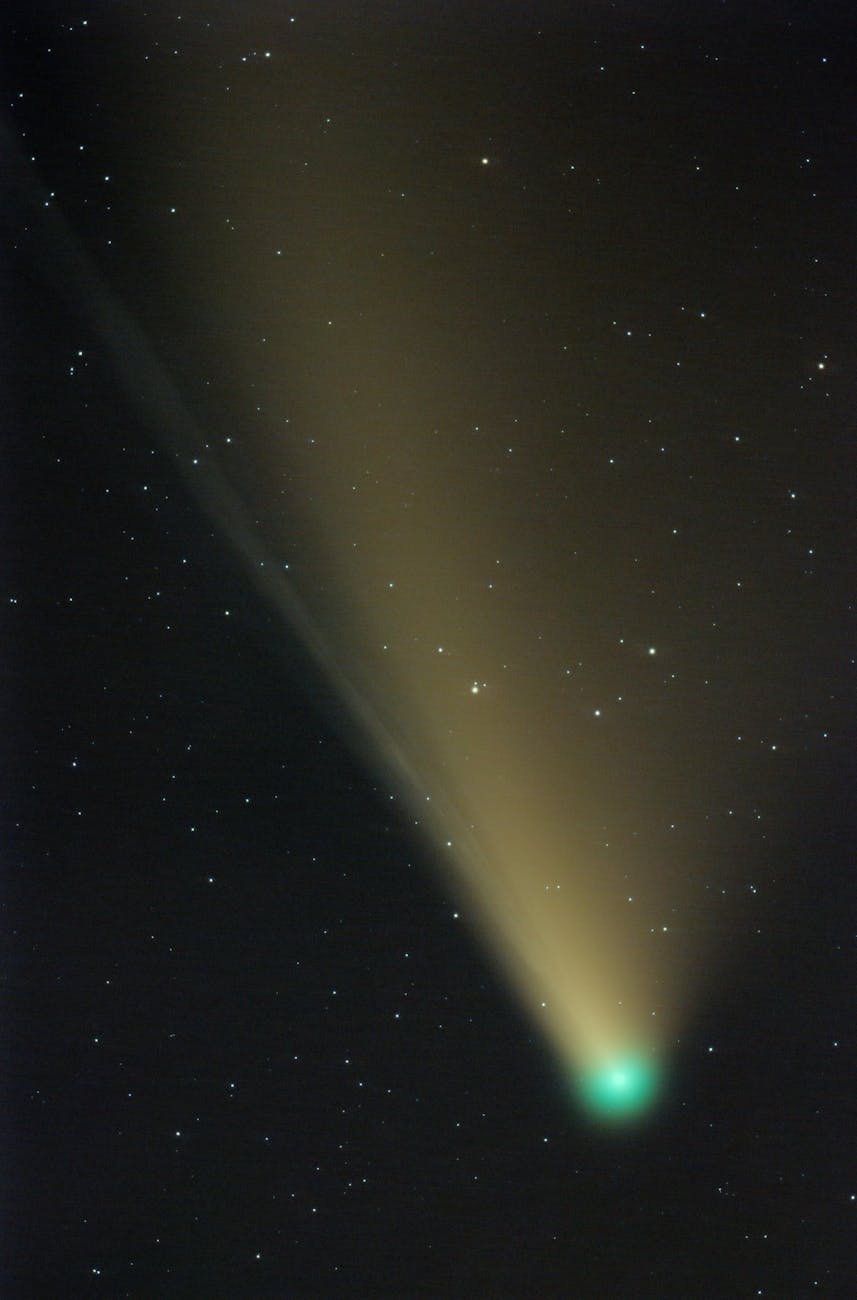
The dust tail is made of solid particles released from the nucleus. Larger dust grains tend to remain closer to the comet’s orbital path, while smaller particles are pushed more strongly by light pressure. This makes the dust tail appear broader and often curved.
That curved shape is important. It shows that dust is partly following the comet’s path around the Sun while also being pushed outward by sunlight. So the dust tail does not point in a perfectly straight line away from the Sun at every point, but its overall orientation still reflects the Sun’s influence.
The ion tail
The ion tail, also called the type I tail, is made of gas whose particles have been ionized by solar ultraviolet radiation. Once charged, these particles interact strongly with the solar wind and the magnetic field it carries.
That is why the ion tail usually points directly away from the Sun. Unlike the dust tail, it is not simply left behind along the comet’s orbit. Instead, it traces the magnetic-field-guided flow of charged material streaming outward from the Sun.
This straight, narrow appearance is one of the clearest signs that the Sun is actively shaping the comet.
Why the tail does not just trail behind the comet
A comet can race through space on an elongated orbit, so it seems intuitive that its tail should stream behind it. But the particles in the tail are not attached to the nucleus like fabric on a kite. Once released, they are acted on by sunlight and the solar wind.
So if a comet is moving away from the Sun, its tail may indeed look as though it trails behind. But if the comet is diving toward the Sun, the tail can appear to lead behind it in a direction that seems counterintuitive from the point of view of motion alone. The key is that the tail responds more to the Sun than to the comet’s direction of travel.
The coma: where the tail begins
The tail does not emerge directly from a cold, inactive rock. It grows out of the coma, the cloud of gas and dust surrounding the nucleus.
When a comet comes within about 3 to 4 astronomical units of the Sun, water can make up to 90% of the volatile material flowing out from the nucleus. An astronomical unit is the average distance between Earth and the Sun. As water and other substances are released, sunlight breaks apart and ionizes some of the material. Dust is also carried away from the nucleus.
This expanding cloud becomes the raw material for the comet’s visible structures. Sunlight reflects off dust, while gases can glow because of ionization. That is why both the coma and tails can become visible when comets enter the inner Solar System.
The strange case of the antitail
One of the most puzzling comet features is the antitail. This looks like a spike or tail pointing toward the Sun, which seems to break the rule completely.
But an antitail is not a true tail flowing sunward. It is an effect of perspective. Sometimes Earth passes through the comet’s orbital plane, the flat plane of the comet’s path around the Sun. Under that viewing angle, material distributed along the comet’s orbit can appear as a sunward-pointing spike.
In other words, the antitail is an illusion created by geometry, not a reversal of the solar forces acting on the comet. Observations of antitails were historically important because they helped scientists better understand the solar wind.
How magnetic fields shape the ion tail
The ion tail is not just blown back like a breeze moving smoke. It is tied to electromagnetic effects.
When particles in the coma are ionized by solar ultraviolet radiation, they gain electric charge. This creates an induced magnetosphere around the comet. An induced magnetosphere is a magnetic environment created by the interaction between the comet’s ionized gases and the solar wind.
As the solar wind flows past, magnetic field lines drape around the comet and help organize the ion tail. The result is a tail that points away from the Sun and can stretch to enormous distances. Ion tails have been observed extending one astronomical unit or more.
This interaction can also produce a bow shock, a kind of shock front formed where the solar wind meets the comet’s ionized environment. Bow shocks at comets were observed by spacecraft flying past several comets, and Rosetta observed an early-stage “infant bow shock” at comet 67P/Churyumov–Gerasimenko.
When a comet’s tail suddenly snaps off
One of the most dramatic comet events is a tail disconnection event. This happens in the ion tail.
As cometary ions load the solar magnetic field with plasma, magnetic field lines can become squeezed together. If conditions are right, magnetic reconnection can occur. Magnetic reconnection is the process in which magnetic field lines break and reconnect in a new arrangement, releasing energy.
When this happens in a comet’s ion tail, the tail can appear to be severed. A famous example occurred on 20 April 2007, when the ion tail of Encke’s Comet was completely cut off as the comet passed through a coronal mass ejection. A coronal mass ejection is a huge eruption of solar gas and magnetic field from the Sun. This event was observed by the STEREO space probe.
So a comet tail is not just a passive streak of glowing material. It can respond violently to changing space weather.
Jets, outbursts, and uneven activity
The flow of material from a comet is not always smooth. Uneven heating can cause gas and dust to erupt from weak spots on the nucleus as jets. These jets can affect the comet’s spin and may even contribute to splitting the nucleus apart.
In some comets, sublimation of frozen carbon dioxide can power jets of material flowing from the nucleus. Infrared imaging of Hartley 2 showed such jets carrying dust grains into the coma.
Comets can also experience sudden outbursts, when large amounts of gas and dust are released over a short time. In 2007, Comet Holmes underwent such an event, and its coma briefly became larger than the Sun.
More than a pretty sky object
Comet tails are visually spectacular, but they also reveal deep physical processes. They show how sunlight can push dust, how ultraviolet radiation can ionize gas, how the solar wind shapes charged particles, and how magnetic reconnection can produce sudden disruptions.
They also remind us that a comet is not static. It changes as it approaches the Sun, sheds material, and interacts with the space environment around it. What looks like a simple streak across the sky is actually a moving laboratory of ice, dust, plasma, radiation, and magnetism.
So the next time you see an image of a comet, remember the basic rule: the tail points away from the Sun. But behind that simple rule lies a much richer story, involving two different tails, giant invisible forces, deceptive viewing angles, and even the possibility of a tail being torn apart in space.
Sources
Based on information from Comet.
More like this
Chase the tail of curiosity — download DeepSwipe and let your knowledge stream away from boredom, just like a comet tail from the Sun.