Full article · 7 min read
Black Holes: How Spin Twists Space and Powers Cosmic Violence
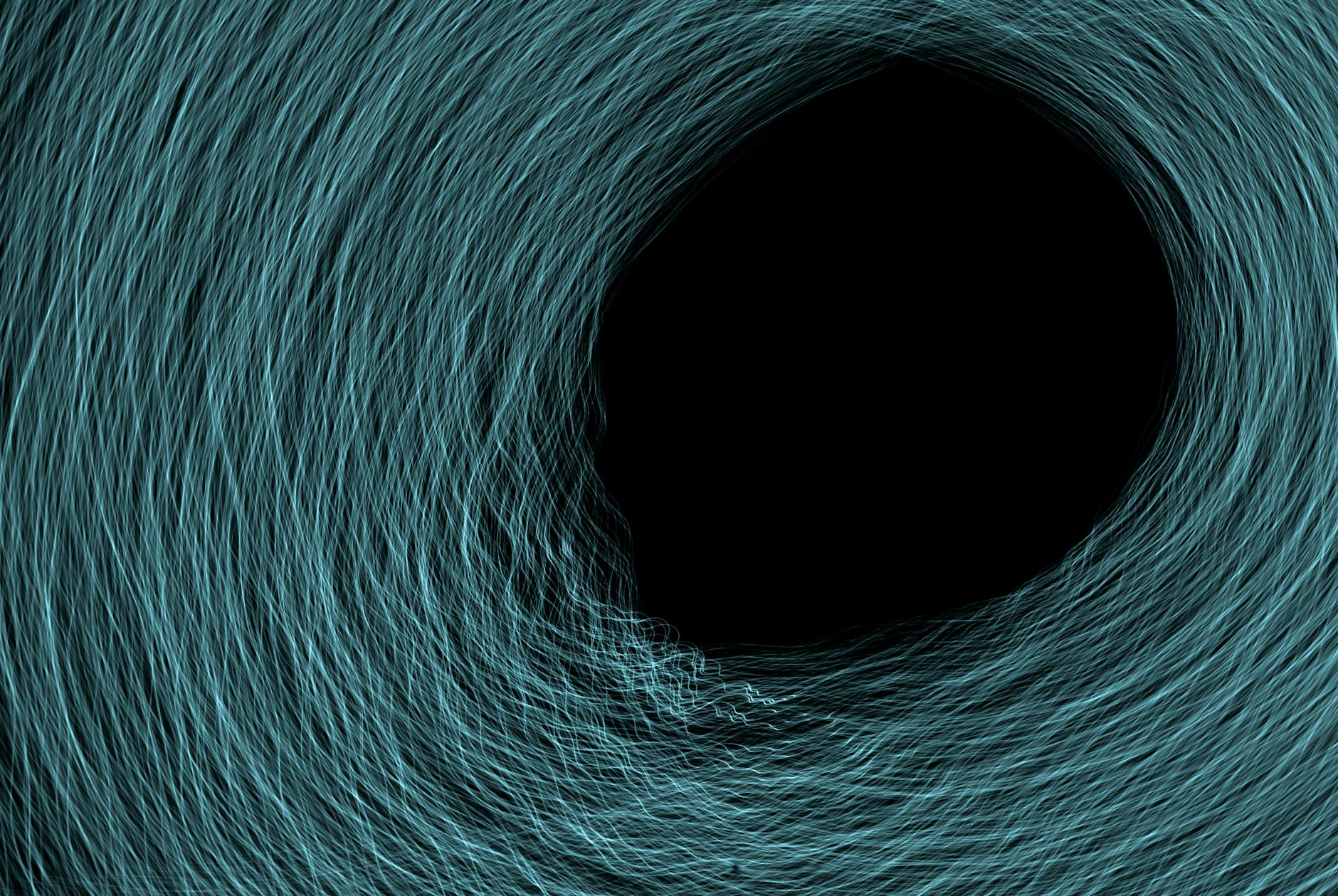
Black holes are famous for trapping light, but some of their most dramatic behavior comes not just from mass, but from spin. A spinning black hole does more than sit in space like a dark, heavy sphere. According to general relativity, it drags the spacetime around it. Near such an object, space itself behaves almost like a vortex.
This is why spin matters so much. It changes the structure around the black hole, affects how matter falls inward, and may help launch some of the most powerful jets in the universe. Two especially striking examples are Sagittarius A*, the supermassive black hole at the center of the Milky Way, which rotates at about 90% of the maximum rate, and the black hole in Messier 87, which appears to have angular momentum very close to the maximum theoretical value.
What it means for a black hole to spin
A spinning black hole has angular momentum, the physical quantity associated with rotation. Black holes are not all motionless, and in fact black holes spin, often fast. Spin is one of the three properties that can describe a stable black hole, along with mass and electric charge.
That might sound surprisingly simple. The no-hair theorem states that a stationary black hole is completely described by just mass, angular momentum, and electric charge. In other words, once a black hole settles down, spin is not a minor detail. It is one of its defining features.
Astronomers can estimate spin in a few ways. One method uses atomic spectral lines in the X-ray range. Gas near a black hole emits high-energy X-rays, and as matter plunges inward, relativistic effects shift the observed light toward the red end of the spectrum. The amount of redshift depends in part on how close that matter gets before plunging in, which in turn depends on the black hole’s spin. Another method uses the temperature of gas accreting onto the black hole, together with measurements of the black hole’s mass and the tilt of the accretion disk.
Frame dragging: when spacetime refuses to sit still
The strangest consequence of spin is frame dragging. Near a rotating black hole, spacetime rotates with it. This is not just a metaphor. General relativity predicts that the spinning mass drags nearby matter and light into rotation around the black hole.
The effect becomes stronger closer in. Eventually there is a region where staying still is impossible, no matter how hard you try. That region is called the ergosphere.
The ergosphere: the place where stillness is impossible
The ergosphere is a volume outside a rotating black hole’s event horizon. It is bounded by the event horizon on the inside and the ergosurface on the outside. At the poles, the ergosurface meets the event horizon, but around the equator it bulges outward.
What makes the ergosphere special is that matter and radiation can still escape from it. That distinguishes it from the event horizon, the boundary beyond which nothing can escape. Inside the ergosphere, you are not doomed simply because you are there, but you are forced to co-rotate with the black hole because the surrounding spacetime itself is being dragged around.
This is one of the most counterintuitive ideas in black hole physics: the black hole is not just pulling on objects moving through space. It is changing the behavior of space itself.
Can you steal a black hole’s spin energy?
Yes, at least in principle. The classic idea is the Penrose process.
In the Penrose process, an object enters the ergosphere and emerges in such a way that more energy comes out than went in. The extra energy is taken from the black hole’s rotational energy. The black hole loses spin as a result.
This matters because it shows that a spinning black hole is not just a passive sink. Its rotation is a kind of energy reservoir. The ergosphere provides a setting where that energy can be extracted.
The article also describes a related idea involving strong magnetic fields: the Blandford–Znajek process. In this picture, magnetic field lines are dragged by the black hole’s rotation, which may launch jets of matter into space. This process is considered a likely mechanism for the enormous luminosity and relativistic jets of quasars and other active galactic nuclei.
Relativistic jets: black hole spin on a cosmic megaphone
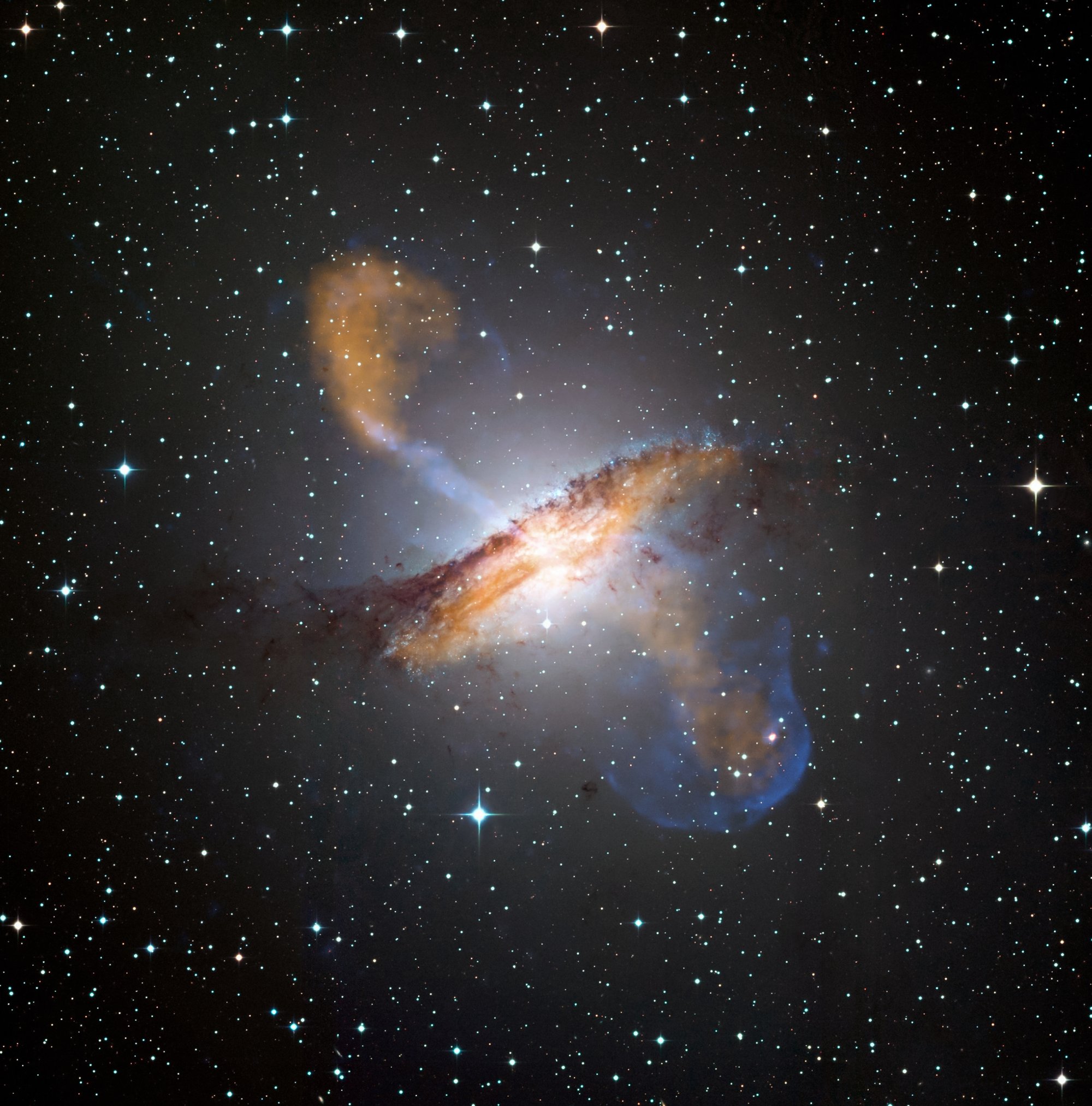
Some black holes produce relativistic jets, thin streams of plasma moving away from the black hole at more than one-tenth of the speed of light. A small fraction of the matter falling toward the black hole gets accelerated away along the rotation axis.
These jets can stretch as far as millions of parsecs from the black hole. They are seen around black holes of different masses, though they are typically observed around spinning black holes with strongly magnetized accretion disks.
An accretion disk is the disk-like structure formed by gas falling toward a massive object. Because of angular momentum, the gas does not usually plunge straight inward. Instead, it spirals around, heats up, and emits radiation. Around black holes, this process can generate huge amounts of energy, especially in X-rays.
Jets are often brighter than the accretion disk itself. In quasars, which are thought to be supermassive black holes with jets, they are tied to some of the brightest objects in the universe. In smaller systems in the Milky Way, black holes with jets are often called microquasars.
Exactly how jets form is still not known. But black hole rotation, magnetic fields, and the structure of the surrounding disk all appear to be central ingredients.
Spin changes the orbits around a black hole
Spin does not only create the ergosphere. It also changes where stable orbits are possible.
In general relativity, there is a smallest radius at which a massive particle can remain in a stable circular orbit around a black hole. This is the innermost stable circular orbit, or ISCO. Inside that radius, even a tiny disturbance can send matter spiraling inward.
For spinning black holes, the ISCO depends on whether matter orbits in the same direction as the black hole’s spin or in the opposite direction. For matter moving in the same direction, called prograde motion, the ISCO moves inward. For matter moving in the opposite direction, called retrograde motion, it moves outward.
This is a big deal for astronomy. The closer matter can orbit before plunging in, the more extreme the environment becomes. That affects the heat, the emitted radiation, and the observational clues astronomers use to estimate spin.
Measuring extreme spin
Some black holes appear to be rotating incredibly fast.
The black hole in Messier 87 appears to have angular momentum very close to the maximum theoretical value for an uncharged black hole. Sagittarius A*, the compact radio source at the center of the Milky Way, rotates at about 90% of the maximum rate.
Those numbers are remarkable because there is a theoretical upper bound on spin. If a black hole exceeded that limit, the usual event horizon would no longer exist in the same way, leading to a so-called naked singularity. Many physicists suspect such objects cannot form through realistic gravitational collapse, though this remains an unresolved issue.
Natural processes also tend to oppose pushing a black hole all the way to the absolute limit. So when astronomers infer near-maximal spin, they are seeing one of the most extreme states allowed by known theory.
Why spin matters beyond the black hole itself
Spin has consequences far beyond the immediate vicinity of a black hole. It influences the shape of nearby spacetime, helps determine how close matter can orbit, affects the X-ray signals used in observations, and may power large-scale jets that reshape their environments.
In active galactic nuclei, black hole activity can be linked to enormous energy output. Jets may energize nearby cavities of plasma and affect gas in galactic centers. Winds and radiation associated with accretion can also influence star formation. So the spin of a supermassive black hole is not just an isolated curiosity. It may help shape the behavior of entire galactic cores.
The twisted heart of black hole physics
If mass tells you how strong a black hole’s gravity is, spin tells you how dynamic and strange its surroundings can become. A spinning black hole can force spacetime into rotation, create an ergosphere where rest is impossible, and potentially give up some of its rotational energy through processes like Penrose and Blandford–Znajek.
That makes spin one of the most fascinating features in all of astrophysics. Black holes are already extreme, but once they start spinning, they do not just trap light. They twist the stage on which the universe performs.
Sources
Based on information from Black hole.
More like this
Twist your mind like spacetime near a spinning black hole — download DeepSwipe and fall into smarter scrolling.