Full article · 6 min read
Enceladus: Saturn’s Tiny Ocean World
Enceladus may look like just another small moon of Saturn, but it has become one of the most intriguing places in the Solar System. What makes it so compelling is not simply that it is icy, but that it appears to be actively sending material from beneath its surface out into space.
That idea turns Enceladus from a frozen moon into something far more exciting: a world with liquid salt water, towering geysers, and chemistry that has made scientists take it seriously as a possible habitat for life.
A moon that sprays its interior into space
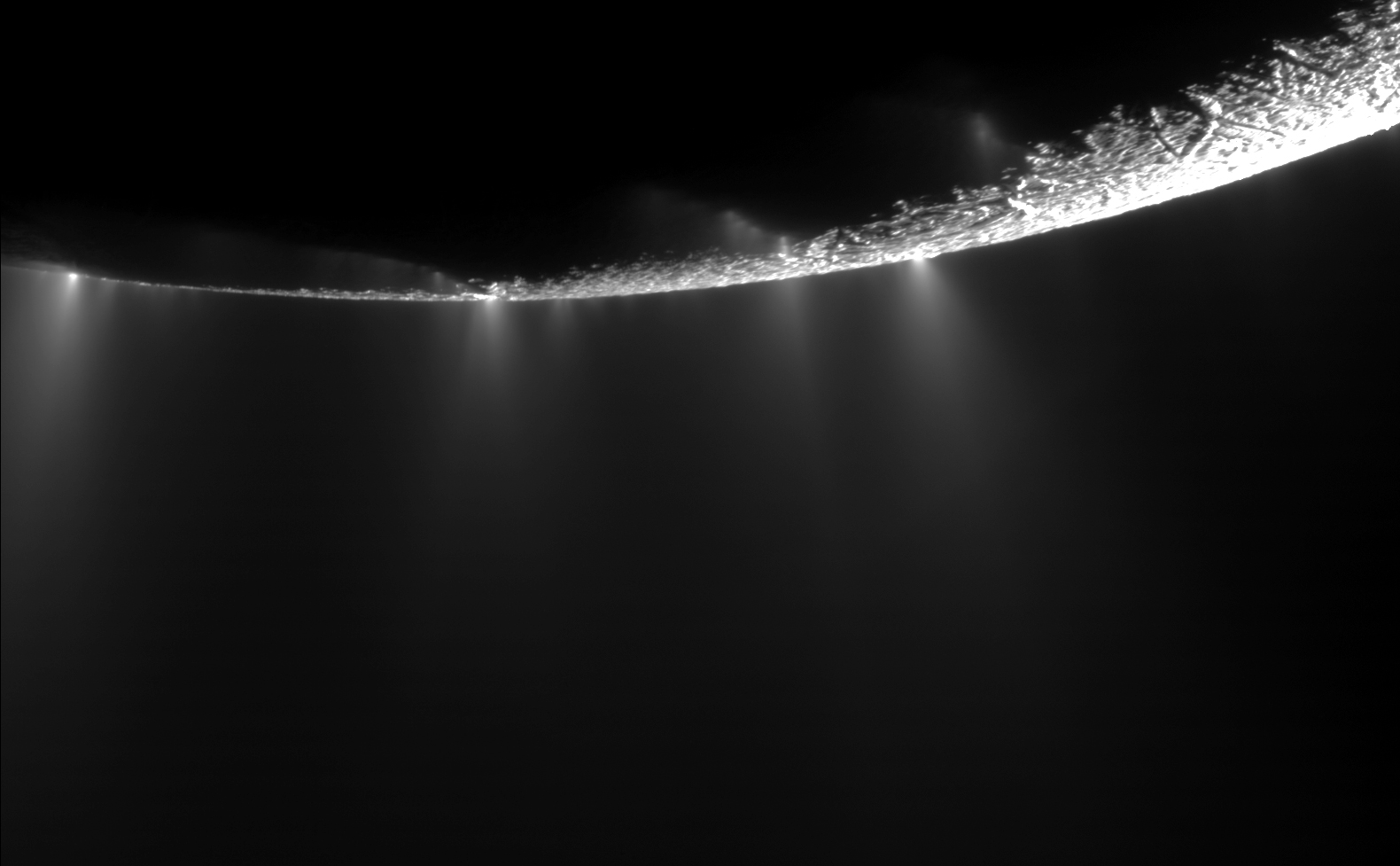
One of the most striking discoveries about Enceladus is that jets of icy particles erupt from vents in its south polar region. More than 100 geysers have been identified there. These jets are not just dramatic surface features. They launch material into orbit around Saturn, effectively giving scientists samples from the moon’s interior without needing to drill through ice.
NASA reported evidence that these liquid water reservoirs lie no more than tens of meters below the surface. That is astonishingly shallow in planetary terms. Instead of being locked away deep underground beyond reach, some of Enceladus’s water appears close enough to the surface to burst outward through fractures as icy plumes.
This is one reason Enceladus stands out so much among Saturn’s many moons. Saturn has 274 known moons, most of them small, but Enceladus has drawn unusual attention because it is not geologically quiet. It is active.
The salty evidence for a hidden ocean
The case for an ocean inside Enceladus does not rest on the geysers alone. The particles in those plumes are salt-rich, and their composition has been described as ocean-like. That matters because it suggests the expelled ice is not just frozen surface material. Instead, it indicates that much of it comes from the evaporation of liquid salt water.
In other words, Enceladus seems to be revealing what lies beneath its icy exterior. The plume grains act like clues, pointing toward a hidden internal sea rather than a completely solid frozen body.
The word “composition” here simply means what a material is made of. When scientists say the grains have an ocean-like composition, they mean the chemical makeup of those particles resembles what you would expect from salty liquid water. That is a major reason Enceladus is often discussed as an ocean world.
Why scientists care so much about this moon
Many worlds in the Solar System are fascinating, but only a few combine liquid water, active geology, and potentially life-supporting chemistry in one place. Enceladus appears to do exactly that.
It has often been regarded as a potential habitat for microbial life. “Microbial” refers to microscopic life, the kind made up of tiny organisms too small to see with the naked eye. The interest is not based on fantasy or science fiction, but on measurements of what Enceladus is actually ejecting into space.
A 2015 flyby by the Cassini spacecraft through one of Enceladus’s plumes found most of the ingredients needed to sustain life forms that live by methanogenesis.
Methanogenesis is a form of energy-making used by some microbes on Earth. In simple terms, these organisms produce methane as part of their metabolism. The finding does not mean life was discovered on Enceladus. But it does mean the moon has chemistry that scientists consider highly relevant to life as we know it.
That is why NASA scientists reported in 2011 that Enceladus was “emerging as the most habitable spot beyond Earth in the Solar System for life as we know it.” That is an extraordinary statement, and it helps explain why this tiny moon has become one of the biggest stars of planetary science.
Cassini’s role in revealing Enceladus
Much of what is known about Enceladus’s plumes came from the Cassini–Huygens mission, which entered orbit around Saturn on 1 July 2004. Cassini transformed understanding of the Saturn system, studying the planet, its rings, and its many moons in remarkable detail.
For Enceladus, Cassini was revolutionary. In 2006, scientists reported evidence of liquid water reservoirs beneath the surface that erupt in geysers. Later, the spacecraft flew through a plume and directly analyzed the material coming off the moon.
This was a rare scientific opportunity. Usually, studying a hidden ocean on another world would seem almost impossible. But Enceladus is venting material into space on its own, allowing a spacecraft to sample it. That makes the moon especially valuable for research.
Cassini’s mission ended in 2017 during its “Grand Finale,” when the spacecraft made a series of passes through the gaps between Saturn and its inner rings before entering Saturn’s atmosphere. By then, it had helped turn Enceladus from a relatively obscure moon into a leading candidate in the search for habitable environments beyond Earth.
Enceladus in Saturn’s extraordinary system
Enceladus is part of a planetary system already famous for extremes. Saturn is the sixth planet from the Sun and the second largest in the Solar System after Jupiter. It is a gas giant made predominantly of hydrogen and helium, with a bright ring system composed mainly of ice particles plus smaller amounts of rocky debris and dust.
The planet is orbited by a huge family of moons, including Titan, the largest, and Enceladus, one of the most scientifically exciting. Saturn itself is known for fast winds, a pale yellow color caused by ammonia crystals in its upper atmosphere, and unusual atmospheric features such as giant storms and a persistent hexagonal pattern around its north polar vortex.
Yet among all of Saturn’s spectacular traits, Enceladus has become special for a different reason. It is not just beautiful or strange. It may offer one of the clearest natural laboratories for studying whether the ingredients and conditions linked to life can exist elsewhere.
What makes Enceladus different from a typical icy moon?
Many icy bodies are cold and inactive on the surface. Enceladus is different because it appears to be exchanging material between its interior and space right now. That active venting means its internal environment is not merely theoretical.
The moon is effectively advertising what is happening below the ice. The south polar geysers, the salt-rich particles, and the life-related chemistry detected in the plume all point in the same direction: Enceladus is not a dead block of ice.
It is a dynamic world with liquid water and complex chemistry, and that combination is what keeps scientists coming back to it.
A tiny moon with huge scientific importance
Enceladus is often described as tiny compared with planets and even compared with some larger moons. But size is not what gives it importance. Its importance comes from accessibility and evidence.
Scientists do not just suspect Enceladus might hide an ocean. They have salty particles, identified geysers, and plume chemistry that supports serious discussion of habitability. Few places beyond Earth offer such a direct set of clues.
That is why Enceladus remains one of the most compelling worlds in the Solar System. A small icy moon orbiting a ringed giant has become a central player in one of science’s biggest questions: could life-friendly environments exist beyond Earth?
For now, Enceladus has not given a final answer. But it has given something almost as powerful — a reason to keep looking.
Sources
Based on information from Saturn.
More like this
Blast off into more bite-size discoveries — download DeepSwipe and explore worlds like Enceladus one swipe at a time.