Full article · 6 min read
Jupiter’s Dusty Rings: The Faint Halo Around a Giant Planet
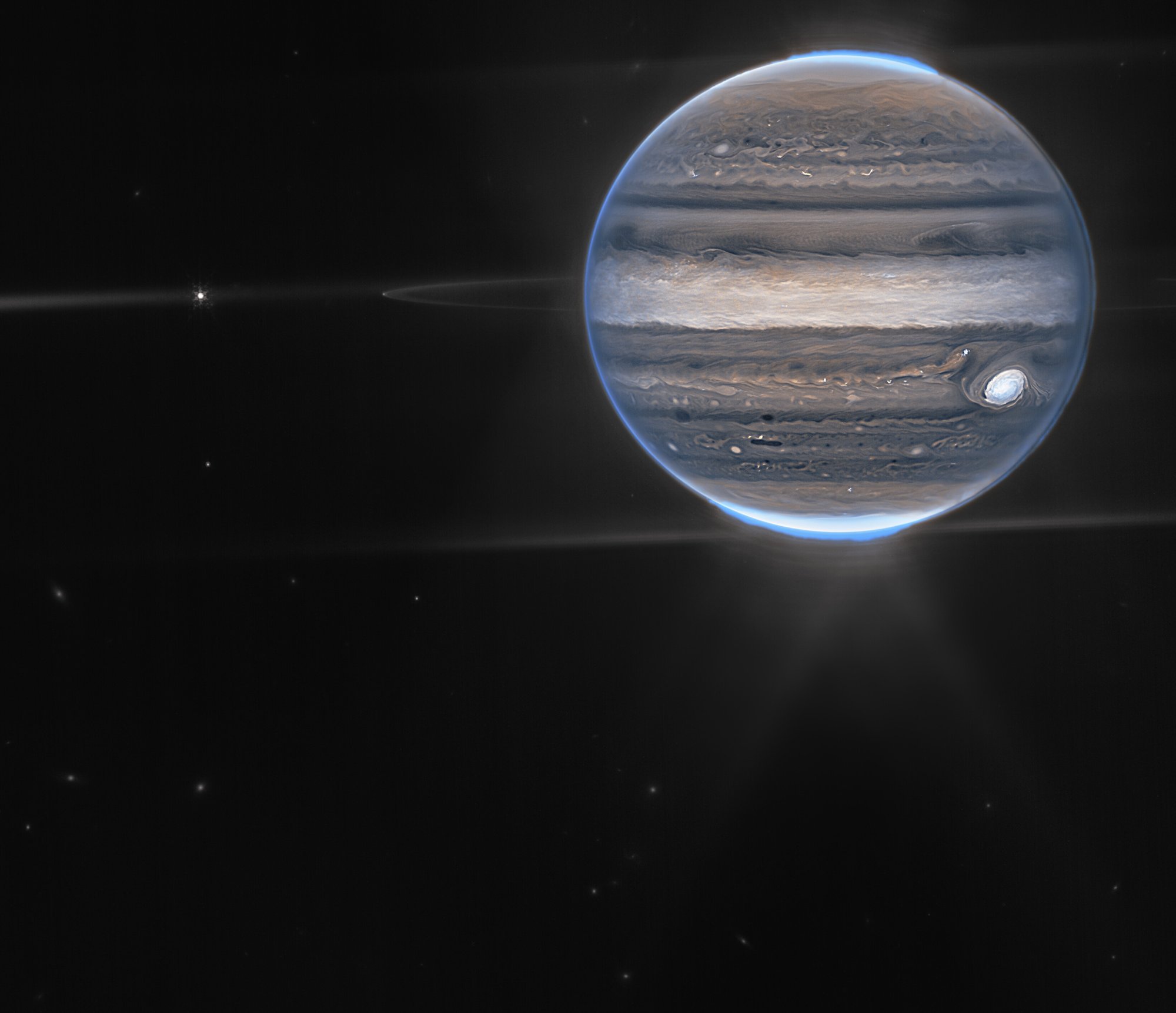
When people think of planetary rings, they usually picture Saturn’s broad, bright bands of ice. Jupiter has rings too—but they are far more elusive. They are faint, dusty, and even show a reddish colour in visible and near-infrared light. That makes them one of the more surprising features of the Solar System’s largest planet.
Jupiter’s ring system is subtle enough to be overshadowed by the planet’s dramatic clouds, its Great Red Spot, and its many moons. Yet these rings tell an intriguing story about dust, impacts, gravity, and the small moons that orbit close to the giant planet.
A ring system in three main parts
Jupiter is surrounded by a faint system of planetary rings with three main segments. Closest in is the halo, an inner torus of particles. A torus is a doughnut-shaped ring or band, rather than a flat, razor-thin structure. Beyond that lies the relatively bright main ring. Farther out is the gossamer ring, a very faint outer ring made of fine dust.
Together, these structures form a delicate ring system that looks very different from Saturn’s more famous rings. Jupiter’s rings are made mainly of dust, not ice. That difference matters: dust scatters light differently, appears much fainter, and helps explain why Jupiter’s rings are so easy to miss.
Their reddish appearance adds another layer of interest. In visible and near-infrared light, the rings show a red tint, giving this faint system a distinctive look despite its low brightness.
Why Jupiter’s rings are so faint
The key reason Jupiter’s rings are hard to see is simple: they are dusty. The article describes them as being composed mainly of dust, unlike Saturn’s icy rings. Ice reflects sunlight very efficiently, which is why Saturn’s rings can be striking even through modest telescopes. Dust, by contrast, tends to produce a much dimmer ring system.
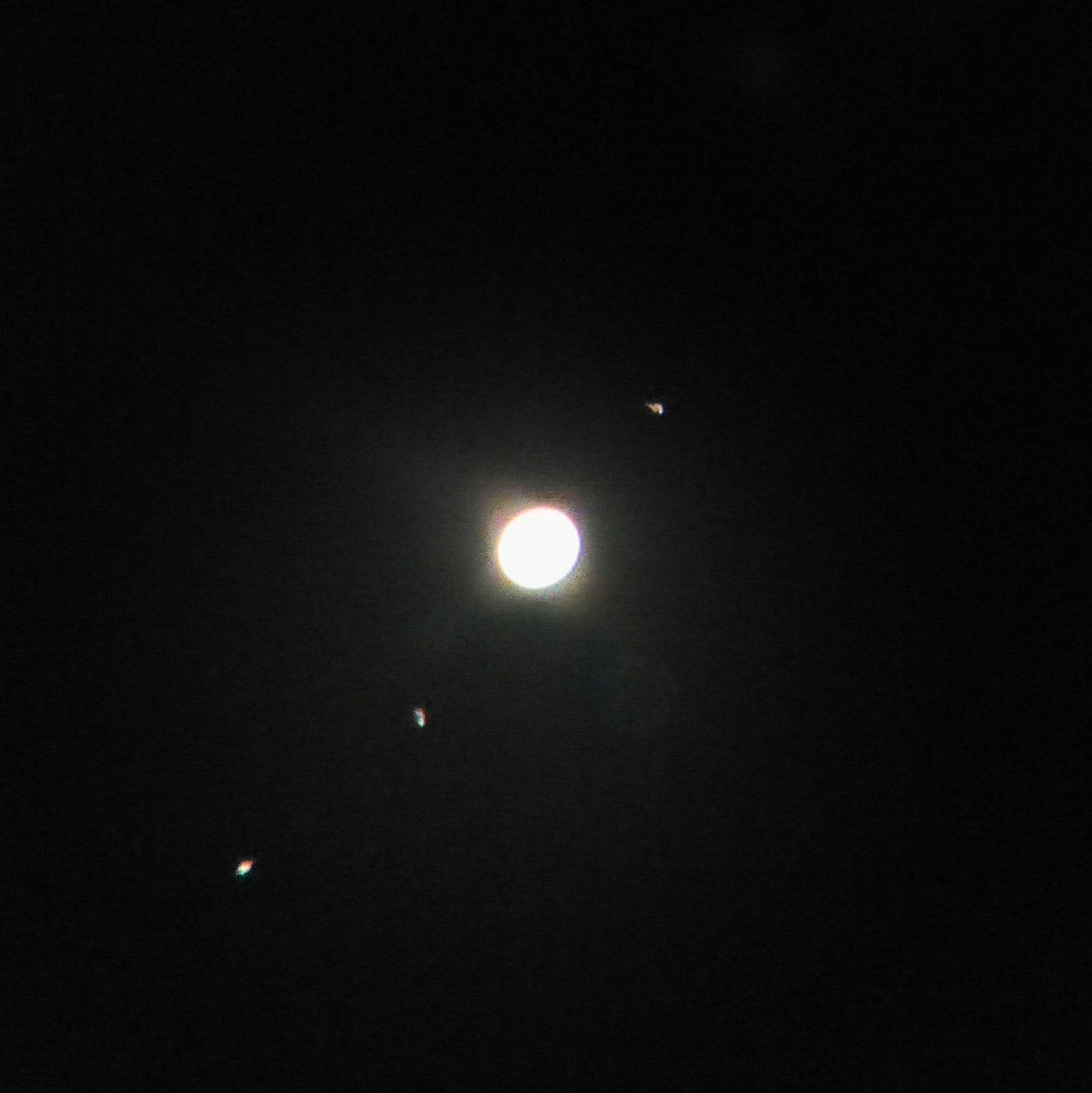
That makes Jupiter’s rings a reminder that not all ring systems are built the same way. Around Jupiter, the ring material forms a faint veil rather than a brilliant disk. Even though Jupiter itself is one of the brightest natural objects in Earth’s night sky, its rings do not share that visibility.
Built from moon dust
Jupiter’s rings are closely tied to several of its small moons. The main ring is most likely made from material ejected from the satellites Adrastea and Metis. This happens when impacts strike those moons and knock material off their surfaces. Jupiter’s strong gravitational influence then helps draw that material into ring form.
The outer gossamer ring is also linked to moons. Thebe and Amalthea are believed to produce two distinct dusty components of that ring. In other words, the rings are not isolated structures floating independently around Jupiter. They are constantly connected to the small bodies orbiting nearby.
This creates a vivid picture of how the ring system is maintained. Tiny impact events on small moons can release dust, and that dust becomes part of the faint structures circling the planet. New material is added by additional impacts, so the rings are fed over time rather than simply remaining unchanged.
There is also evidence of a possible fourth ring, made of collisional debris from Amalthea and stretched along that moon’s orbit. Even in a system already known for its faintness, there may be more structure than first meets the eye.
The halo: a dusty inner torus
The innermost part of Jupiter’s ring system is called the halo. It is described as an inner torus of particles. This makes it different from the flatter image many people associate with rings.
Because the halo is made of dust and sits deep in Jupiter’s gravitational environment, it contributes to the unusual layered look of the whole system. Instead of a single clean band, Jupiter has a more complex arrangement: a halo near the planet, a brighter main ring outside it, and then the ghostly gossamer ring farther away.
The word halo is especially fitting. It suggests a soft, diffuse glow rather than a sharply defined ring edge, which matches the faint and dusty nature of the structure.
A mystery as old as Jupiter?
One of the most intriguing questions about Jupiter’s rings is their age. The age of the ring system is unknown. It is even possible that the rings date back to Jupiter’s formation.
That possibility makes the rings especially fascinating. Jupiter is believed to be the oldest planet in the Solar System, having formed just one million years after the Sun and roughly 50 million years before Earth. If the rings really do trace back that far, they may preserve a connection to extremely early Solar System history.
At the same time, the rings are also being replenished by impacts on small moons. That means the system combines mystery and renewal: it may be ancient in origin, yet it is also shaped by ongoing processes.
Rings in the shadow of a giant
Jupiter is enormous—the largest planet in the Solar System, with a diameter about 11 times that of Earth and a mass 2.5 times that of all the other planets combined. It spins in slightly less than ten hours, has a powerful magnetic field, and hosts at least 97 moons. With so many dramatic features, its faint rings can feel like a footnote.
But that is exactly what makes them compelling. They reveal a quieter side of Jupiter. Instead of giant storms and blazing auroral activity, the rings tell a story of fine particles, repeated impacts, and subtle structure.
They also highlight how active the Jovian system is. Jupiter’s moons do not merely orbit as passive companions. Some help generate rings. The ring system itself is part of a broader network of interactions between the planet, its gravity, and its satellites.
Jupiter’s rings versus Saturn’s rings
The contrast with Saturn is one of the best ways to understand Jupiter’s rings. Saturn’s rings are famous for being bright and icy. Jupiter’s are faint and dusty. That single difference changes almost everything about how they appear.
Jupiter’s rings are not the kind that dominate the view. They are more like a hidden feature of the Solar System, one that rewards closer attention. Their reddish colour, their division into halo, main ring, and gossamer ring, and their origin in dust blasted off small moons all make them a distinctive ring system in their own right.
Rather than being a lesser version of Saturn’s rings, they are a different phenomenon altogether.
A faint system with a big story
Jupiter’s rings may be hard to see, but they are rich in meaning. They are made mainly of dust, organized into the halo, main ring, and gossamer ring. Their reddish colour sets them apart visually. Their material likely comes from impacts on small moons such as Adrastea, Metis, Thebe, and Amalthea. And their true age remains uncertain, with the possibility that they could reach back to the planet’s earliest history.
In a Solar System full of spectacular sights, Jupiter’s dusty rings stand out precisely because they do not shout for attention. They whisper. And sometimes, the faintest features tell the most intriguing stories.
Sources
Based on information from Jupiter.
More like this
Chase the faintest wonders in the Solar System—download DeepSwipe and let your curiosity orbit something new every day.