Full article · 7 min read
What Makes Performing Arts Different?
Some art stays put. A painting hangs on a wall. A sculpture occupies space. A photograph can be revisited again and again in the same physical form. Performing arts are different. You can’t hang a performance on a wall or place it on a pedestal and experience it in quite the same way, because its defining feature is the act of being performed.
That is what makes performing arts so distinctive and so fascinating. They are built around human performance as the principal product. Rather than existing mainly as a static object, they unfold over time. This temporal quality is central to how dance, music, theatre, opera, and mime are created, experienced, and remembered.
Performing arts happen in time
Performing arts are distinguished from visual and literary arts by the performance element. In visual art, the product may be a painting, sculpture, photograph, or building. In literature, it may be a poem, play text, or prose work. But in performing arts, the work comes alive through an event.
That event is temporal, meaning it occurs over a period of time rather than all at once. A dance is made of movement that appears and disappears. A musical performance unfolds note by note. A theatre production advances scene by scene, using speech, gesture, sound, and spectacle in front of an audience.
This gives performing arts an unusual power. They are experienced in the moment. Even when a piece is repeated, each performance occupies its own slice of time, with its own energy, pace, and presence.
Repeatable, but never exactly the same
One of the most interesting things about performing arts is that they can be both repeatable and unpredictable.
Some works are broadly repeatable because they are guided by a script or a score. A play can be staged many times from the same written text. A musical composition can be performed again and again by different musicians. Choreography, the art of making dances, can also provide a structure for repetition.
Yet repetition does not erase difference. A performance may follow the same plan, but the live event still changes from one occasion to the next.
Other performing works are improvised, meaning they are created in the moment rather than fully fixed in advance. Improvisation can function as its own tradition, especially in music, where it sits between composition and performance. In these cases, what the audience experiences may be unique to that performance.
This tension between plan and spontaneity is part of the thrill. Is the artwork the script? The score? The choreography? Or is it the unrepeatable act itself?
The people who make a performance possible
When audiences think of performing arts, they often picture the visible performers: actors, dancers, musicians, singers, magicians, or comedians. These are the people in front of the audience, and they are indeed central. They are the ones whose bodies, voices, gestures, and timing carry the work.
But performing arts are rarely created by performers alone.
They are also supported by other artists and essential workers, including songwriters and the people involved with stagecraft. Stagecraft refers to the practical and artistic work behind the scenes that helps build the performance environment. It includes elements such as lighting, sets, sound, and backstage work. These components shape what the audience sees and hears and can dramatically influence mood, rhythm, and meaning.
Performers also adapt their physical appearance using costumes and theatrical makeup. These tools are not just decoration. They help establish character, atmosphere, and style, and they can transform the performer into part of a larger artistic world.
In that sense, a performance is often a collaboration of many hands, even when the audience mainly notices the few people on stage.
Theatre: stories acted out in front of us
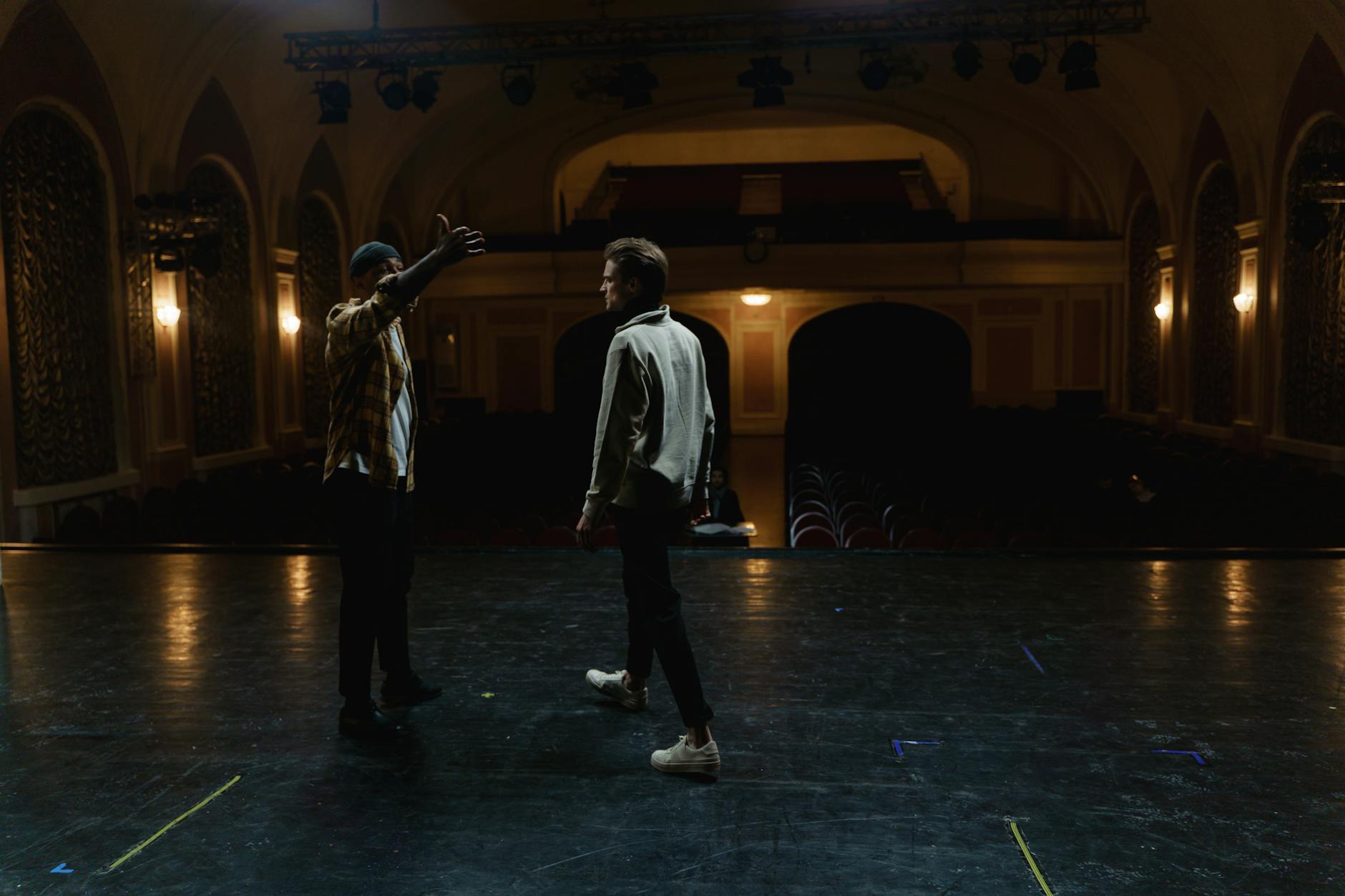
Theatre offers one of the clearest examples of what makes performing arts different. It is concerned with acting out stories in front of an audience through combinations of speech, gesture, music, dance, sound, and spectacle.
That definition reveals something important: theatre is not only about dialogue. It is a layered art form built from many elements working together in time. A pause, a movement, a sound cue, a costume change, or a shift in lighting can all carry meaning.
Theatre also appears in a wide range of forms beyond standard narrative dialogue. These include opera, ballet, mime, kabuki, Chinese opera, and Indian classical dance. Some of these forms lean more heavily on music, others on gesture or movement, but all rely on live performance as the heart of the experience.
Dance and music as living performance
Dance generally refers to human movement used as expression or presented in a social, spiritual, or performance setting. Because dance is made through motion, it exists only as it is being performed. Choreography may provide structure, but the art reaches the audience through the moving body.
Music is likewise inseparable from time. It is an art form whose medium is a combination of sounds. Commonly identified aspects include pitch, duration, intensity, and timbre. Duration includes rhythm and tempo, both of which depend on time passing. Even a familiar composition becomes a fresh event in performance, shaped by the performers’ choices and the atmosphere of the occasion.
Together, dance and music show why performing arts feel so immediate. They do not simply depict action or emotion. They enact them.
Opera and other art forms that merge disciplines
Some performing arts become even more intriguing when they combine multiple artistic fields. Opera is a classic example. It is often categorized as a performing art of music, yet it combines sets, costumes, acting, a libretto, singers, and an orchestra into a single artistic experience.
A libretto is the text used in an opera, comparable to the words or dramatic framework that performers bring to life. Because opera blends literary, visual, and musical elements, it shows how porous the boundaries between art forms can be.
This fusion was emphasized by Richard Wagner, who described a synthesis of the arts in connection with opera. The idea points to a larger truth about performing arts: they often gather other forms into a live event. Theatre can include music and dance. Ballet combines dance with orchestral music. Performance art may combine instruments, objects, and other art forms within a predefined or less well-defined structure.
Even audience participation may occur, making the final experience depend partly on those who witness it.
Is the work the plan, the act, or the memory?
This question gives performing arts their philosophical edge. In forms built around live performance, it is not always obvious where the artwork truly resides.
Is it in the written script or musical score, which allows a work to be repeated? Is it in the actual live event, where bodies, voices, sounds, and gestures meet an audience in real time? Or is it in the impression that remains afterward: the memory, emotion, or judgment carried home by the audience?
The arts more broadly transmit values, ideas, visions, impressions, and experiences across time and space. Performing arts do this in a particularly delicate way, because the event itself passes. Once over, it survives through recollection, retelling, influence, and sometimes later performances.
That fleeting quality may be exactly the point. A performance can vanish as an event while remaining powerful as an experience.
Why performing arts matter
The arts are a medium through which humans cultivate social, cultural, and individual identities. They also preserve and embody changing relationships between people and the world. Performing arts do this with special intensity because they involve living humans presenting action, sound, and expression in shared time.
They can be carefully studied, trained, and theorized, yet they also retain a sense of immediacy. They can be formal or improvised, spectacular or minimal, repeatable or singular. They can stand alone or intertwine with literature, visual design, and music.
Most of all, performing arts remind us that not all art is an object. Some art is an encounter.
It appears, unfolds, and disappears. And in that disappearance, it leaves behind one of the most human things art can offer: a moment shared between performers and audience that can never be exactly duplicated.
Sources
Based on information from The arts.
More like this
Catch ideas before they vanish like a live performance—download DeepSwipe and turn spare moments into encores of knowledge.