Full article · 8 min read
Roman Roads: The Vehicles, Wagons, and Travel Speeds of an Ancient Superhighway
Roman roads were not just strips of stone stretching across an empire. They were working transport corridors used by soldiers, officials, traders, and travelers, and they carried a surprising variety of vehicles. From light two-person cars to heavy cargo wagons, the Roman road network was designed to keep people, goods, and armies moving.
At its peak, this network linked 113 provinces by 372 great roads, with more than 400,000 kilometres of roads in total. Over 80,500 kilometres were stone-paved. That scale helps explain why Roman transport became so organized: once roads spread across Italy and beyond, the empire needed practical vehicles, way stations, official postal services, and rules about who could drive where.
What kinds of vehicles used Roman roads?
Roman transport can be divided into three broad groups: cars, coaches, and carts.
Cars were used to carry one or two individuals. Among them, the carrus was especially common. It was an open vehicle with a closed front and space for a driver and a passenger. Variants were named according to the number of horses pulling them. A biga had two horses, a triga had three, and a quadriga had four. Their tires were made of iron, which gave them durability on long journeys.
When not in use, the wheels of a carrus could be removed for easier storage. That detail gives a vivid sense of Roman practicality. These were not ceremonial objects alone; they were tools meant to be maintained, parked, and reused efficiently.
A more luxurious version of the car was the carpentum. It was used to transport women and officials and had an arched cloth cover overhead. Drawn by mules, it offered more shelter than the open carrus. A lighter and simpler option was the cisium, which was open above and in front and had a seat. It was drawn by one or two mules or horses and was used for cab work. The cab drivers were called cisiani.
The heavy-duty workhorse: the raeda
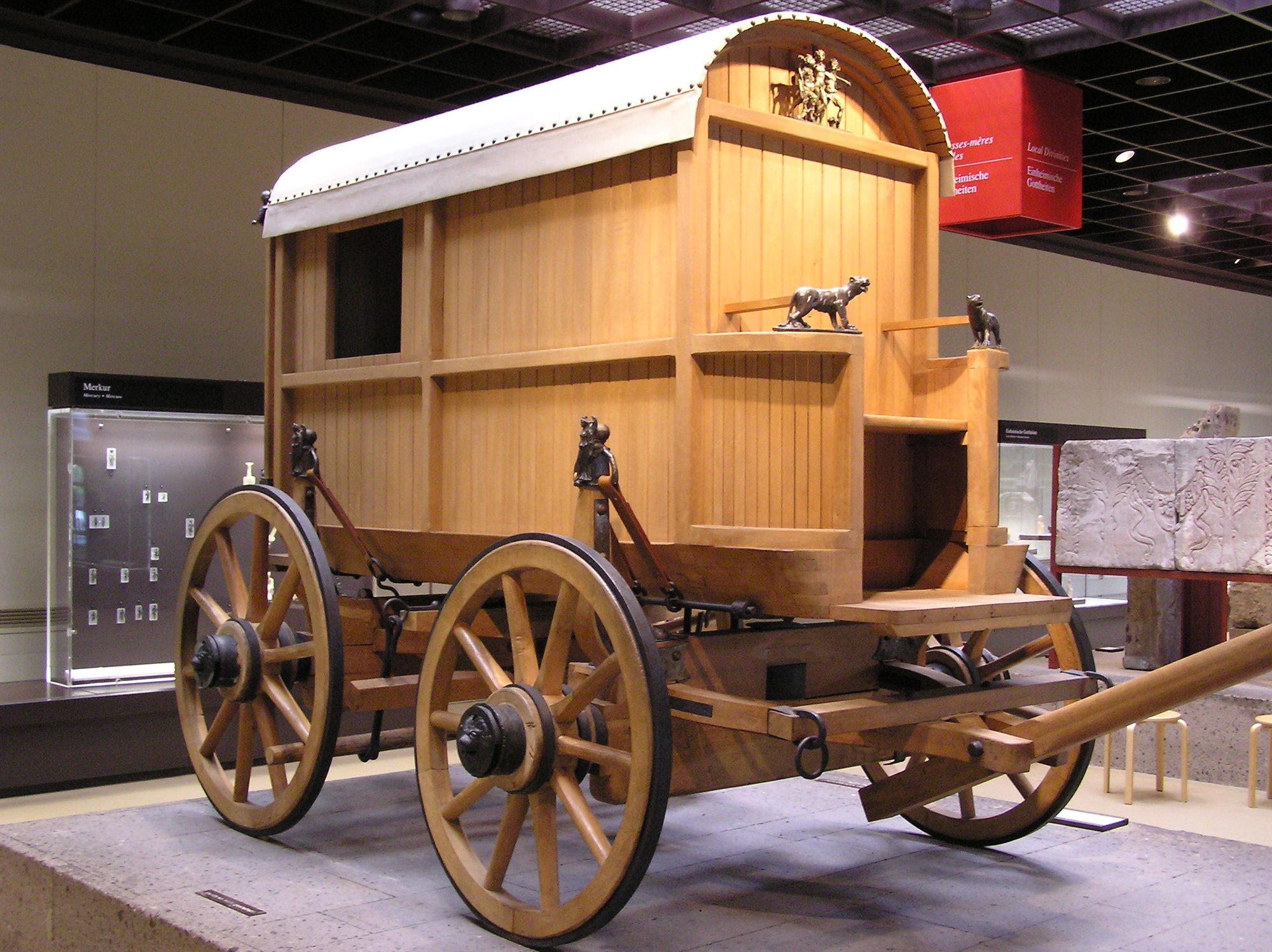
If the carrus was for lighter personal travel, the raeda was built for bigger loads and longer trips. This four-wheeled coach had high sides forming a box-like body with seats inside. It could carry several people along with baggage up to the legal limit of 1,000 Roman librae, equivalent here to 328 kilograms.
The raeda could be drawn by oxen, horses, or mules. For bad weather, a cloth top could be added, making it resemble a covered wagon. This made it one of the most practical vehicles for road travel, especially for groups moving with supplies.
There were also hired raedae, known as raedae meritoriae, and a government version called the fiscalis raeda. Even the driver and builder had a specific title: raedarius. That kind of specialized vocabulary hints at how developed Roman road transport had become.
Cargo carts and farm wagons
For pure hauling power, Romans relied on carts such as the plaustrum, also spelled plostrum. This was a basic but sturdy vehicle: essentially a platform of boards attached to wheels and a cross-tree. The wheels, called tympana, were solid rather than spoked and were several centimetres thick.
Sides could be added in the form of boards or rails, and sometimes a large wicker basket was placed on top. A normal four-wheel version existed, along with a two-wheel version. The larger type was called the plaustrum maius.
These carts were ideal for cargo rather than comfort. They fit the rougher side of road life: agricultural transport, freight movement, and the practical business of keeping settlements supplied.
How fast could Romans travel?
Speed on Roman roads depended greatly on whether you were walking or riding.
Horse-drawn carts could travel about 40 to 50 kilometres per day. Pedestrians, by comparison, usually managed 20 to 25 kilometres per day. Those figures are a reminder that even on one of the ancient world’s greatest road systems, travel still demanded patience.
Yet those daily distances become impressive when viewed across the entire network. A road system extending from Rome to the provinces allowed movement on a scale earlier societies could not match so efficiently over land. Straight alignments, carefully prepared surfaces, drainage, bridges, and causeways all helped keep movement consistent.
Roman roads were often laid out as straight as possible. Some long sections extended for as much as 55 miles. In ordinary terrain, gradients of 10% to 12% are known, and in mountainous country 15% to 20%. That could make travel steep and demanding, especially for commercial traffic. The Roman preference for direct routes sometimes produced slopes that were less than ideal for wagons, and over time they also built longer, more manageable alternatives.
Army transport and the wagon train
Roman roads had a deeply military purpose. The public road system was designed to unite and secure Roman conquests, and the army made constant use of it.
A legion on the march brought its own baggage train, called impedimenta. This included the gear and supplies that kept the force operational. The military used a standard wagon in its transportation service, the cursus clabularis. The standard wagon itself was called a carrus clabularius, or in variant forms clabularis, clavularis, or clabulare.
This wagon train moved the material backbone of an army. Roads allowed troops to march, camps to be supplied, and conquered regions to remain connected to Roman power. Every evening, a legion also constructed its own camp, or castra, by the roadside. Roman roads were therefore not just for movement; they were part of an entire military system.
Road rules, cities, and traffic control
Roman law and tradition restricted vehicle use in urban areas. Vehicles were generally forbidden in cities except in certain cases. Married women and government officials on business could ride, while commercial carts were limited to night-time access in the city within the walls and within a mile outside them under the Lex Julia Municipalis.
This rule makes sense when you picture narrow streets filled with pedestrians, animals, goods, and noise. Even in antiquity, traffic management was a real problem.
Public roads also had legal width expectations. The Laws of the Twelve Tables required a public road to be 8 Roman feet wide where straight and twice that where curved. Later rural public roads were commonly about 12 Roman feet wide, enough for two standard carts to pass without interfering with pedestrians.
Stations, inns, and changing horses
Long-distance travel required infrastructure beyond the road surface itself. For officials and people on official business, the government maintained mansiones, or staying places, usually about 25 to 30 kilometres apart. A traveler with the proper passport could stop there and find a complete villa set aside for use.
For ordinary travelers, there were private inns called cauponae near the mansiones. They offered similar services, though they had a rough reputation. A more respectable option could be found in tabernae, which began as roadside hostels and in some cases became quite luxurious.
Vehicles and animals had their own support network too. Mutationes, or changing stations, were placed every 20 to 30 kilometres. Here drivers could obtain help from wheelwrights, cartwrights, and equarii medici, meaning veterinarians for the animals.
These stations could dramatically increase speed when used as relays. One striking example records Tiberius traveling 296 kilometres in 24 hours by using such stations as chariot relays.
Roads built for wheels
The efficiency of Roman transport depended on road engineering. Main roads could be stone-paved and metaled, with a cambered surface. Camber means the road was slightly raised in the middle so water could drain away rather than collect on the surface. Footpaths, bridleways, and drainage ditches often ran alongside.
Roman builders used surveying tools such as the groma to lay out straight lines and right angles. After excavation of the road bed, called the fossa, layers of rubble, gravel, stone, and sometimes sand were added. The final road could include foundations, concrete layers, and a top surface of paving stones.
This structure helped roads resist rain, freezing, and flooding, and reduced the need for repair. That durability explains why the routes, and sometimes even the surfaces, of many Roman roads survived for millennia.
A transport network that reshaped the ancient world
The genius of Roman roads was not just that they existed, but that they supported a complete system of movement. Vehicles were specialized. Loads had legal limits. Distances were measured by milestones. Inns, changing stations, and official lodgings were spaced along routes. Postal services used relay transport. Armies moved with standardized wagons and baggage trains.
In that world, a carrus, a raeda, or a plaustrum was more than a vehicle. Each was part of a vast machine of administration, trade, and conquest rolling across one of history’s most famous road systems.
And while modern highways are faster, the Roman achievement still feels familiar: carefully engineered roads, traffic rules, roadside services, official mail, and transport built around speed, cargo, and control. The wheels may have been iron, but the logic behind the network still feels surprisingly modern.
Sources
Based on information from Roman roads.
More like this
Roll your curiosity down history’s fast lane — download DeepSwipe and take your daily knowledge trip the Roman way.