Full article · 10 min read
Roman roads: the 400,000-kilometre network that held an empire together
Rome did not just conquer territory. It connected it.
At the height of Roman power, the empire was threaded together by more than 400,000 kilometres of roads, with over 80,500 kilometres of them stone-paved. From Rome itself, 29 great military highways radiated outward, while 372 major roads linked 113 provinces into a single vast network. This was infrastructure on a continental scale, and it was essential to how the Roman state worked.
These roads were not all alike. Some were small local routes, while others were broad long-distance highways connecting cities, major towns, and military bases. But the big routes shared a recognizable Roman style: they were carefully surveyed, often paved with stone, built with drainage in mind, and designed to keep traffic moving in all seasons as reliably as possible.
More than roads: a system for empire
Roman roads were vital to the maintenance and development of the Roman state because they allowed efficient overland movement. Armies marched on them. Officials traveled along them. Official messages could be carried inland across long distances. Trade goods moved through the empire by way of this prepared network.
The system reached astonishing scale. The empire was described as being penetrated by roads almost everywhere a Roman official might need to go, whether for civil administration or military duty. In Britain they reached the Wall. They ran along the Rhine, the Danube, and the Euphrates, and spread across the interior provinces like a web.
That reach helps explain why Roman roads loom so large in history. They were not isolated engineering projects. They were the physical structure behind governance, military control, communication, and commerce.
Built for speed, drainage, and durability
The famous Roman road was not just a strip of stone. Its design reflected a practical understanding of weather, terrain, and wear.
Major roads were often metaled and stone-paved. “Metaled” refers to a prepared road surface made with compacted stone materials rather than simple dirt. They were commonly cambered, meaning the center was slightly raised so rainwater would run off toward the sides instead of collecting on the surface. Footpaths, bridleways, and drainage ditches often flanked the main carriageway.
This attention to water mattered enormously. A road that stays dry lasts longer and remains usable. Roman builders aimed to create roads that would resist rain, freezing, and flooding while requiring as little repair as possible.
They also preferred directness. Many Roman roads are famous for long ruler-straight stretches. Surveyors laid out lines with impressive accuracy, and the builders often chose to cut through hills or bridge rivers and ravines rather than bend around them. In marshy country, sections could even be supported on rafted or piled foundations, and causeways were raised above wet ground.
That straightness came with trade-offs. In some places it produced steep slopes, and over time the Romans sometimes built longer, easier alternatives. Even so, the overall preference is clear: go straight, build solidly, and keep the route functioning.
How Roman road builders actually worked
Roman road construction began with surveying. Specialists called agrimensores laid out the road bed. They used rods and an instrument called a groma, which helped them establish right angles and align straight courses. A line was marked out, and if a surveyor could not clearly see the intended endpoint, a signal fire might be lit to guide the work.
After the route was fixed, workers excavated the road bed, sometimes down to bedrock or at least to the firmest ground available. This excavation was called the fossa, or ditch. The depth varied depending on the terrain.
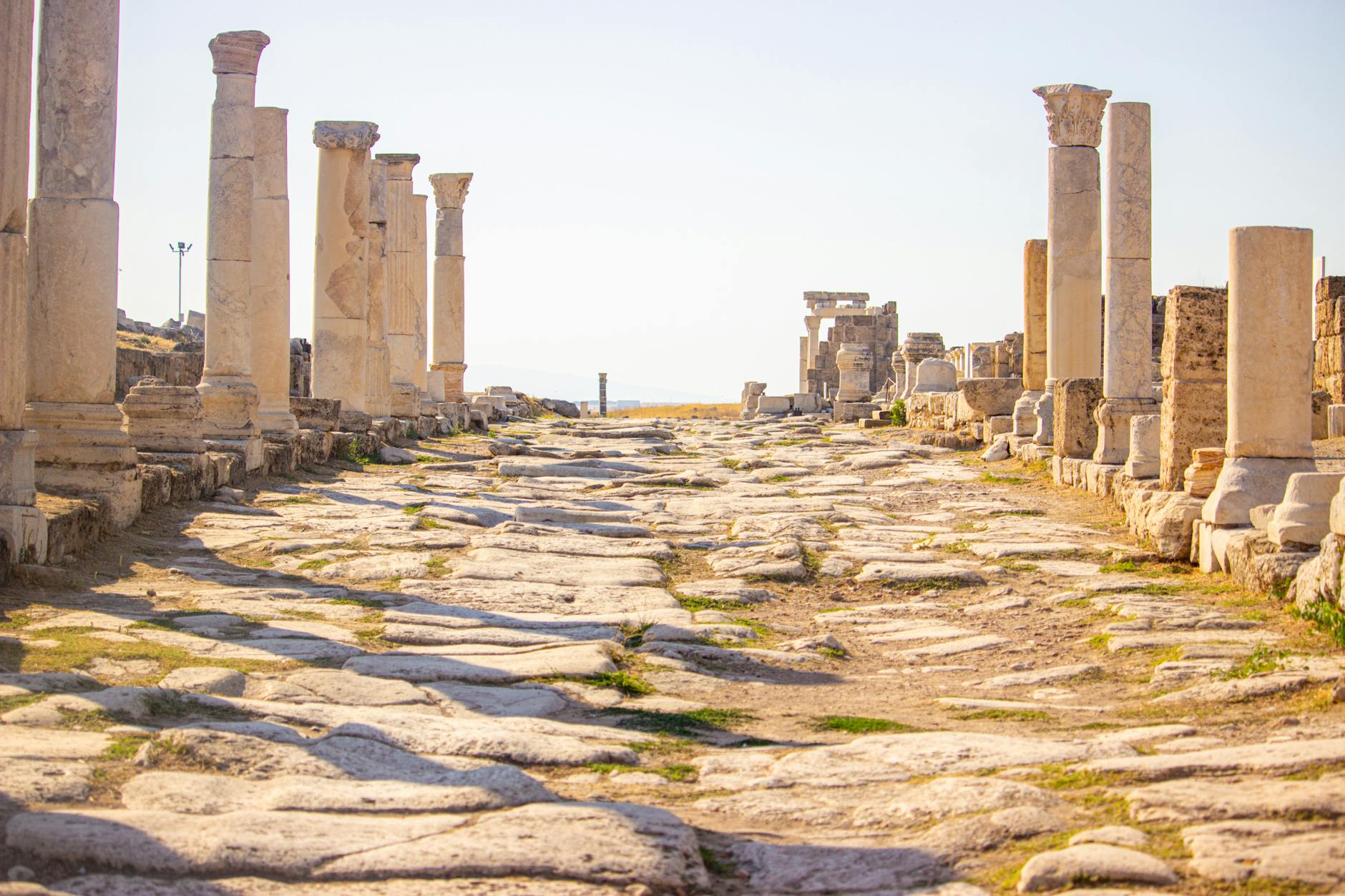
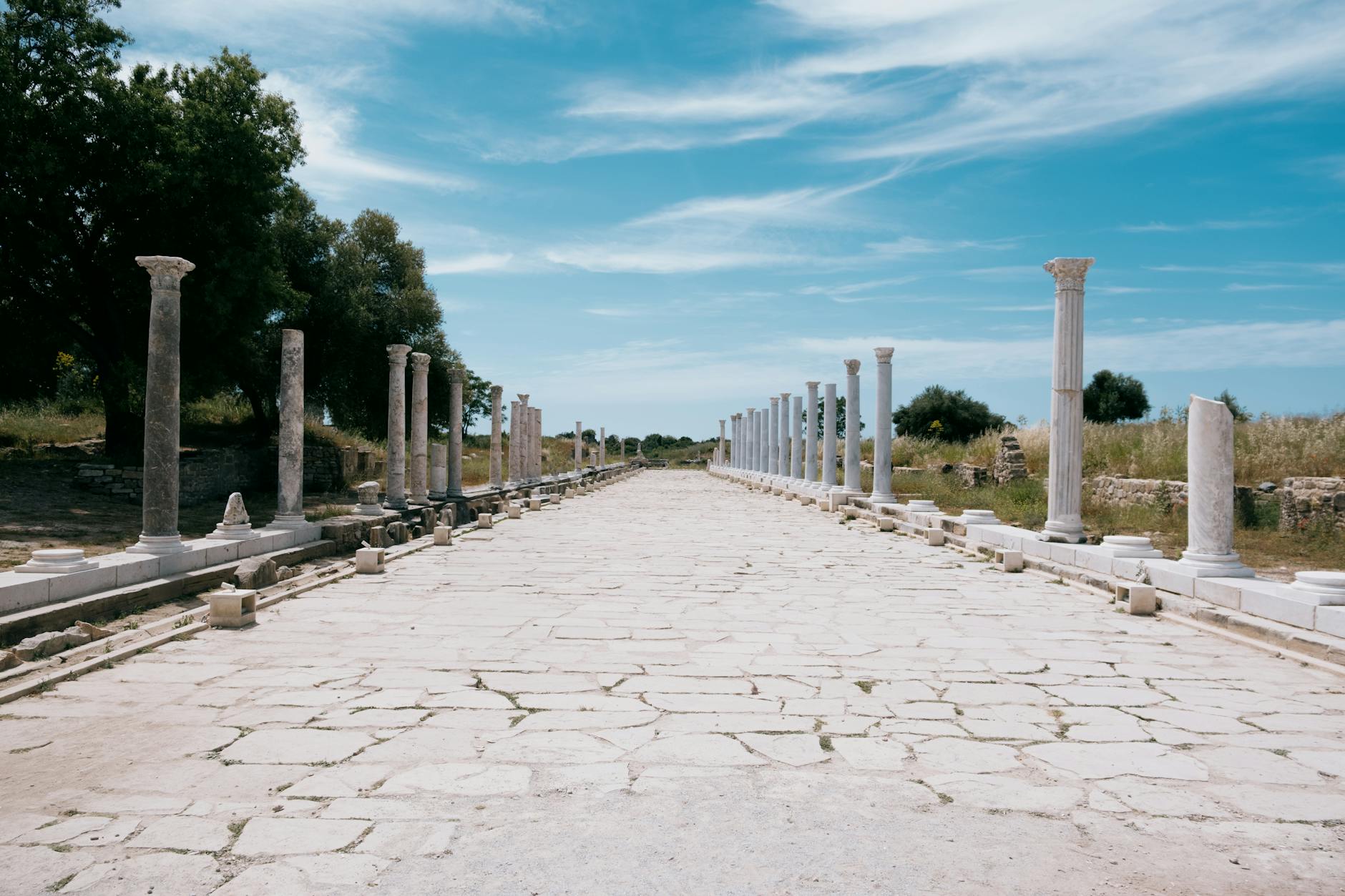
From there, the road was built up in layers. Builders filled the excavation with rubble, gravel, and stone. Sometimes sand was added where available. Near the top, gravel was tamped down to harden the surface. In more elaborate roads, flat stones set in cement could form a foundation, followed by layers of coarse and fine concrete. On top came the visible paving stones, often polygonal or square blocks of rock.
The final surface was crowned for drainage, another sign that Roman road engineering was deeply concerned with keeping water moving away from the road instead of through it.
The result could look rough today, because material between the stones has worn away over centuries. But the original surface was likely much flatter than the surviving remains suggest.
Not every Roman road was the same
Roman writers recognized different kinds of roads.
Public highways, known as viae publicae, consulares, praetoriae, or militares, were the main state roads. These were built and maintained at public expense, and they connected major destinations such as towns, the sea, public rivers, or other public roads. Many became famous under names tied to the officials who ordered their construction or reconstruction, such as the Via Appia, Via Cassia, and Via Flaminia.
Private and country roads formed another category. These could be built by private individuals, including roads leading from public roads to estates or settlements. Some were paved, others had only gravel surfaces, and beyond them were plain dirt roads.
Then there were the viae vicinales, village or district roads leading through or toward a vicus, meaning a village or small settlement. Depending on how they had originally been funded and built, these might be treated as public or private.
This layered hierarchy is one reason the Roman network was so effective. It was not just a set of grand highways. It was a connected system reaching from major strategic routes down to local access roads.
Rules, widths, and the right to pass
Roman roads were also legal institutions, not just physical ones.
The Laws of the Twelve Tables, dating to about 450 BC, required public roads to be 8 Roman feet wide when straight and twice that on curves. Later rural public roads were often around 12 Roman feet wide, enough for two standard carts to pass without interfering with pedestrians.
Roman law also defined rights of use across land. The ius eundi was the “right of going” across private land on foot, while the ius agendi was the “right of driving,” meaning use with a carriage. A via combined both rights, provided it met the proper width.
There were also urban restrictions. Vehicles were generally forbidden in urban areas except in certain cases. Commercial carts were limited to night-time access within the city walls and for a mile beyond under the Lex Julia Municipalis.
All of this shows that roads were regulated spaces. Width, use, maintenance, and access were not left entirely to chance.
Paid for by the state, shared by society
Road building was a Roman government responsibility, but maintenance was more complicated. Different officials, commissioners, contractors, and local landowners all played roles.
Public highways were overseen by curatores, or commissioners, and repaired by contractors at public expense, though neighboring landowners could be required to contribute a fixed share. In villages and districts, local magistrates could call on nearby landowners either to provide workers or to maintain specific stretches of road.
In Rome itself, householders were legally responsible for the section of street passing their own house, while the aediles enforced that responsibility. If a street ran between a public building and a private house, the cost could be shared between the treasury and the property owner.
Financing came from several sources. Officials could seek contributions, high-ranking individuals might distribute funds, censors were expected to pay for repairs from their own money in some cases, and taxes were also used.
Roads were not necessarily free to use, either. Tolls were common, especially at bridges, and could also be collected at city gates. Freight faced additional import and export taxes.
Augustus and the management of the network
Under Augustus, the administration of road maintenance was reorganized. He reduced the number of magistrates involved in urban administration and abolished the duoviri who had supervised roads outside the city. He also appointed curators for major public roads as a more permanent arrangement rather than relying only on temporary commissions.
These curators were expected to contract for maintenance and ensure the work was properly done in both quantity and quality. Augustus also authorized sewer construction and the removal of obstructions to traffic, reinforcing the practical link between roads, drainage, and urban order.
The emperors who followed remained closely involved in the condition of roads and bridges. Their names often appear in inscriptions commemorating repairs and restorations. This continued attention reflects how central the road network remained to imperial administration.
Milestones, maps, and knowing where you are
A road system this large required standardization.
Roman roads were marked by milestones, or miliaria. These columns recorded the number of miles along a road and often included information about the officials who built or repaired it. The word “mile” itself comes from the Latin milia passuum, meaning one thousand paces.
Milestones made distance measurable and locations recordable. That was useful not just for travelers but for administration and history.
Travelers could also consult an itinerarium, essentially a route list showing towns and distances along a road. More schematic route-planners also existed, showing roads and branches in simplified form. The Roman government even commissioned master itineraries of the network.
Together, milestones and itineraries turned roads into something more than paths on the ground. They became an organized, legible system.
The empire moved on these roads
The Roman public road system was thoroughly military in purpose and spirit. It was designed to unite and consolidate Roman conquests. A legion on the march brought its baggage train and set up camp each evening near the road.
But military movement was only part of the picture. Officials on state business used way stations called mansiones, placed roughly 25 to 30 kilometres apart. These gave authorized travelers a place to stay. Nearby changing stations, called mutationes, allowed animals and vehicles to be serviced or exchanged.
Mail also moved through the network. Under Augustus, the cursus publicus carried official correspondence by relay across the Roman roads.
Private travel used the same broad infrastructure. Romans rode horses, drove cars and coaches, and hauled cargo in carts. Horse-drawn carts could cover 40 to 50 kilometres per day, while pedestrians traveled around 20 to 25 kilometres.
The edge of the paved world
The Roman network did not spread evenly everywhere, but where it did appear, it could be transformative. In Gaul, no less than 21,000 kilometres of roadways are said to have been improved. In Britain, at least 4,000 kilometres were improved.
Beyond the empire’s borders, there were no paved roads. Footpaths and dirt roads certainly existed, and in places like Britain there had been pre-Roman trackways such as the Ridgeway and the Icknield Way. But the prepared, paved network was a Roman signature.
That contrast made the Roman road system feel like the physical frontier of imperial order. On the road, distances were measured, traffic was regulated, and movement was organized. Step beyond it, and the pavement ended.
Why Roman roads still matter
Many Roman road courses survived for millennia, and some modern roads still follow their lines. That longevity is one of the clearest signs of how well they were planned and built.
Roman roads were not merely ancient transport routes. They were an infrastructure system that combined engineering, law, administration, and military strategy on an enormous scale. Their straight alignments, durable surfaces, drainage design, milestones, and way stations all served one larger goal: making a huge empire move.
That is why the Roman world can still seem so vividly mapped in the imagination. It was, quite literally, laid out in roads.
Sources
Based on information from Roman roads.
More like this
Take the fast lane to smarter scrolling — download DeepSwipe and pave your own road through fascinating knowledge.