Full article · 8 min read
Roman Roads Were More Than Highways
When people think of Roman roads, they often picture stone paving and marching legions. But the road system was also a travel network packed with way stations, relay stops, inns, couriers, carts, and roadside businesses. In practical terms, it helped the Roman world move people, messages, animals, and goods over long distances with surprising organization.
This travel infrastructure made fast official journeys possible. It also created a whole roadside economy, from government lodging to rough private inns, and from horse-changing depots to towns that grew up around travelers’ needs.
The official travel network: mansiones
For officials and others traveling on state business, the Roman government maintained mansiones, literally “staying places.” These were official way stations placed about 25 to 30 kilometres apart. A traveler on government duty who arrived with the proper identification could expect more than a simple shelter. A mansio offered the equivalent of a complete villa dedicated to official use.
That detail matters because it shows how seriously the Romans treated movement across their empire. Roads were not just strips of engineered ground. They were supported by a state-run service structure that allowed administrators and messengers to keep going day after day.
Passports were required for identification, which suggests that access to this system was controlled. These were not public free-for-all rest houses. They were part of the machinery of government.
Over time, a mansio could become more than a stopover. In some places, a permanent military camp or even a town grew up around one. A simple official lodging point could therefore help shape the settlement pattern of a region.
Mutationes: the Roman pit stop
Alongside the mansiones were mutationes, or “changing stations.” These were usually located every 20 to 30 kilometres. Their purpose was practical and wonderfully familiar to modern travelers: keep the journey moving.
At a mutatio, drivers could change animals, arrange repairs, and get help for transport problems. These stations could provide access to wheelwrights, who worked on wheels, cartwrights, who repaired or built carts, and equarii medici, veterinarians for horses and other transport animals.
In other words, Roman roads had a support system much like a combination of a service plaza, repair garage, and horse relay depot. If a wheel failed, an axle needed work, or an exhausted animal had to be replaced, the mutatio was where the journey was saved.
This relay system was a major reason speed was possible. A road alone does not create rapid travel. Fast movement requires fresh animals, maintenance, and predictable stopping points. The Romans understood that.
The cursus publicus and relay mail
The empire also operated a public postal and transport service known as the cursus publicus. Founded by Augustus, it carried official mail across the Roman road system by relay.
Relay transport means the message or traveler keeps moving while animals are replaced at intervals rather than ridden to exhaustion. That basic idea dramatically increases speed. According to the record, a relay of horses could carry a letter about 80 kilometres in a day.
The vehicle used for carrying mail was a cisium fitted with a box, though urgent delivery could be even faster by horse and rider. The cisium itself was a light vehicle, open above and in front, drawn by one or two mules or horses.
Roman couriers even had recognizable attire. The postman wore a leather hat called the petanus. That small detail makes the system feel surprisingly concrete: not just an abstract bureaucracy, but real people on real roads, marked out by a distinctive piece of travel gear.
The work could also be dangerous. Postal workers were targets for bandits and enemies of Rome. Fast communication was valuable, and anything valuable attracts danger.
Tiberius and the 24-hour sprint
One of the most striking examples of Roman relay travel comes from Tiberius. Using these stations as chariot relays, he covered 296 kilometres in 24 hours to reach his brother Drusus Germanicus, who was dying of gangrene after a fall from a horse.
That kind of speed is startling in the ancient world. It was only possible because the road system was more than pavement. It included a chain of organized stopping points, replacement animals, and transport services ready to support urgent movement.
The story also reveals the human side of the system. Roman roads served administration and empire, but they also carried people in moments of personal crisis.
Not everyone stayed in official lodgings
Most travelers were not government officials with access to mansiones. For unofficial travelers needing food, drink, or a bed, there was a private roadside system of inns called cauponae.
These were often placed near the mansiones and performed many of the same practical functions. But they had a far less respectable reputation. They were said to be frequented by thieves and prostitutes, and the surviving ruins of some preserve graffiti on their walls.
That reputation gives a vivid glimpse of travel culture. Roads brought opportunity, but also petty crime, hustlers, and the seedier side of mobility. The Roman roadside was not always polished imperial efficiency. It could be rough.
Tabernae and the rise of roadside towns
Travelers seeking something better than a caupona had another option: tabernae. Early on, when unofficial services were still limited, houses near roads were legally required to offer hospitality on demand. Those houses likely evolved into the first tabernae.
These were hostels rather than what the modern word “tavern” might suggest. As traffic increased, tabernae became more developed and sometimes more luxurious. Some earned good reputations, others bad ones.
One recorded example, the Tabernae Caediciae at Sinuessa on the Via Appia, had a large storage room containing barrels of wine, cheese, and ham. That detail hints at the scale of provisioning along major routes. A busy road needed not just beds, but stored food and drink in quantity.
Roadside lodging could have lasting effects on geography. Some present-day cities grew up around a taberna complex. What began as a place to stop for the night could become a permanent settlement.
Roads built for movement, not just display
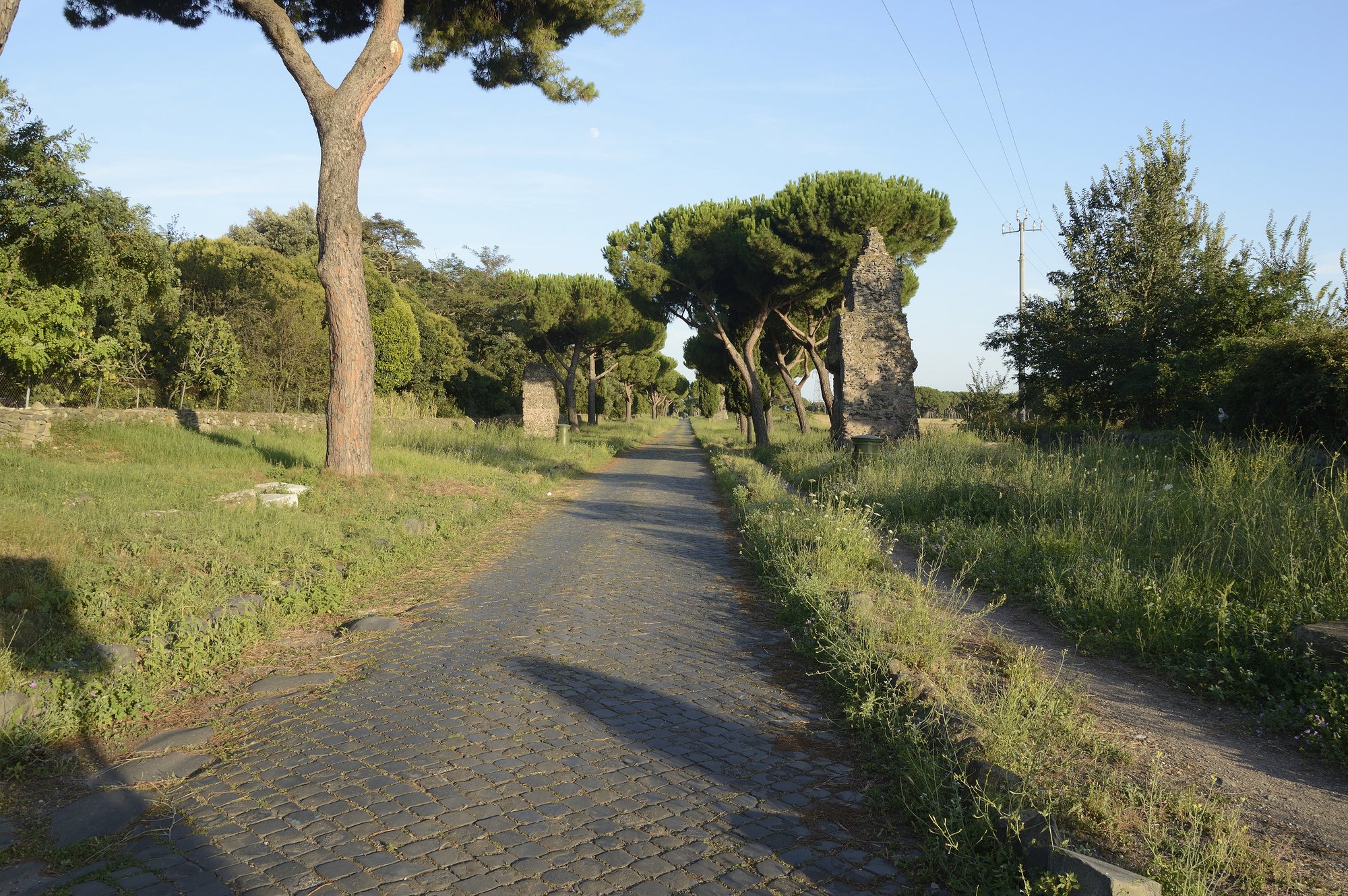
This entire travel system worked because Roman roads were engineered with practical movement in mind. Major roads could be stone-paved and metaled, cambered so water drained away, and flanked by footpaths, bridleways, and drainage ditches. They were often laid out on accurately surveyed lines, and some sections crossed difficult ground on bridges, piled foundations, or causeways.
Roman builders aimed for straightness and durability. Many roads were designed to resist rain, freezing, and flooding, and to need as little repair as possible. Surveyors used tools such as the groma to lay out lines and right angles. In difficult terrain, the Romans often preferred cuts, tunnels, bridges, and projecting structures rather than long detours.
That engineering mattered directly to travelers. A courier cannot maintain relay speed through endless mud. A cart cannot move efficiently without a stable roadbed. Inns and stations only function well when the route itself is reliable.
Vehicles on the Roman road
The roads carried many kinds of vehicles. Ox carts moved cargo. Horse-drawn carts could travel about 40 to 50 kilometres per day, while pedestrians generally covered 20 to 25 kilometres per day.
Roman vehicles included cars, coaches, and carts. The carrus was a standard chariot-like vehicle. The cisium was lighter and commonly used for cab work. The raeda was a four-wheeled coach used to carry several people with baggage, and it was probably a main travel vehicle on the roads. There was even a fiscalis raeda, a government coach.
These transport types mattered because they matched different travel needs: private movement, hired travel, freight hauling, and official business. The roads were not built for one kind of user alone.
A network that held an empire together
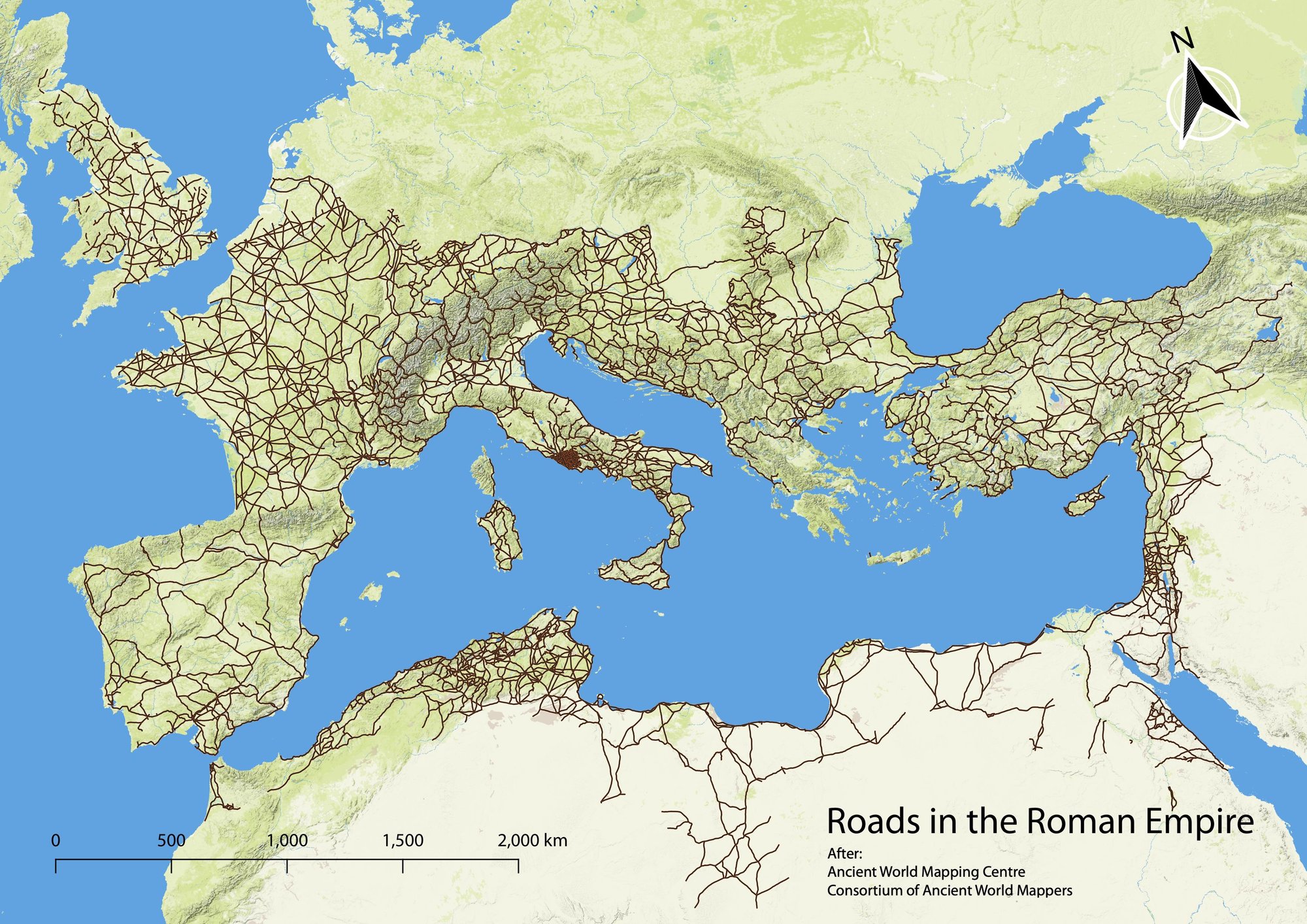
Roman roads were vital to the maintenance and development of the Roman state. They enabled armies, officials, civilians, official communications, and trade goods to move overland efficiently. At the height of Roman development, 29 great military highways radiated from Rome, and 113 provinces were linked by 372 great roads.
The total network amounted to more than 400,000 kilometres of roads, with over 80,500 kilometres stone-paved. That scale helps explain why systems like mansiones, mutationes, postal relays, inns, and town-building along the roadside were so important. A network that vast needed infrastructure for living on the move.
The Roman road was therefore never just a road. It was a corridor of communication, logistics, hospitality, repair, commerce, and control.
Why this still feels modern
There is something surprisingly familiar about the Roman travel experience. Official rest houses every few dozen kilometres. Relay stations for fresh animals and repairs. A government post system. Rough inns with bad reputations. Better roadside lodging for wealthier travelers. Settlements growing around transport hubs.
The details are ancient, but the pattern is modern. Roman roads did not merely connect places on a map. They created a travel ecosystem, one capable of moving messages quickly, helping officials cross huge distances, and turning roadside stops into lasting communities.
That is what made the system remarkable: not just stone underfoot, but services all along the way.
Sources
Based on information from Roman roads.
More like this
Change horses for your brain — download DeepSwipe and keep your knowledge journey moving at Roman relay speed.