Full article · 7 min read
Milky Way: How Big Is Our Galaxy, Really?
When people picture the Milky Way, they often imagine a neat spiral with a clear outer edge. The reality is messier, bigger, and more fascinating. Our galaxy has a bright stellar disk, faint outer reaches, and an enormous surrounding region shaped by matter we cannot see directly.
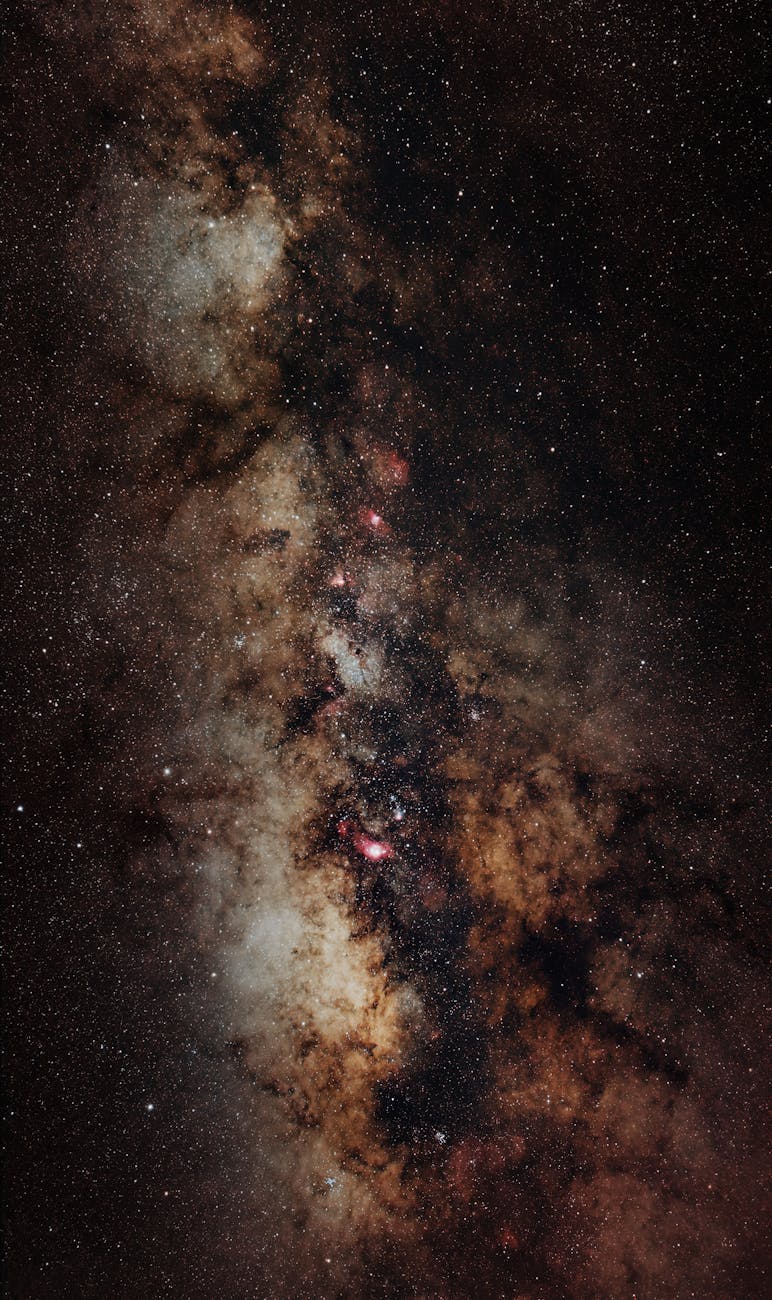
The Milky Way is the galaxy that contains the Solar System, and from Earth it appears as a hazy band of light across the night sky. That glowing band comes from huge numbers of distant stars blended together, too far away to be picked out individually with the naked eye. But the visible band is only a small clue to the full scale of the galaxy we live inside.
The main disk: about 87,400 light-years across
A commonly cited estimate puts the Milky Way’s stellar disk at about 26.8 kiloparsecs in diameter, which is roughly 87,400 light-years. A light-year is the distance light travels in a year, so this number gives a sense of truly cosmic scale.
The Milky Way is a barred spiral galaxy, meaning it has a central bar-shaped region and spiral arms winding outward through the disk. Even with that enormous width, the galaxy is surprisingly thin by comparison. In the spiral arms, it is only about 1,000 light-years thick. That makes the Milky Way look less like a puffed-up ball and more like a vast, flattened structure.
This thinness matters because it helps explain why the galaxy appears as a band in our sky. Since the Solar System sits within the galactic disk rather than far above it, we are looking through the crowded plane of the Milky Way. In some directions, that means seeing dense star fields and bright star clouds. In others, dust blocks the view and creates dark lanes.
Our place inside it
The Solar System is not near the center of the Milky Way. It lies about 27,000 light-years from the Galactic Center, near the inner edge of the Orion Arm. That arm is one of the spiral-shaped concentrations of gas and dust in the disk.
The center of the galaxy is marked by Sagittarius A*, an intense radio source understood to be a supermassive black hole with a mass of about 4.1 million Suns. Around that central region, the innermost 10,000 light-years contain a bulge of stars and one or more bars radiating outward.
Because we live inside the disk and off to the side rather than above it, measuring the Milky Way is much harder than measuring a distant galaxy that we can see from the outside. We have to infer its structure from star counts, motions, brightness measurements, and other indirect methods.
Why the “edge” is hard to define
One of the biggest challenges in answering “How big is the Milky Way?” is that galaxies do not come with a crisp boundary line.
The disk of stars does not suddenly stop. Instead, the concentration of stars decreases with distance from the center. Beyond roughly 40,000 light-years from the center, the number of stars per cubic parsec drops much more quickly, but that still does not mean there are no stars beyond that point.
That is why different methods can give different sizes. Astronomers often use a standard based on surface brightness called the D25 isophote. An isophote is a contour of equal brightness. In this case, it marks a level used to define the visible size of a galaxy in blue light. Using that standard gives the 87,400 light-year diameter estimate for the Milky Way.
But that estimate does not settle the matter completely. It describes a meaningful visible size, not a final hard edge.
The Milky Way may extend farther than once thought
Recent studies have suggested that disk stars exist much farther out than older models once assumed. One 2018 study found probable disk stars at distances of about 26 to 31.5 kiloparsecs from the Galactic Center, which is roughly 84,800 to 103,000 light-years.
That matters because there was once thought to be a more abrupt drop-off in the stellar disk around 13 to 20 kiloparsecs from the center. If stars are present well beyond that, then the Milky Way’s disk is more extended than many people imagine.
So when someone asks how big the Milky Way is, the best answer depends on what part they mean. The bright, standard visible disk is about 87,400 light-years across. But stars associated with the disk likely reach farther outward, pushing the galaxy’s stellar extent to around 100,000 light-years from the center in some cases.
Then there’s the dark matter halo
The biggest surprise may be that the Milky Way is surrounded by something much larger than its shining disk: a vast halo dominated by dark matter.
Dark matter is matter that does not shine or absorb light in a way we can directly see, but its gravity affects how galaxies move and hold together. In the Milky Way, much of the galaxy’s mass appears to be dark matter. The evidence comes in part from the galaxy’s rotation curve, which describes how fast stars and gas orbit the center.
If the Milky Way contained only the mass seen in stars, gas, and other ordinary matter, orbital speeds would fall off with distance from the center. Instead, the observed rotation curve stays relatively flat. That points to additional unseen mass spread through a large halo.
Recent simulations suggest that a dark matter region, also containing some visible stars, may extend to nearly 2 million light-years in diameter. That is wildly larger than the bright stellar disk. It means the galaxy’s gravitational influence reaches far beyond the glowing structure most people think of as the Milky Way.
A galaxy with layers
A helpful way to picture the Milky Way is as a set of overlapping components.
First, there is the central region with its bulge, bar, and Sagittarius A*. Then comes the main disk, where the spiral arms, gas, dust, and most visible stars are concentrated. Surrounding that is a halo of old stars and globular clusters. Globular clusters are dense, spherical groups of stars, many of them extremely old.
Beyond the stellar halo lies the much larger dark matter halo. There is also evidence for a gaseous halo containing hot gas that extends for hundreds of thousands of light-years, reaching close to the distance of the Large and Small Magellanic Clouds.
So the Milky Way does not have just one size. It has several, depending on whether you are talking about the bright disk, the outer stellar disk, the stellar halo, the gaseous halo, or the dark matter halo.
Seeing the scale in human terms
The numbers involved are so large that analogies help. One comparison described the Milky Way this way: if the Solar System out to Neptune were the size of a US quarter, the Milky Way would span approximately the greatest north–south line of the contiguous United States.
That image captures the mismatch between the scale of our planetary neighborhood and the size of the galaxy around it. Even the Solar System, which feels unimaginably large in everyday life, is tiny compared with the Milky Way.
Why the answer keeps changing
The Milky Way’s size is still an active scientific question because better observations keep revealing more structure. The Gaia spacecraft, for example, is mapping the Milky Way by measuring the distances and motions of huge numbers of stars through parallax. Parallax is the apparent shift in an object’s position when viewed from different locations, and in astronomy it is a key method for measuring stellar distances.
Gaia’s data has been described as transformational, expanding both the number of observed stars and the measurable volume of space. That kind of improvement helps astronomers test older assumptions about where the disk fades, how the halo is structured, and how matter is distributed through the galaxy.
And because the Milky Way is warped, irregular, and influenced by interactions with satellite galaxies, there may never be a single perfectly simple number that captures its true size in every sense.
So, how big is our galaxy really?
The clearest short answer is this: the Milky Way’s visible stellar disk is about 87,400 light-years across and roughly 1,000 light-years thick in the spiral arms. But the galaxy does not end there. Disk stars likely extend much farther than older estimates suggested, and the surrounding dark matter region may stretch to almost 2 million light-years in diameter.
In other words, the Milky Way is both enormous and fuzzy-edged. Its brightest part has a measurable scale, but its true full extent depends on whether you count only the stars we see easily, the far-flung stellar outskirts, or the vast invisible halo revealed by gravity.
That makes the Milky Way a perfect reminder that in astronomy, even “home” can be bigger, stranger, and less sharply defined than it first appears.
Sources
Based on information from Milky Way.
More like this
Think the Milky Way is big? Swipe through even bigger ideas—download DeepSwipe and explore the universe one bite-sized story at a time.


