Full article · 7 min read
Milky Way: Many Names, One Sky
The Milky Way is our home galaxy, but for much of human history, people first knew it simply as a glowing band in the night sky. Seen from Earth, it appears as a hazy river of light stretching overhead, made from countless distant stars that blend together to the naked eye. Because it is so striking, many cultures gave it names that turned the sky into a story, a road, a river, or even a migration path.
This rich variety of names reveals something remarkable: the same celestial feature inspired very different meanings in different places, yet many of those meanings revolve around travel, landscape, and connection.
Why the Milky Way looks like a glowing band
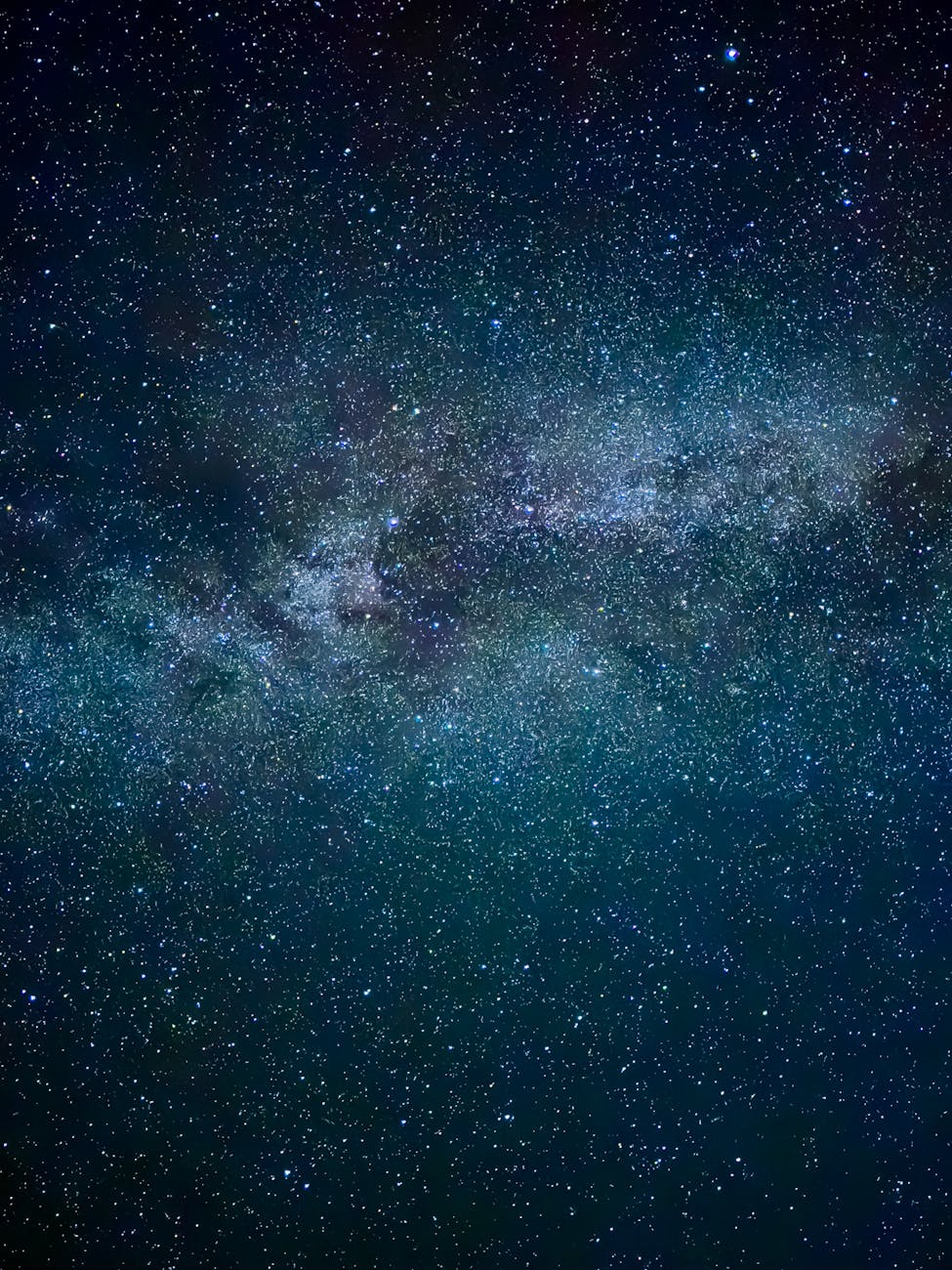
From Earth, the Milky Way is visible as a broad, white, hazy strip arching across the sky. It is about 30 degrees wide and marks the direction of the galactic plane, the flattened region where much of the galaxy’s stars, gas, and dust are concentrated.
The glow comes from unresolved stars. That means the stars are so far away that, without a telescope, human eyes cannot separate them into individual points of light. Instead, they merge into a soft band. Within that band are brighter patches called star clouds, and darker gaps where interstellar dust blocks light from more distant stars.
These dark regions mattered as much as the bright ones. In some traditions, they were not empty spaces at all, but meaningful shapes in the sky. That is one reason the Milky Way became such a vivid source of names and stories.
Its visibility also depends heavily on darkness. Moonlight and artificial light can wash it out, which is why it is far easier to see from rural places than from brightly lit cities. For people living under darker skies in the past, the Milky Way would have been one of the most dramatic features of the night.
The meaning behind the name “Milky Way”
In Western culture, the name “Milky Way” comes from the galaxy’s pale, milky appearance. The term traces back through Classical Latin via lactea and ultimately to the Greek galaxías kýklos, meaning “milky circle.” The Greek root galaxias is also where the modern word “galaxy” comes from.
The name was also tied to mythology. In one Greek story, Zeus places the infant Heracles on Hera’s breast while she sleeps so that he can drink divine milk and become immortal. Hera wakes, pushes him away, and her spilled milk becomes the band of light in the sky. Another version says Athena gives the abandoned Heracles to Hera to feed, but his forcefulness causes Hera to tear him away, producing the same celestial result.
So even the familiar English name is not just a description. It combines visual appearance, language history, and myth.
Birds’ Path: a sky route for migration
One of the most evocative names for the Milky Way is “Birds’ Path.” This name appears in several Uralic, Turkic, and Baltic languages. Northern peoples observed that migratory birds follow the course of the galaxy while traveling through the Northern Hemisphere.
Some languages use close variations on the same idea. In Chuvash, Mari, and Tatar, related names include “Way of the grey goose” or “Way of the wild goose.” In Erzya and Moksha, the image becomes the “Way of the Crane.”
This is a powerful example of how people linked the sky to the natural world around them. The Milky Way was not just something to admire. It was read as a route, a guide, and a repeating pattern tied to the seasonal movement of birds.
Rivers in the sky
Across many cultures, the Milky Way became a river overhead.
In South Australia, the Kaurna people of the Adelaide Plains called it wodliparri, meaning “house river.” That name turns the sky into a lived landscape, something close and familiar rather than distant and abstract.
In many Indian languages, a Sanskrit-based name means “River Ganga of the Sky.” In East Asia, the Chinese name “Silver River” is used widely, including in Korea and Vietnam. In Japan, the Milky Way is also known as the “River of Heaven,” and this name also appears as an alternative in Chinese. In Vietnamese, “River of Heaven” refers to any galaxy.
These river names make intuitive sense. The Milky Way stretches across the sky like a luminous current, flowing from horizon to horizon. Naming it as a river gave people a way to map the heavens using the shapes and forces of life on Earth.
The Emu in the Sky and other dark-sky visions
Not every sky story focused on the bright band itself. Some focused on the dark lanes within it.
The Gomeroi people between New South Wales and Queensland called the Milky Way Dhinawan, the giant “Emu in the Sky” that stretches across the night sky. This image is linked to the dark dust lanes that cut through the glowing band. These are real regions where interstellar dust blocks the light of distant stars.
Such dark cloud constellations were also identified by peoples of the southern hemisphere, including the Inca and Australian Aboriginal peoples. This way of seeing the Milky Way is especially fascinating because it treats the shadowed regions as shapes in their own right, not as missing light.
In astronomy, one especially notable dark region is the Great Rift, and another is the Coalsack. To modern science, these are dust-rich areas that obscure starlight. To skywatchers over generations, they could become animals, pathways, or signs woven into the night.
A road for pilgrims
In Europe, the Milky Way also became a path for human travel.
It was traditionally used as a guide by pilgrims journeying to Santiago de Compostela, giving rise to the name “The Road to Santiago.” The glow of the Milky Way was connected so strongly to pilgrimage that “La Voje Ladee,” meaning “The Milky Way,” was also used for the pilgrimage road itself.
In England, the galaxy was called the Walsingham Way, referring to the shrine of Our Lady of Walsingham in Norfolk. This name was understood either as a guide for pilgrims heading there or as an image of the pilgrims themselves.
These names show how the Milky Way could serve as both symbol and practical orientation point. A bright band arching across a dark sky naturally suggests a road, especially in a world where long-distance travel often depended on close attention to the heavens.
Winter Street, straw, and other everyday metaphors
Some names for the Milky Way reflect seasonal viewing or ordinary materials.
Scandinavian peoples, including Swedes, called it “Winter Street” because the galaxy is especially visible during winter in the Northern Hemisphere. At high latitudes, the Sun’s glow late at night can obscure it during summer, making winter its clearest season.
In parts of West Asia, Central Asia, and the Balkans, names for the Milky Way are connected to the word for straw. In Serbo-Croatian, one of the names is “Kumova slama,” literally “Godfather’s Straw,” alongside a name equivalent to “Milky Way.” These straw-based names may have spread through medieval Arabic transmission, possibly borrowed from Armenians.
These examples show how people often named the Milky Way by comparison: if it looked like spilled milk, a pale river, a road, or scattered straw, then language followed vision.
One sky, many human meanings
The Milky Way is a barred spiral galaxy that contains the Solar System, but long before telescopes revealed its structure, people knew it as a visible feature of the night sky. Galileo first resolved its band of light into individual stars with a telescope in 1610, helping transform it from a mysterious glow into an astronomical object made of countless stars.
Yet scientific understanding did not erase its cultural richness. If anything, it deepened the wonder. The same bright band has been read as Birds’ Path, Silver River, River of Heaven, River Ganga of the Sky, Dhinawan, wodliparri, Road to Santiago, Walsingham Way, Winter Street, and more.
That diversity says something important about human beings as much as about the galaxy itself. People looked up at the same sky, but they connected it to birds, rivers, homes, journeys, shrines, and seasons. The Milky Way became a map of what mattered most.
In that sense, “Many Names, One Sky” is more than a poetic phrase. It is a reminder that the night sky has always been both a physical reality and a cultural mirror. The Milky Way shines across all of them at once.
Sources
Based on information from Milky Way.
More like this
Follow your own knowledge trail across the night sky—download DeepSwipe and explore stories as wide as the Milky Way.