Full article · 7 min read
Micronesia’s Ocean Code: How Stick Charts, Stone Pillars, and Island Knowledge Guided a Seafaring World
Micronesia may be made up of small islands, but its history is anything but small. Long before modern navigation tools, Micronesian peoples were crossing wide stretches of ocean, settling islands, building enduring stone features, and developing systems of power suited to island life. Their world was shaped not only by land, but by the sea between lands.
One of the most striking parts of Micronesian history is the way navigation, settlement, and political life all grew out of close observation of the environment. In a region where islands can be tiny, widely scattered, and vulnerable to storms, surviving and thriving required extraordinary practical knowledge. That is what makes Micronesia’s story so compelling: it is a history written in movement, memory, and material traces that still survive today.
The sea as a map
Micronesian navigators are known for crossing great distances between islands. One of the clearest symbols of this expertise is the traditional stick chart. These charts were used for inter-island navigation and are famous for the way they represent the ocean rather than a land-heavy view of geography.
A stick chart is a hand-made navigational aid built from arranged sticks and shells or other markers. In this context, the sticks indicate relationships in the seascape, while island positions are marked in simplified form. What makes them remarkable is that they reflect knowledge of wave behavior and the location of islands across open water. In a place where travel often meant moving over immense expanses of ocean, that kind of information was essential.
The existence of traditional stick charts also points to a broader truth about Micronesia: navigation was not just about directions. It depended on a deep familiarity with the sea itself. The ocean was not empty space between destinations. It was full of patterns to be understood.
Early settlement in Micronesia
Micronesia began to be settled several millennia ago, though scholars have proposed competing theories about where the first settlers came from and how they arrived. Reconstructing that past is difficult. Many islands are small, archaeological sites can be limited, and storms damage evidence. Settlement patterns have also complicated excavation work. Because of these challenges, linguistic analysis has become especially important for understanding the deeper past.
Even so, archaeology has revealed major clues. The earliest archaeological traces of civilization in Micronesia have been found on Saipan and date to 1500 BCE or slightly earlier. The ancestors of the Micronesians settled there more than 4,000 years ago. That places Micronesia among the early zones of island settlement in Oceania.
This early settlement was a major achievement. It meant reaching and sustaining life on islands spread across the Pacific. In practical terms, that required successful sea travel, knowledge of resources, and the ability to adapt to small and sometimes isolated environments.
The ancient people of the Marianas
The Northern Mariana Islands preserve one of Micronesia’s most vivid early histories. The first people reached these islands sometime between 4000 BCE and 2000 BCE, coming from Southeast Asia. These settlers became known as the Chamorros, the Indigenous people of the Mariana Islands.
The Chamorro language takes its name from them, reflecting the continuity between people, place, and culture. Their history is also visible in the built environment. Ancient Chamorro sites are marked by megalithic ruins, including the famous latte stones.
Latte stones are stone pillars that supported traditional Chamorro houses. A pillar is a vertical support, and in this case the stones formed the base structures for buildings. They are among the best-known archaeological features in Micronesia and remain powerful reminders that even on small islands, communities created substantial and durable architecture.
The Marianas later saw further movement of peoples. In the 1800s, Refaluwasch, also known as Carolinian people, came to the Marianas from the Caroline Islands. This adds another layer to Micronesia’s long history of inter-island connection.
Small islands, larger political worlds
Micronesia’s history was not only about survival on scattered islands. It also involved the growth of organized political and religious life. Over time, a decentralized chieftain-based system developed into a more centralized economic and religious culture centered on Yap and Pohnpei.
A chieftain-based system is one in which authority is organized around chiefs rather than a single modern-style state. Decentralized means power is spread across multiple communities or leaders. Centralized, by contrast, means influence becomes more concentrated in particular places or institutions.
That shift matters because it shows that Micronesian societies were dynamic. They were not static village worlds frozen in time. They changed, reorganized, and built more connected systems. Yap and Pohnpei emerged as especially important centers in this process.
Yap and Pohnpei are island states in what is today the Federated States of Micronesia. Their importance in earlier Micronesian history suggests that some islands became hubs for exchange, leadership, and spiritual life. In an island region, a center of power does not need to be large in area to be highly influential.
Why Micronesia’s past is hard to uncover
Micronesia’s history can feel tantalizingly incomplete. That is not because the region lacked complexity, but because the evidence is often fragile.
Archaeologists face numerous difficulties in Micronesia. The islands are small, which limits the scale of excavations. Settlement patterns can be hard to trace over time. Storm damage can disturb or destroy archaeological remains. All of this means that the material record is harder to recover than in places with larger, more continuous sites.
This is one reason so much of the prehistory of many Micronesian islands, including Yap, is still not known very well. Prehistory refers to the period before written records in a given place. In Micronesia, understanding that era often depends on piecing together clues from archaeology, language, and surviving cultural traditions.
The result is a history that is both rich and elusive. We know enough to see early settlement, skilled navigation, major cultural development, and enduring architecture. But many details remain hidden, scattered like coral fragments after a storm.
Navigation and memory across the Marshall Islands
Micronesian colonists gradually settled the Marshall Islands during the 2nd millennium BCE. A millennium is a period of one thousand years, so this means settlement unfolded deep in the ancient past. Inter-island navigation in the Marshalls was made possible using traditional stick charts.
That detail highlights how practical these charts were. They were not decorative curiosities. They were tools linked to colonization, travel, and sustained connections between islands. In a region of far-flung atolls and ocean passages, navigation knowledge was a foundation of society.
The Marshall Islands example also helps explain why Micronesian navigational traditions are often admired today. Their significance lies not only in ingenuity, but in what they made possible: settlement, exchange, and continuity across one of the most oceanic parts of the world.
Micronesia in the wider map of Oceania
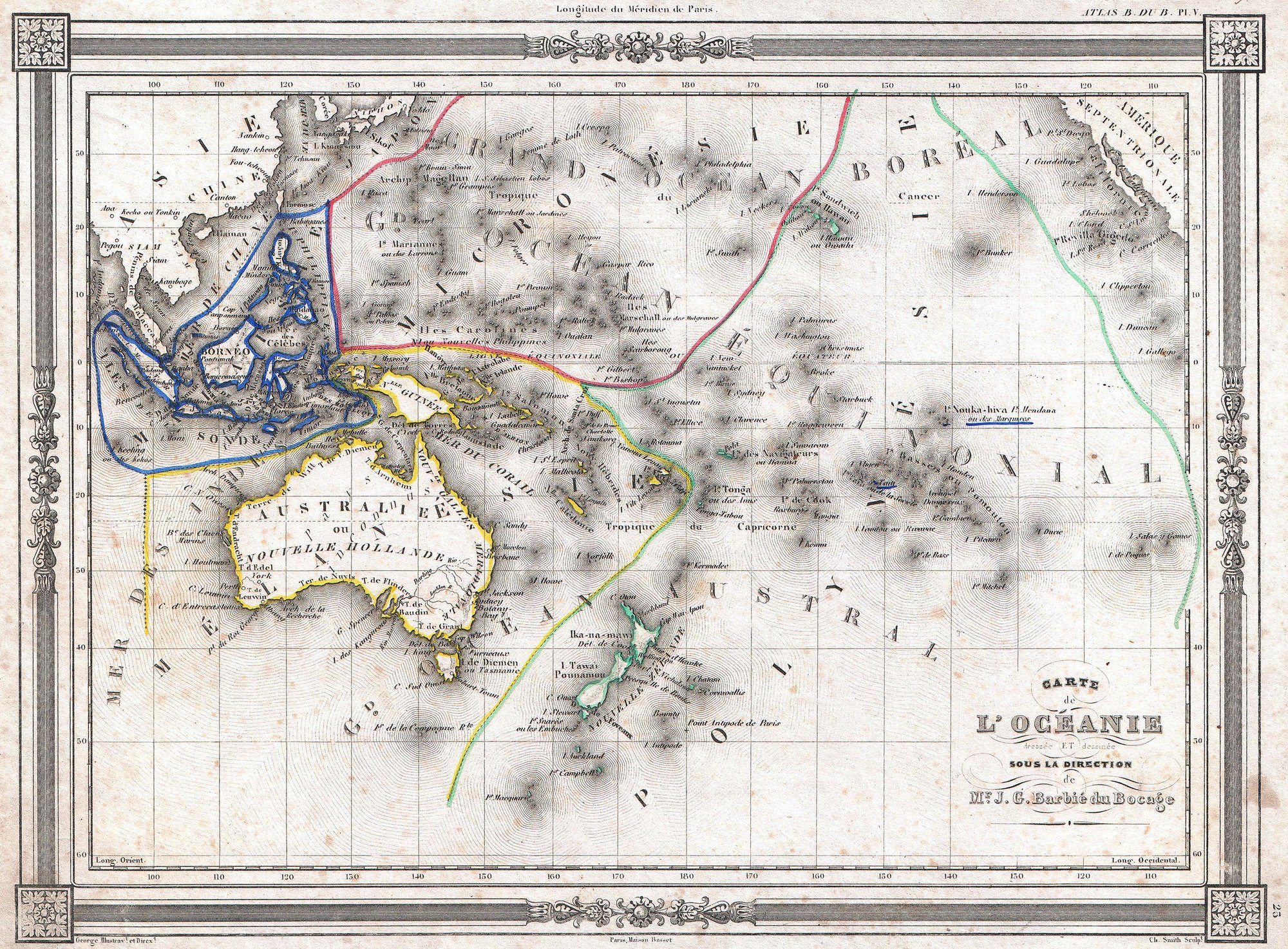
Micronesia is one of the major subregions of Oceania and lies north of the equator and west of the International Date Line. It includes the Mariana Islands in the northwest, the Caroline Islands in the centre, the Marshall Islands to the west, and the islands of Kiribati in the southeast.
Seen this way, Micronesia is not a single island but a vast network of islands spread across the Pacific. That geographic reality helps explain why navigation became so important and why political life developed in distinctive ways. Distance, small land area, and the ocean itself shaped daily life.
Micronesia also sits within a broader Oceanian story in which islands are linked by water rather than separated by it. In this region, the ocean is the connective tissue. That makes Micronesia’s stick charts especially fitting as a symbol: they express a worldview in which reading waves and locating islands are parts of the same cultural intelligence.
Stone and sea
Micronesia’s history can be summed up through two unforgettable images: the stick chart and the stone pillar. One represents motion, memory, and mastery of the sea. The other represents settlement, architecture, and continuity on land.
Together, they reveal a region whose people built sophisticated lives on small islands scattered across a vast ocean. They settled places like Saipan more than 4,000 years ago, left megalithic Chamorro remains such as latte stones, and developed political and religious centers on islands like Yap and Pohnpei. At the same time, much of their deep past remains difficult to reconstruct because storms, small sites, and shifting settlements obscure the evidence.
That tension is part of what makes Micronesia so fascinating. Its history is visible enough to inspire awe, yet mysterious enough to keep inviting questions. Across the Pacific, the sea carried people, knowledge, and connection. And in Micronesia, that ocean knowledge became a code people could sail.
Sources
Based on information from Oceania.
More like this
Navigate your next knowledge voyage with DeepSwipe — download the app and chart a smarter course, one swipe at a time.