Full article · 7 min read
Africa: Cradle of Modern Humans
Human history begins in Africa. Long before cities, writing, or agriculture, the continent was already home to some of the earliest members of the human line. That is why Africa is so often described as the cradle of modern humans: it is widely accepted as the place where Homo sapiens emerged, and it is considered by most paleoanthropologists to be the oldest inhabited territory on Earth.
Paleoanthropologists are scientists who study ancient humans and their relatives through fossils, bones, and other physical evidence. Their work has helped build the picture of Africa as the setting for the deepest chapter of our story.
Where modern humans emerged
Homo sapiens, meaning modern humans, are believed to have originated in Africa roughly 350,000 to 260,000 years ago. That places the birth of our species on the African continent far earlier than the rise of civilization. Before Homo sapiens appeared, Africa was already inhabited by earlier apelike humans and human relatives.
Fossil remains of several early species have been discovered in Africa, including Australopithecus afarensis, dated to about 3.9 to 3.0 million years before present, Paranthropus boisei, dated to around 2.3 to 1.4 million years before present, and Homo ergaster, dated to roughly 1.9 million to 600,000 years before present. These finds are part of the reason Africa holds such a central place in the study of human origins.
The idea that Africa is humanity’s starting point is tied not only to a single fossil or site, but to the continent’s immense time depth. The article of human history in Africa stretches back millions of years, making later migrations out of the continent just one chapter in a much older story.
The great movement out of Africa
After the evolution of Homo sapiens in Africa, the continent was mainly populated by groups of hunter-gatherers. A hunter-gatherer society relies on wild plants and animals rather than farming or herding. These early modern humans later spread beyond Africa in what is often called the Out of Africa II migration, dated to approximately 50,000 years ago.
How did they leave? Several routes are considered possible.
One was across Bab-el-Mandeb, the narrow waterway at the southern end of the Red Sea between Africa and Arabia. Another was the Strait of Gibraltar, the passage linking the Atlantic Ocean and the Mediterranean between Morocco and Spain. A third possible route was the Isthmus of Suez in Egypt, a land bridge connecting Africa and Asia.
Each route matters because it shapes how scientists imagine the movement of people, environments, and timing. The exact pathways are still being pieced together, but the larger picture is clear: modern humans spread from Africa to populate the rest of the globe.
Africa after the migration
The story does not end when some people leave. Africa remained home to many human communities, and the continent continued to develop its own extraordinary diversity.
Evidence points to migrations of modern humans within Africa itself around the same general period, with signs of early settlement in Southern Africa, Southeast Africa, North Africa, and the Sahara. That means the continent was not a static homeland waiting to be departed. It was a dynamic landscape of movement, adaptation, and survival.
At the end of the Ice Ages, estimated to have been around 10,500 BC, the Sahara became a green and fertile valley again. Populations returned from interior and coastal highlands, and rock art in places such as Tassili n'Ajjer depicts a much wetter Sahara with large populations and rich life. Later, however, the climate warmed and dried. By 5,000 BC, the Sahara was becoming increasingly dry and hostile, and around 3500 BC it underwent rapid desertification, meaning a process in which fertile land becomes desert.
These huge environmental shifts mattered deeply for human communities. They influenced where people could live, what they could hunt, and eventually where they could herd animals or farm.
Hunter-gatherers, herders, and early lifeways
Africa remained a mosaic of different societies for a very long time. A mosaic, in this context, means a patchwork of many different groups living in different ways across a vast continent.
The domestication of cattle in Africa appears to have preceded agriculture and existed alongside hunter-gatherer cultures. It is speculated that cattle were domesticated in North Africa by 6,000 BC. That means some African communities were herding animals even while others were still primarily hunting and gathering.
In West Africa, Niger–Congo speakers domesticated plants such as oil palm and raffia palm between 9,000 and 5,000 BC, followed by black-eyed peas, voandzeia or African groundnuts, okra, and kola nuts. Since many of these plants grew in forest environments, polished stone axes were used for clearing forest.
This broader context helps explain what “stayed behind” after early migrations out of Africa: not a single leftover population, but a vast range of societies adapting in different ways to forests, savannas, deserts, and coasts.
The Khoisan and deep human history
Some of the most striking clues to early human dispersals come from southern Africa. Over 150,000 years ago, there was an early dispersal of anatomically modern humans to Southern Africa, associated in the article with the modern-day Khoisan.
The term anatomically modern humans refers to people whose physical form falls within the range of modern Homo sapiens. The Khoisan are indigenous peoples of southern Africa, and the article notes that they have preserved a traditional hunter-gatherer way of life. They are also associated with languages known for click consonants, making them linguistically distinctive as well.
In the Kalahari Desert, the San, often grouped within the broader Khoisan label, are described as indigenous people of southern Africa. The article also notes that they are physically distinct from other Africans and have long been present in this part of the continent.
Central Africa, too, preserves traces of very deep human histories. Pygmies are described as the pre-Bantu indigenous peoples of central Africa, and are thought to have inhabited the region for many millennia, splitting into eastern and western groups around 5,000 years before present.
Together, these examples show that Africa’s role in human origins is not just about one beginning point. It is also about long continuity, with some communities preserving lifeways linked to ancient patterns of adaptation.
Why Africa matters so much to human origins
Africa’s importance comes from both fossils and living diversity. It is considered by anthropologists to be the most genetically diverse continent, a result linked to being the longest inhabited. That matters because long population history often leaves behind a rich and complex record.
The continent’s geography also helps explain its role. Africa straddles the equator and the prime meridian, and its climates range from tropical regions to deserts and even subarctic conditions on its highest peaks. Central and southern areas include savanna plains and dense rainforest, while the north is largely arid. Over long spans of time, these shifting environments created both opportunities and pressures for human adaptation.
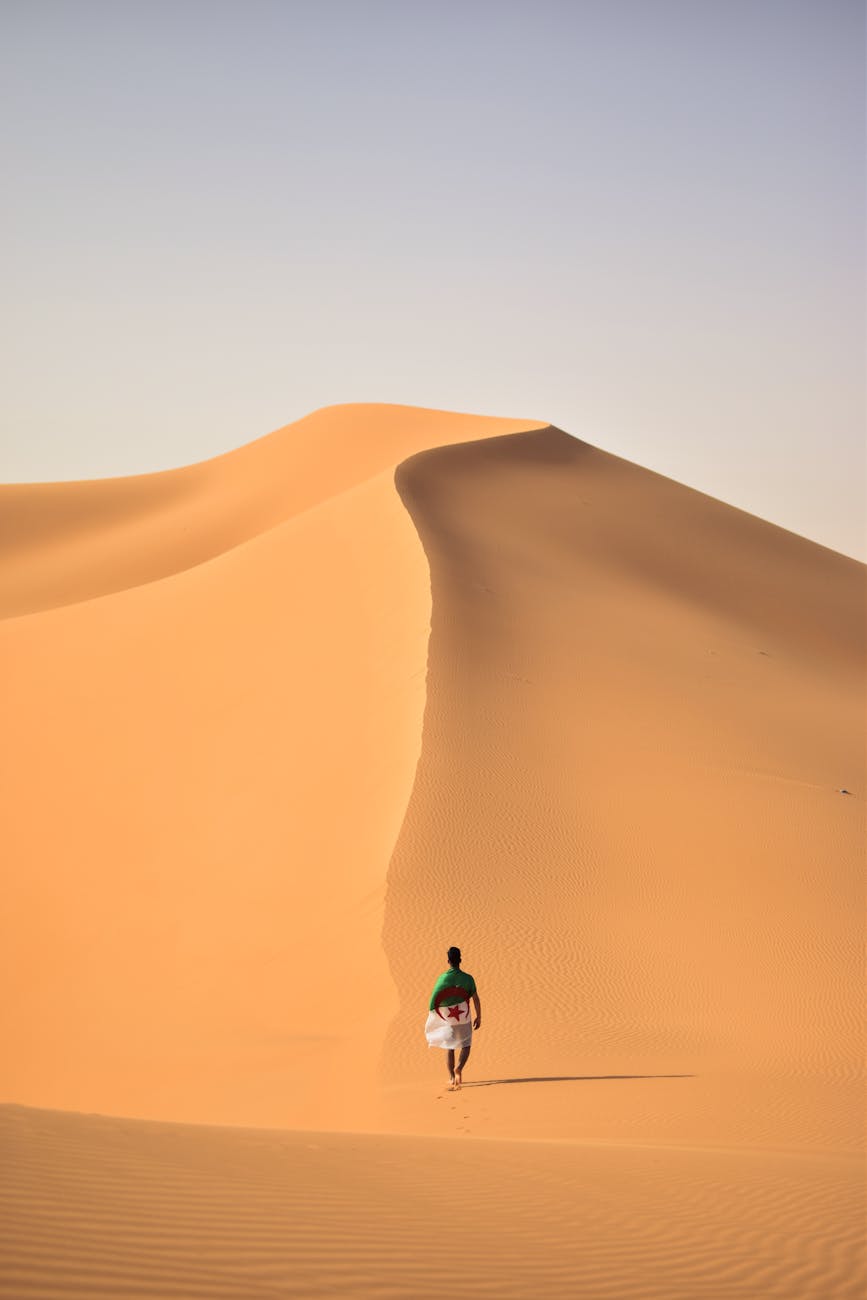
The Sahara itself is a powerful example. It was not always the vast desert many imagine today. At different times it acted as a passageway and place of dwelling during humid phases. In one era it could support populations and movement; in another, it could become a barrier.
That changing environmental backdrop helps explain why human prehistory in Africa is so complex. People moved, split, adapted, and survived in landscapes that were constantly changing over thousands of years.
A beginning shared by everyone
The idea that “everyone’s story starts in Africa” is more than a slogan. It reflects a broad scientific view that modern humans emerged there, that the earliest chapters of human evolution unfolded there, and that later migrations carried African-born Homo sapiens across the globe.
Even the possible exit routes out of Africa tell a dramatic story. Bab-el-Mandeb suggests movement across a narrow seaway. Gibraltar hints at a crossing between continents at the western edge of the Mediterranean world. Suez represents a land connection at Africa’s northeastern corner. These are not just map points. They are possible gateways in one of the biggest journeys in history.
Yet the deeper lesson is not simply that humans left Africa. It is that Africa remained central the entire time: as the birthplace of Homo sapiens, as a continent of early migrations within itself, and as a homeland of communities whose roots stretch back into the oldest human past.
When we look for the beginning of modern humanity, Africa is not one stop along the way. It is the starting ground of the species itself.
Sources
Based on information from Africa.
More like this
Trace humanity’s biggest journey with a thumb swipe — download DeepSwipe and explore the origins of everything, starting in Africa.