Full article · 7 min read
Tardigrade Toolkit: How Water Bears Hunt, Walk, and Thrive
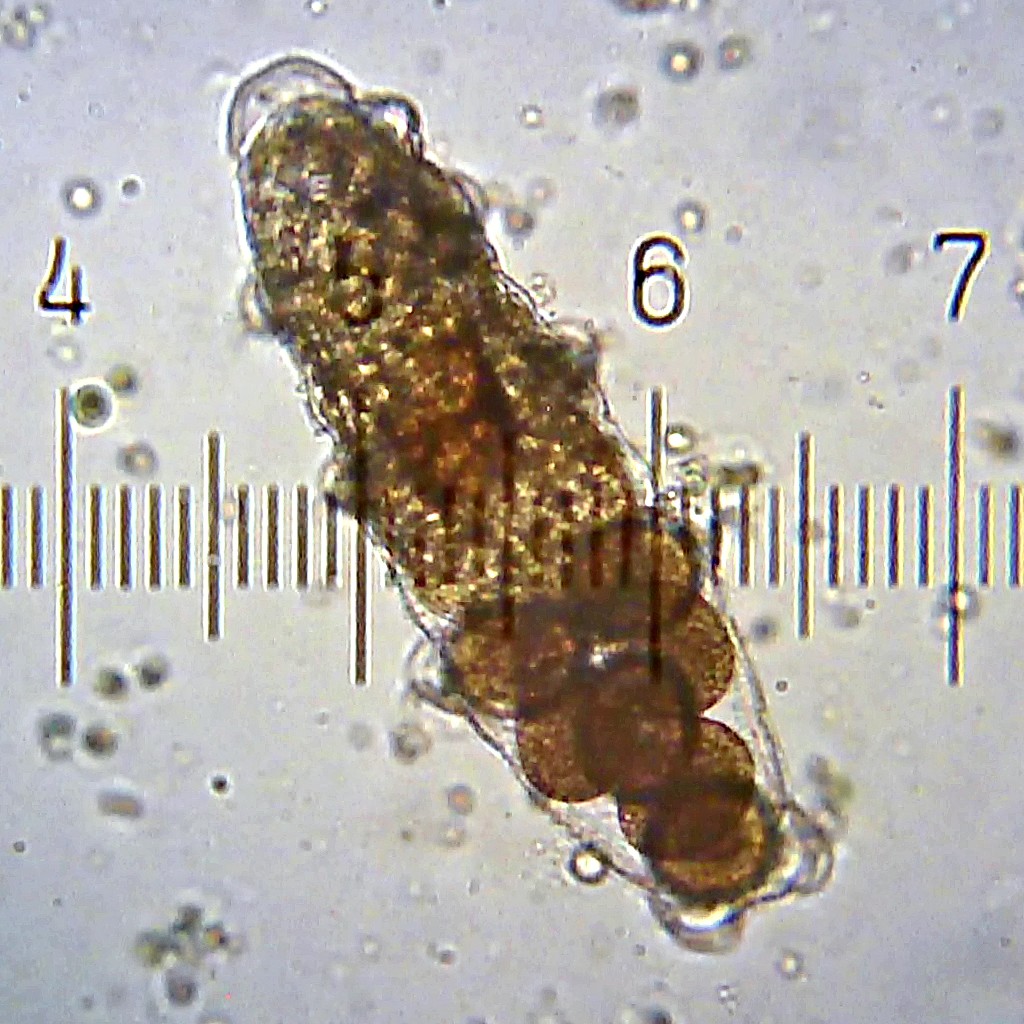
Tardigrades may look like tiny plush toys under a microscope, but their bodies are equipped with surprisingly effective tools for survival and feeding. These eight-legged micro-animals, also called water bears or moss piglets, are usually about 0.5 mm long when fully grown, with a short, plump body and four pairs of legs. Despite their cute appearance and clumsy crawl, they can act as predators, fluid-feeders, and expert climbers in the miniature worlds of moss, soil, freshwater, and the seafloor.
Their success comes from a compact but remarkable body plan: claws for gripping, stylets for piercing, muscles for pumping food, and a locomotion system that lets them stride rather than simply squish around. In places like mosses, where tardigrades can reach densities of over 2 million per square metre, that toolkit really matters.
The tiny mouthparts that make feeding possible
Tardigrades feed by sucking animal or plant cell fluids, or by feeding on detritus, which is dead organic material. To do that, they use one of their most important tools: a pair of stylets.
Stylets are tiny piercing structures that act like microscopic daggers. In tardigrades, these stylets are made of aragonite, a hard mineral form of calcium carbonate. That is the same basic material family found in many shells, which gives some idea of how tough these structures are despite their tiny size.
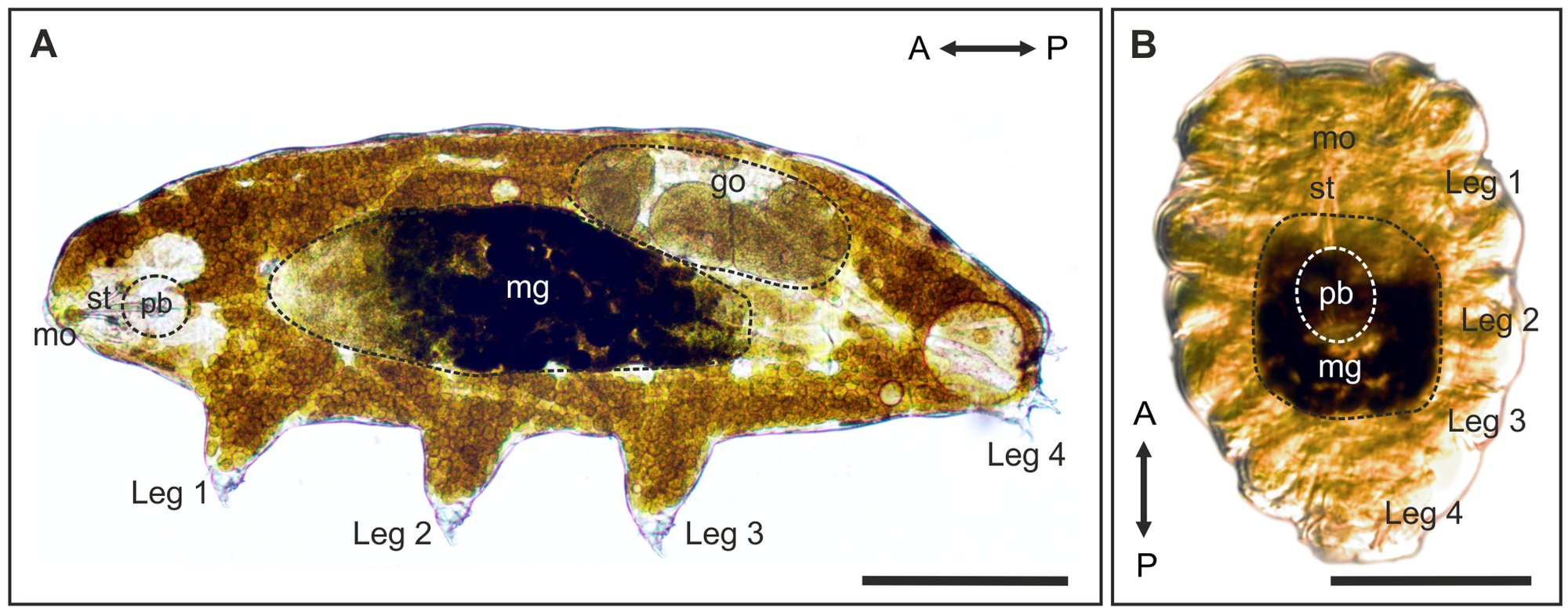
When a tardigrade finds suitable food, the stylets pierce the prey or plant tissue. After that, muscles in the pharynx do the heavy lifting. The pharynx is the muscular region behind the mouth, and in tardigrades it works like a pump, drawing fluids from the pierced cells into the gut. So even though tardigrades are minuscule, their feeding system is not passive at all. It is an active, mechanical setup built for puncturing and suction.
This helps explain how some tardigrades can be predators. They consume prey such as nematodes, which are roundworms commonly found in soil and water, and some species even eat other tardigrades. One example named as predatory is Milnesium lagniappe, which includes other tardigrades among its prey.
Disposable daggers: stylets that get replaced
One especially strange detail of the tardigrade feeding system is that the stylets are not permanent.
Tardigrades have salivary glands that secrete digestive fluid into the mouth, helping begin the process of breaking food down. But these glands do something even more impressive: they produce replacement stylets each time the animal moults.
A moult is when an animal sheds its old outer covering. Tardigrades have a cuticle, an outer body covering made of hardened proteins and chitin, and this cuticle is replaced during moulting. Since the stylets are also renewed, tardigrades effectively get a fresh set of feeding tools with each new outer layer.
That means the same system that protects the body is tied to maintenance of the mouthparts. For an animal living by piercing cells and sucking out fluids, having a renewable set of sharp mouth tools is a major advantage.
A body built for gripping, not sloshing
At first glance, a tardigrade looks soft and squishy, and in some ways it is. Its body cavity is a haemocoel, meaning an open circulatory system filled with colourless fluid. But tardigrade movement does not work mainly by simple fluid pressure.
Instead, tardigrades walk using muscles arranged in antagonistic pairs. That means one muscle pulls in one direction while another pulls in the opposite direction, a setup that allows controlled back-and-forth movement. This is similar in principle to how paired muscles operate in many animals: one contracts while the opposite one provides the counter-action.
These muscle pairs move each leg step by step, allowing the tardigrade to crawl with surprising control. There are also flexor muscles that work against the pressure of the fluid-filled haemocoel. So while fluid pressure plays a role, tardigrades do not merely wobble forward. They stride.
That detail matters because tardigrades often move across textured, uneven, particle-filled habitats. They live among mosses, lichens, leaf litter, soil particles, seaweeds, and sediments on aquatic bottoms. Walking through those environments requires traction.
Why tardigrade claws matter so much
Each tardigrade leg ends in claws or, in some species, sticky pads. Depending on the species, there may be one or more claws on each leg, usually four to eight.
These claws are not decorative. They help prevent the legs from sliding during walking and are used for gripping. In the microscopic landscapes where tardigrades live, gripping is crucial. Surfaces are irregular, damp, crowded, and often slippery. A tardigrade moving through moss or between particles in sediment needs dependable contact points.
That clawed grip likely helps explain how they can be so common in dense moss habitats. Mosses and lichens are among the places where tardigrades are especially prevalent, and their abundance there makes them easy to collect and observe under a low-power microscope.
In marine species, the legs can be telescopic. That means they can extend and retract, which likely helps these species operate in marine environments where movement through water films and around particles may differ from life on land or in freshwater.
Micro-hunters in crowded miniature worlds
Tardigrades are found across an astonishing range of habitats: mountaintops, tropical rainforests, the deep sea, Antarctica, freshwater bottoms, soils, mosses, and lichens. But many species live in damp terrestrial habitats such as moss, liverworts, soil, and leaf litter.
Those habitats can be incredibly crowded at a microscopic scale. In soil, there can be as many as 300,000 tardigrades per square metre. On mosses, densities can exceed 2 million per square metre.
That means a patch of moss is not just a green cushion. It is a packed miniature ecosystem full of tiny animals, microbes, food sources, predators, and prey. In that world, a tardigrade’s feeding apparatus and locomotion system make a big difference.
Some tardigrades feed on plant or animal cell fluids. Some eat detritus. Many are predatory. They consume nematodes and, in some cases, other tardigrades. At the same time, tardigrades are themselves preyed upon by soil arthropods including mites, spiders, and cantharid beetle larvae.
So the tardigrade is not merely a survivor of extreme conditions. It is also an active participant in busy food webs, hunting and being hunted in spaces that are easy for humans to overlook.
Small body, surprisingly complex design
Although tardigrades are made up of only about 1000 cells, their bodies are highly organized. They have a nervous system with a brain-like cerebral ganglion, nerve cords, and ganglia associated with each pair of legs. They also possess sensory structures including eyespots and antenna-like clavae that may function as chemoreceptors, helping them sense chemical cues.
That coordination supports their feeding and movement. To walk with multiple leg pairs, grip surfaces, locate food, and operate piercing mouthparts and a muscular pump, even a tiny animal needs reliable control.
Their compact design becomes even more impressive when you remember that tardigrades live in habitats ranging from damp moss cushions to sea bottoms and can include predatory species. Their toolkit is not just a collection of odd features. It is an integrated system.
More than just “indestructible”
Tardigrades are famous because some species can survive extreme temperatures, dehydration, radiation, starvation, lack of oxygen, and even exposure to space. But their everyday success is just as fascinating.
The same animal known for entering a cryptobiotic tun state when conditions become dry is also, in ordinary life, a crawler with gripping claws, a piercer armed with mineral stylets, and a fluid-feeder powered by muscular suction. Its cuticle is moulted and renewed. Its feeding parts are replaced. Its legs step with controlled motion rather than aimless squishing.
That combination helps explain why tardigrades have become so popular with students, amateur scientists, and anyone who has ever peered into a scrap of moss and discovered a whole hidden world moving inside it.
Why the tardigrade toolkit is so memorable
What makes tardigrades captivating is the contrast. They are tiny, clumsy-looking, and almost cartoonishly cute. Yet they are also equipped like serious micro-animals.
They carry mineral stylets for piercing. They pump food with pharyngeal muscles. Their salivary glands make digestive fluid and replacement mouthparts. Their antagonistic muscles move their legs in controlled steps. Their claws keep them anchored as they walk. And in marine species, those legs can even be telescopic.
In other words, the water bear is not just durable. It is engineered for life in the microscopic rough-and-tumble of moss, soil, and sediment.
Sources
Based on information from Tardigrade.
More like this
Claw into tiny worlds and big ideas — download DeepSwipe and let your curiosity walk like a water bear.