Full article · 8 min read
Earth’s Plate Tectonics Time Machine
Earth looks solid and permanent, but its outer shell is anything but still. The ground beneath oceans and continents is slowly on the move, shifting so gradually that humans rarely notice it directly. Yet over immense spans of time, this motion reshapes the planet. Mountains rise, volcanoes erupt, ocean basins open, trenches deepen, and earthquakes mark the boundaries where giant pieces of Earth grind past one another.
This is the world of plate tectonics: the long, slow recycling system that constantly rebuilds Earth’s outer layer. It is one of the biggest reasons our planet is geologically dynamic, and it helps explain one of Earth’s strangest contrasts: why the seafloor is comparatively young while parts of the continents preserve rocks from more than 4 billion years ago.
Earth’s moving outer shell
Earth’s rigid outer layer is called the lithosphere. It is made from Earth’s crust together with the cold, rigid top of the upper mantle. Rather than forming one unbroken shell, the lithosphere is split into tectonic plates.
These plates are rigid segments that move relative to one another. Their motion happens at three main kinds of boundaries:
- convergent boundaries, where two plates come together
- divergent boundaries, where two plates pull apart
- transform boundaries, where two plates slide laterally past one another
These interactions are responsible for many of Earth’s most dramatic surface features. Along plate boundaries, earthquakes can occur, volcanoes can form, mountain building can take place, and oceanic trenches can develop.
The plates move on top of the asthenosphere, a part of the upper mantle that is solid but less viscous, meaning it can slowly flow. In simple terms, the asthenosphere is softer and more mobile than the rigid rock above it, allowing the plates to ride over it.
Earth recycles its “skin”
A useful way to think about plate tectonics is as a recycling system for the planet’s outer surface.
At divergent boundaries, mantle material rises upward. This upwelling creates mid-ocean ridges, enormous underwater mountain chains that stretch across the globe. At these ridges, new oceanic crust forms.
At convergent boundaries, the opposite happens. Oceanic crust sinks beneath the leading edge of another plate in a process called subduction. This crust descends back into the mantle, where it is eventually recycled.
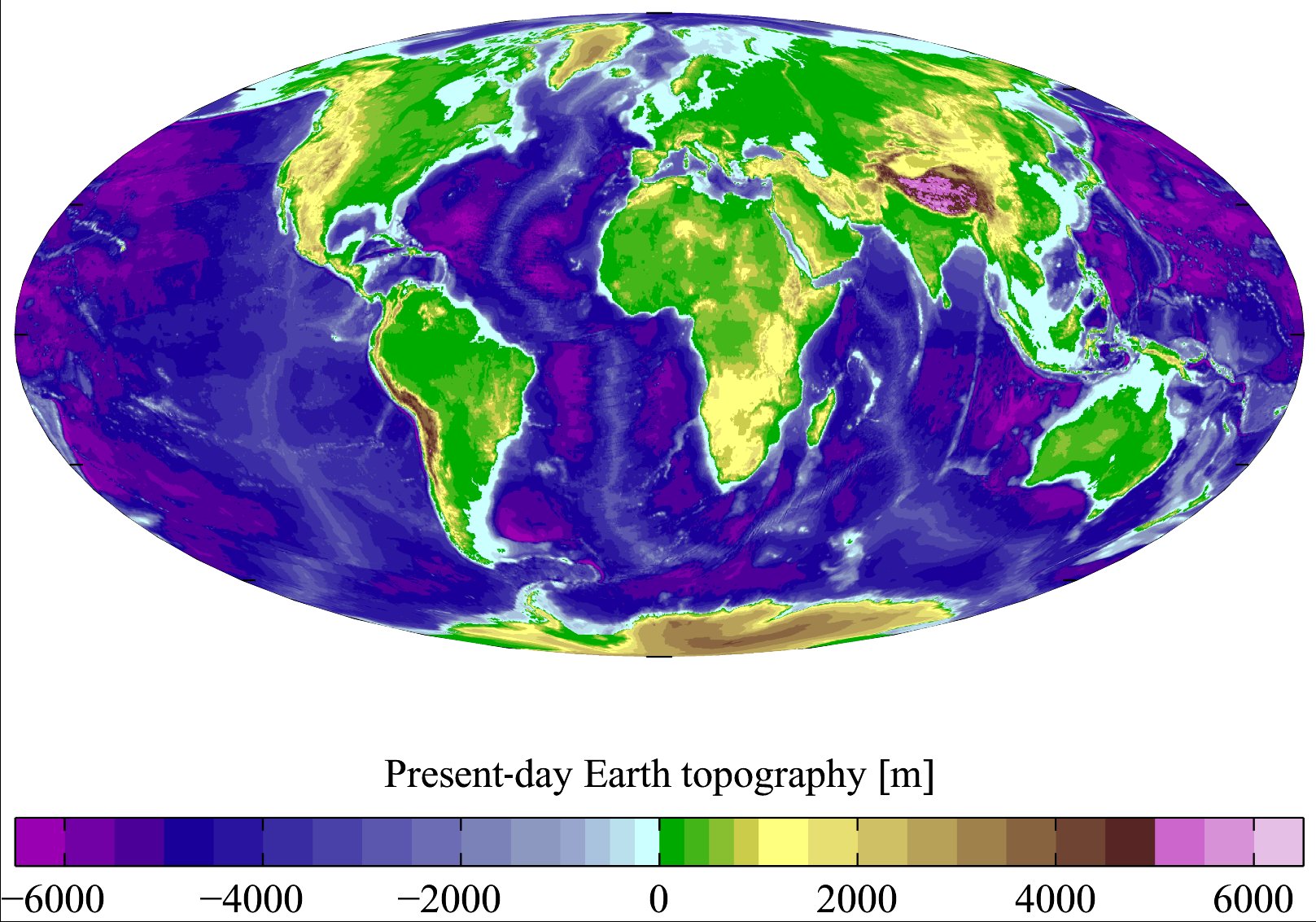
Together, these two processes continuously renew the ocean floor. New crust is created at mid-ocean ridges, while older crust is consumed at trenches. That is why the ocean floor does not preserve the same vast age record as the continents do.
The system is powered by Earth’s internal heat. Heat left over from Earth’s formation, along with heat produced by radioactive decay, drives convection within the planet. Some of this heat is transferred upward by mantle plumes and by mantle upwelling associated with mid-ocean ridges. In the long run, plate tectonics is part of how Earth loses heat from its interior.
Mid-ocean ridges: where new crust is born
Mid-ocean ridges are one of the key engines of plate tectonics. They are long undersea mountain systems formed where plates are pulled apart and fresh crust rises into place.
Because new crust is continuously added there, the seafloor near a ridge is relatively young. As more material emerges, older seafloor is pushed away from the ridge. Over time, it travels across the ocean basin until it may eventually be subducted at a trench.
This helps explain a striking geological fact: most of the ocean floor is less than 100 million years old. In the Western Pacific, the oldest oceanic crust is estimated to be about 200 million years old, which is ancient by human standards but young compared with the oldest continental materials.
So the seafloor is not a static archive. It is more like a conveyor belt that is constantly being manufactured, moved, and destroyed.
Trenches: where old seafloor disappears
Oceanic trenches are deep features associated with convergent plate boundaries. They form where one plate bends and descends beneath another.
This is where old seafloor dives back into Earth. As oceanic crust is subducted, it is recycled into the mantle. The article’s big geological punchline follows from this process: if old seafloor is continually destroyed, the deep ocean floor cannot preserve the oldest chapters of Earth’s surface history.
That loss of old oceanic crust is one reason the continents are so important. They hold much of the surviving record of deep time.
Continents: Earth’s long memory
Continental crust behaves differently from oceanic crust. While oceanic crust is efficiently recycled, continental crust can survive for extraordinary lengths of time.
The oldest dated continental crust is 4,030 million years old. Even more remarkably, zircons preserved within very ancient sedimentary rocks give ages up to 4,400 million years, showing that at least some continental crust existed very early in Earth’s history.
This is why the phrase deep time fits so well. Deep time refers to the immense spans of geological history measured not in centuries or even millennia, but in millions and billions of years. Continental crust is one of the planet’s great memory banks, storing evidence from near the beginning of Earth itself.
The early formation of crust was complex. As Earth’s molten outer layer cooled, the first solid crust formed. Later, more continental-style crust formed through partial melting of earlier material. Scientists have proposed different models for how this continental crust accumulated: one suggests relatively steady growth through time, while another suggests rapid early growth during the Archean. These ideas may be reconciled by large-scale recycling of continental crust during the early stages of Earth’s history.
Supercontinents come and go
Plate tectonics does not just shuffle coastlines. Over hundreds of millions of years, it reorganizes the entire world map.
Tectonic forces have repeatedly gathered continental crust together into supercontinents and then broken them apart again. One of the earliest known supercontinents, Rodinia, began to break apart about 750 million years ago. Later came Pannotia, between 600 and 540 million years ago. Then came Pangaea, which began to break apart about 180 million years ago.
This means the arrangement of continents we know today is only a temporary snapshot. Earth’s geography is not fixed. It is one frame in a film that has been running for billions of years.
That is the “time machine” aspect of plate tectonics: by reading rocks, crust, ocean basins, and plate boundaries, scientists can reconstruct lost worlds.
Why plate tectonics makes Earth so active
Plate motion helps create many of the features people most strongly associate with a living planet.
Mountain ranges can form where plates converge. Volcanoes occur along certain plate boundaries and in hotspots linked to mantle plumes. Earthquakes happen where rigid plates build up stress and then suddenly slip.
These are not isolated events. They are surface expressions of deeper planetary processes. Earth’s crust is not merely sitting on a static interior; it is linked to a dynamic planet with an active mantle and a heat-driven engine below.
This activity is part of what makes Earth different in feel from a dead, frozen world. The crust is continually shaped by internal tectonic processes as well as by weathering, erosion, water, wind, ice, temperature, and biological activity.
Young oceans, old continents
The contrast between oceanic and continental crust is one of the most elegant consequences of plate tectonics.
Oceanic crust is predominantly basaltic beneath the ocean-floor sediments and is constantly recycled. Continental crust includes lower-density materials such as granite, sediments, and metamorphic rocks, and large portions of it can persist for immense spans of time.
Because oceanic crust is renewed and destroyed, the seafloor mostly records relatively recent geological history. Because continental crust survives far longer, it preserves some of Earth’s oldest surviving materials.
That is why Earth’s oceans appear geologically young, while the continents preserve traces of the distant past. One part of the planet is continuously rewritten; another keeps fragments of the earliest chapters.
Why this matters beyond geology
Plate tectonics is not just a story about rocks. It helps shape climate, habitats, and resources.
Earth’s surface environment is continually reshaped by tectonic activity. The creation of mountains affects topography. Volcanoes and crustal processes alter the surface. Plate interactions help form ocean basins, trenches, and ridges that influence the shape of the planet.
The crust also contains mineral ore bodies formed through processes tied to magmatism, erosion, and plate tectonics. These include concentrations of metals and other elements that humans extract by mining. Fossil fuels are obtained from Earth’s crust as well, though they are non-renewable on human timescales.
On the broadest scale, plate tectonics is part of why Earth is a restless world rather than a frozen shell. It links the interior to the surface, the ancient past to the present, and local landscapes to planetary change.
A planet written in motion
Earth formed about 4.5 billion years ago, and since then its crust has never stopped changing. The ocean floor is renewed so efficiently that most of it is younger than 100 million years. Meanwhile, parts of the continents preserve crust older than 4 billion years.
That contrast tells a profound story. Earth is both an archive and a recycling machine. It destroys and preserves, erases and remembers.
Plate tectonics is the mechanism behind that paradox. It is the reason Earth can forge mountain chains, trigger earthquakes, open oceans, consume seafloor, and still preserve fragments from almost the beginning of planetary history. If you want to understand why our planet looks the way it does, why its surface is so varied, and why some rocks are unimaginably old while others are geologically fresh, plate tectonics is one of the most powerful explanations we have.
It is, in every sense, Earth’s time machine.
Sources
Based on information from Earth.
More like this
Swipe through deep time without waiting 100 million years — download DeepSwipe and let your curiosity drift with the plates.