Full article · 8 min read
How Does the Milky Way’s Spiral Structure Work?
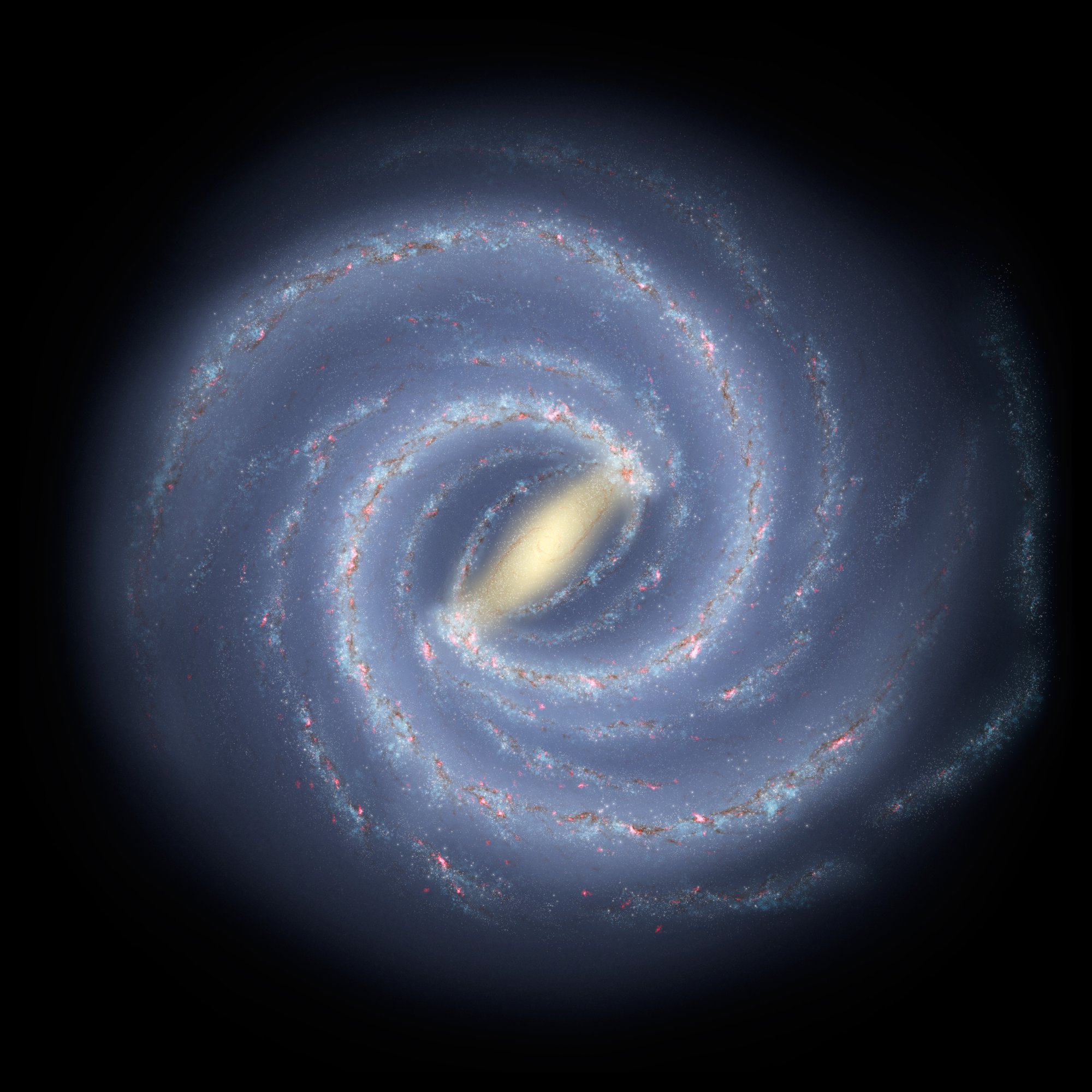
The Milky Way looks like a classic spiral galaxy from the outside, but its spiral arms are far from simple. Instead of a neat pinwheel with evenly drawn lanes, our galaxy seems to have a more tangled design: arms that branch, merge, and twist, a local spur where the Sun resides, and evidence that different parts of the spiral pattern may behave in different ways.
That is what makes the Milky Way’s spiral-arm mystery so interesting. Even after centuries of studying the hazy band across the sky and decades of modern observations, astronomers still do not fully agree on the exact structure of the arms.
Why the Milky Way’s arms are hard to map
One big challenge is perspective. We are inside the Milky Way, not viewing it from afar. From Earth, the galaxy appears as a hazy band of light arching across the night sky. That band is formed by countless unresolved stars and other material concentrated along the galactic plane.
Because we are embedded within the galactic disk, figuring out the Milky Way’s large-scale shape is much harder than looking at a distant spiral galaxy in a telescope image. Dust also gets in the way. Interstellar dust can block light from distant stars, creating dark regions such as the Great Rift and making parts of the galaxy difficult to trace in visible light.
Even so, astronomers can still piece together the pattern by looking at different kinds of objects. Old stars, gas, dust, star-forming regions, and molecular clouds each reveal different parts of the galactic structure. And that is where the mystery begins.
Two major stellar arms, but four arms in gas and young stars
A key puzzle is that different tracers tell different stories.
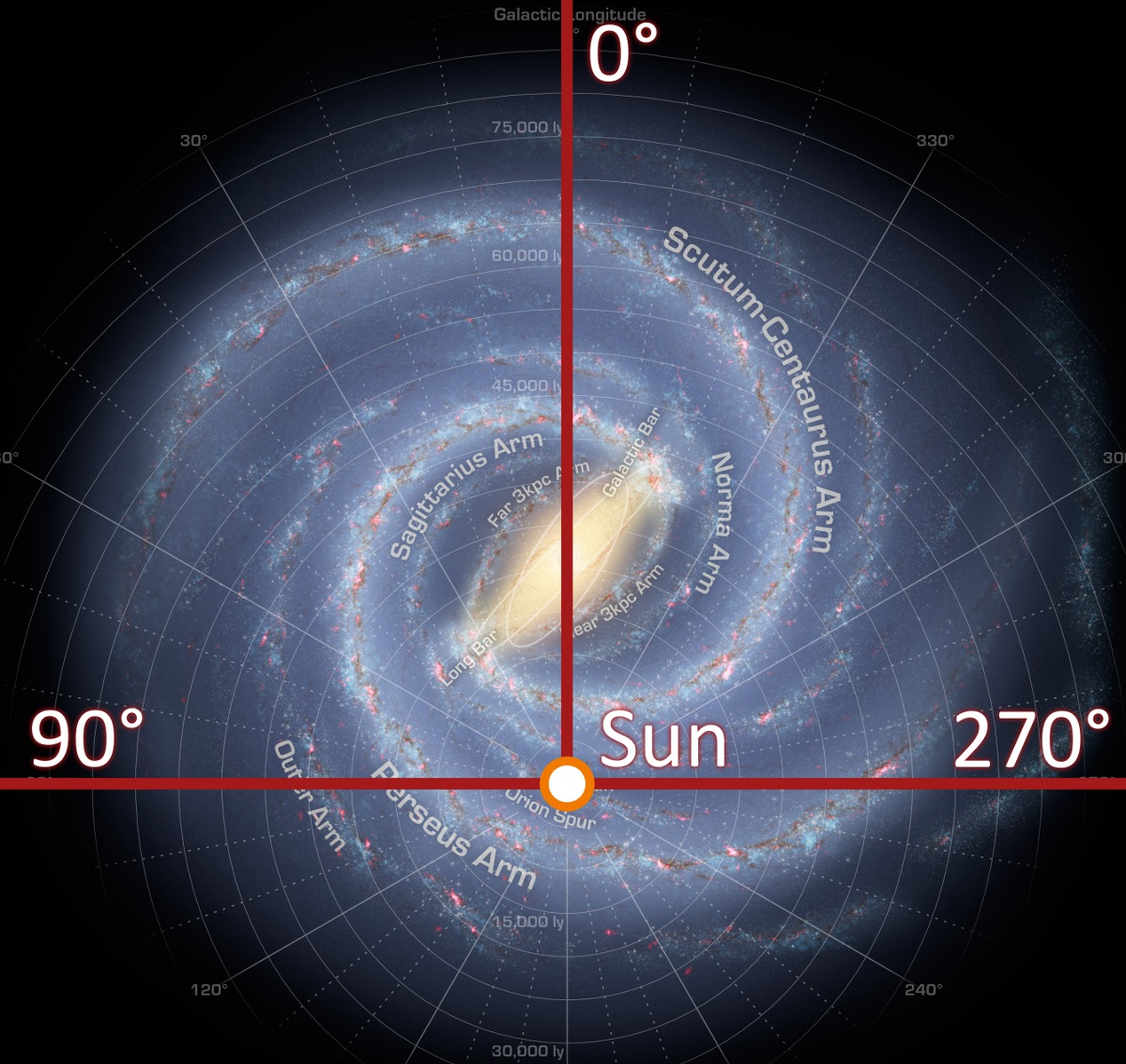
Observations in near-infrared light found the predicted overabundance of red giant stars in the Scutum–Centaurus Arm, but not in the Carina–Sagittarius Arm. In fact, the Scutum–Centaurus Arm contains about 30% more red giants than expected if no spiral arm were present. That result suggests the Milky Way may have only two major stellar arms: the Perseus Arm and the Scutum–Centaurus Arm.
But the picture changes when astronomers map young stars and star-forming regions. Their distribution matches a four-arm description of the Milky Way. In other words, the galaxy seems to show two spiral arms when traced by old stars, yet four when traced by gas and young stars.
That mismatch remains unexplained.
This is not just a technical detail. It points to something deep about how spiral structure forms and evolves. The arms seen in old stars may not line up perfectly with the arms outlined by gas and new star formation. The visible pattern depends on what exactly you choose to map.
The Milky Way’s spirals are not clean geometric lines
It is tempting to imagine spiral arms as perfect, smooth curves. But the Milky Way does not appear to follow a tidy blueprint.
Current research says there is no full consensus on the exact nature of the galaxy’s arms. Perfect logarithmic spirals only crudely describe features near the Sun because galaxies can have arms that branch, merge, and twist unexpectedly. There is also a degree of irregularity in the structure.
This matters because it means the Milky Way may not be built from a few simple, permanent lanes. Its spiral pattern could be more dynamic and more uneven than textbook diagrams suggest.
Estimates of the pitch angle of the arms — the angle that describes how tightly wound a spiral is — range from about 7° to 25°. That wide range reflects just how uncertain the structure still is.
Where the Sun fits in: the Orion Arm
The Solar System is located about 27,000 light-years from the Galactic Center, on the inner edge of the Orion Arm. The Orion Arm is not one of the Milky Way’s grand major arms. Instead, it is described as a spur or local arm.
A spur is a smaller branch-like feature connected to a larger spiral pattern. That means the Sun is not sitting in the middle of a dominant arm like Perseus or Scutum–Centaurus, but in a more local structure.
This is one reason the Milky Way’s map looks messy from our vantage point. Living inside a local spur makes it harder to infer the galaxy’s full design. It also supports the idea that features like the Orion Arm may not be unusual. Similar branch-like structures may exist elsewhere in the Milky Way.
Special features near the center
The spiral story becomes even more complicated closer to the Galactic Center.
The Milky Way is a barred spiral galaxy, meaning it has a bar-shaped central region. Outside the gravitational influence of that bar, the gas, dust, and stars in the disk are organized into spiral arms. The central region also includes unusual structures such as the Near 3 kpc Arm and the Far 3 kpc Arm.
The Near 3 kpc Arm was discovered through 21 centimeter radio measurements of atomic hydrogen. It was found to be expanding away from the central bulge at more than 50 km/s. The Far 3 kpc Arm, discovered later, lies in the first galactic quadrant about 3 kpc from the Galactic Center.
These inner structures show that the Milky Way’s central zones are not just a simple launch point for symmetrical arms. They are active, asymmetric, and still being sorted out.
Did collisions help shape the spiral pattern?
One intriguing idea is that the Milky Way’s spiral structure may have been influenced by repeated encounters with the Sagittarius Dwarf Elliptical Galaxy, a small companion galaxy now interacting with the Milky Way.
A simulation published in 2011 suggested that the Milky Way may have obtained its spiral arm structure as a result of repeated collisions with the Sagittarius Dwarf Elliptical Galaxy. In other words, the arms may preserve a kind of gravitational fingerprint from past interactions.
This is a powerful idea because galaxies are not isolated. The Milky Way has several satellite galaxies, and it is currently accreting material from small companions, including the Large and Small Magellanic Clouds through the Magellanic Stream. Interactions can disturb the disk, trigger ripples, and reshape large-scale structure.
So the Milky Way’s arms may not be purely self-generated patterns. At least part of their form could be the aftermath of cosmic encounters.
Could the Milky Way have two spiral patterns at once?
Another possibility is even stranger: the galaxy may host two different spiral patterns simultaneously.
One proposed scenario suggests an inner pattern formed by the Sagittarius Arm that rotates quickly, while an outer pattern formed by the Carina and Perseus arms rotates more slowly and is more tightly wound. In this picture, the outer pattern would create an outer pseudoring.
A pseudoring is a ring-like structure formed when spiral arms wrap around the disk and nearly connect. It is not a perfect ring, but it can look ring-like on large scales.
The proposed link between the inner and outer patterns is the Cygnus Arm. If true, this would mean the Milky Way is not governed by a single, uniform spiral rhythm. Different parts of the galaxy’s structure may rotate or evolve differently.
That could help explain why mapping the galaxy produces mixed results. A fast inner pattern and slower outer one would make the Milky Way less like a frozen picture and more like overlapping motions in a complex system.
The outer ring and the warped disk
Beyond the major spiral arms, the Milky Way includes the Monoceros Ring, a ring of gas and stars thought by some to have been torn from other galaxies billions of years ago. However, some researchers have argued that the Monoceros structure may instead be an overdensity caused by the flared and warped thick disk of the Milky Way.
That uncertainty mirrors the broader spiral-arm puzzle: features in the Milky Way are often difficult to classify cleanly. Is something a ring, a wrapped arm, debris from an interaction, or part of a warped disk? Sometimes the answer is still under debate.
The disk itself is warped along an S-shaped curve, which adds another complication to any simple map of the galaxy.
A galaxy still being decoded
The Milky Way contains between 100 and 400 billion stars, and its visible disk stretches across tens of thousands of light-years. It is vast, structured, and still not fully understood. The old idea of a galaxy with a few elegantly drawn spiral arms is giving way to a more nuanced picture: a barred spiral with major stellar arms, gas-rich arm segments, local spurs, inner expanding arms, possible overlapping patterns, and signs of past interactions.
What makes the spiral-arm mystery compelling is not just that some details remain uncertain. It is that the uncertainty reveals how alive the galaxy is as a scientific problem. The Milky Way is not merely the backdrop of the Solar System. It is a changing system with structure that still challenges astronomers trying to reconstruct it from within.
So if you have ever looked up at the pale band of the Milky Way and imagined a clean spiral shape, the truth may be even better: our galaxy is weirder, more irregular, and more dynamic than a simple diagram can show.
Sources
Based on information from Milky Way.
More like this
Swipe through the galaxy’s weirdest mysteries — download DeepSwipe and explore the Milky Way one spiral at a time.