For centuries, the biggest map of the universe in learned astronomy placed Earth at the center. That was the geocentric model, most famously associated with Ptolemy, whose description of the Solar System remained accepted well into the early Renaissance. Then came a radically different idea: heliocentrism, the view that the Sun sits at the center and the planets orbit around it.
It sounds obvious to many modern readers, but this change was anything but quick. In fact, the path from Ptolemy to Galileo was a long struggle involving ancient ideas, mathematical debates, and new instruments that changed what people could see. The eventual shift to heliocentrism was not a single eureka moment. It was a slow overturning of an old cosmic order.
Watch the story on DeepSwipe
The older universe: Ptolemy’s geocentric system
In a geocentric model, Earth is treated as the center of the universe, with the Sun, planets, and stars moving around it. Ptolemy’s great astronomical work, the Almagest, presented a geocentric description of the Solar System that proved enormously influential. It was accepted through the early Renaissance and became the dominant framework for understanding the heavens.
This was not just a random preference. Ptolemy’s system was a serious attempt to account for what astronomers observed in the sky. For generations, it offered a structured and workable picture of planetary motion.
One technical feature in this tradition was the equant. The equant was a point offset from the true center of a planet’s orbit, used in Ptolemy’s model to better match the changing observed speeds of planets. That may sound abstract, but the basic idea is simple: it was a mathematical device that helped the model line up more closely with what astronomers actually saw.

Aristarchus: the early voice for a Sun-centered cosmos
Long before the Renaissance, the Greek astronomer Aristarchus of Samos proposed a heliocentric model in the 3rd century BCE. In his picture, the Sun stood at the center and all the planets orbited it.
That proposal was extraordinary for its time. Yet it was widely rejected. One reason given was that it was believed to violate the laws of physics. As a result, Aristarchus’s idea did not become the standard view. Instead, geocentric astronomy continued to dominate learned thought for many centuries.
This is one of the most fascinating turns in the history of science: a remarkably bold idea appeared early, but lacked the conditions needed to win acceptance.
Copernicus revives the Sun-centered model
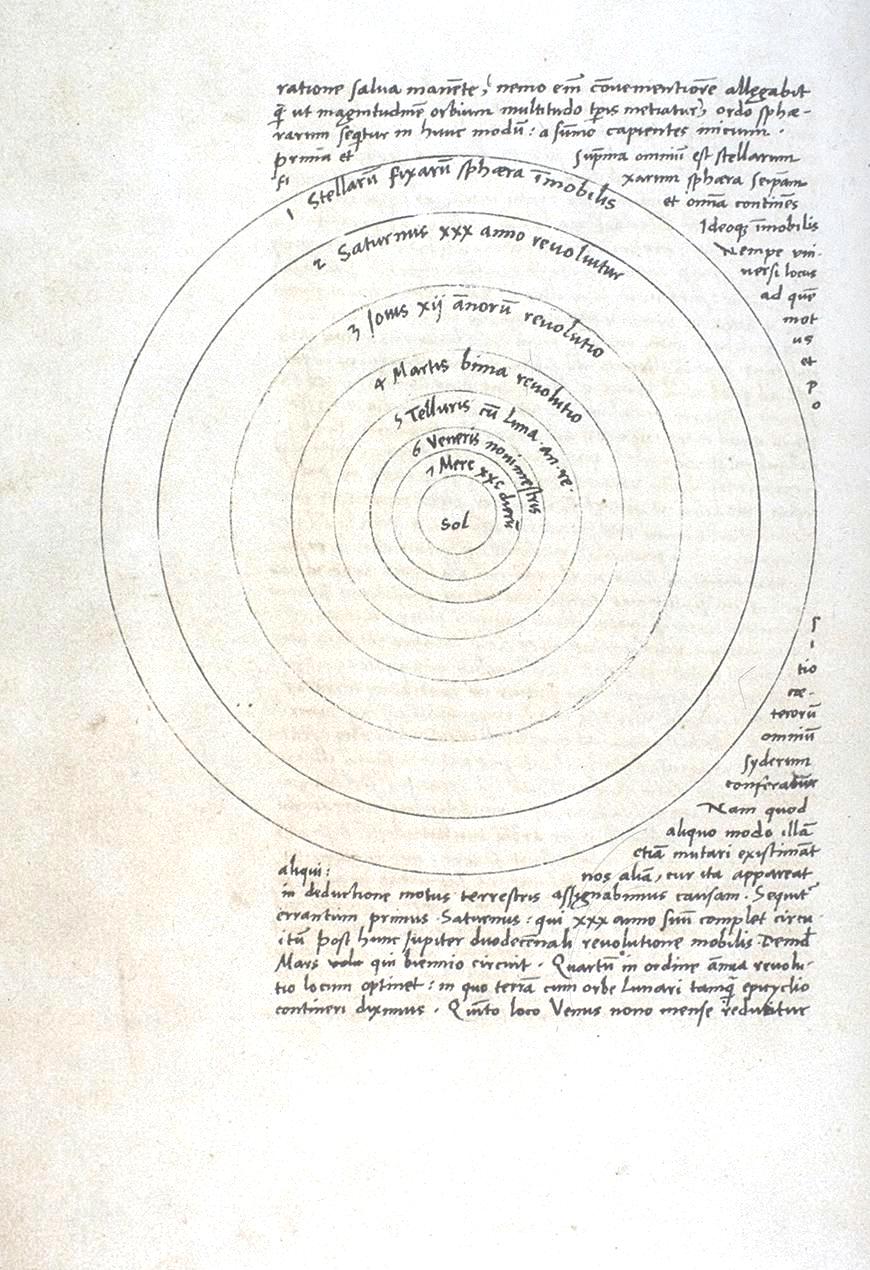
In the 16th century, Nicolaus Copernicus formulated a heliostatic model of the Solar System. In this arrangement, the Sun was positioned near the center of the universe and remained motionless, while Earth and the other planets orbited it in circular motions at uniform speeds, modified by epicycles.
Epicycles were extra circular motions added into planetary models to account for the way planets seemed to wander through the sky. Even though heliocentrism is often imagined as a clean and simple replacement for older astronomy, Copernicus still used a fairly elaborate mathematical system.
His model directly challenged the dominant geocentric system of Ptolemy. But challenging an old framework is not the same as replacing it.
Why Copernicus did not win immediately
Copernicus is often remembered as the figure who changed astronomy forever, but his model did not instantly sweep the field. In fact, it did not displace Ptolemy’s system.
One reason his work drew attention was that it eliminated the equant. For 16th-century astronomers, this was a major achievement. The removal of the equant mattered because it addressed a problematic feature in the older model that many specialists disliked.
Yet that success was not enough. Copernicus’s model still failed to replace Ptolemy’s in practice. According to the historical account, his system never displaced the older one at the time. That is a reminder that in science, better ideas do not always win immediately. Sometimes a new model is admired for certain improvements while still failing to overthrow the established framework.
The lens changes the argument
What Copernicus began, Galileo helped push forward. About seventy years after Copernicus, Galileo’s telescopic observations of 1610 helped drive Ptolemy’s model out of favor.
This marks one of the great turning points in scientific history. The telescope was not just a new gadget. It was a tool that transformed astronomy by extending human sight. Suddenly, the heavens could be examined in a new way.
More broadly, developments in optics played a major role in the Renaissance and in the rise of new science. Advances in the study of light and vision contributed to technologies such as the camera obscura and the telescope. The telescope, in particular, became crucial to astronomy because it made new observations possible—observations that older systems had not been built to handle.
Galileo’s work sits within that larger transformation. Astronomy was no longer only a matter of inherited models and mathematical tradition. It was becoming increasingly tied to instrument-based observation.
Galileo and the fall of the old cosmic order
Galileo made major contributions to astronomy, physics, and engineering. In the story of heliocentrism, his importance lies in the fact that his telescopic observations helped weaken confidence in Ptolemy’s geocentric system.
That did not mean heliocentrism became instantly uncontested. But it did mean the old model began to lose its grip. A worldview that had endured for centuries was now vulnerable because new evidence could be brought to bear through a new instrument.
This is a classic example of how scientific change often works. A theory may survive for a long time not because no one can imagine an alternative, but because there is not yet enough persuasive evidence to push the alternative into dominance. Galileo helped provide that push.
The cost of speaking too openly
The triumph of heliocentrism was not only an intellectual story. It was also a human one.
Galileo became persecuted after Pope Urban VIII sentenced him for writing about the heliocentric model. He was tried and placed under house arrest. That punishment has become one of the most famous symbols of the tension that can arise when new ideas challenge powerful established views.
His case also shows that scientific debates do not happen in a vacuum. They unfold inside institutions, social pressures, and systems of authority. The acceptance of a theory can depend not only on arguments and observations, but also on who is allowed to speak, what may be published, and what risks come with defending a controversial position.
Why heliocentrism matters in the history of science
The shift from Ptolemy to Galileo captures a broader transformation in the history of science. Ancient and medieval scholars had built rich traditions of natural philosophy and astronomy. During the Renaissance and the Scientific Revolution, however, older conceptions increasingly came under pressure from new ideas, new methods, and new discoveries.
The heliocentric debate is a striking example of that transition. Aristarchus introduced the bold idea early. Copernicus reformulated it in a powerful new mathematical way. Galileo’s telescopic observations then helped turn the balance against the geocentric system that had ruled for centuries.
So how did heliocentrism win? Not all at once, and not by theory alone. It won through a combination of conceptual daring, technical revision, and observation aided by a revolutionary instrument. The old universe did not collapse in a day. But once the telescope entered the argument, the center could no longer hold.