Full article · 8 min read
Comets: How Jets Make These Icy Wanderers Spin, Crack, and Break Apart
Comets can look delicate from Earth: glowing comas, long tails, and ghostly arcs across the sky. But up close, they can be surprisingly violent. As a comet nears the Sun, heat can trigger bursts of gas and dust from weak spots on its surface. These eruptions act like natural thrusters, twisting the comet’s solid core and, in some cases, helping tear it apart.
That combination of sunlight, escaping gas, and structural weakness makes comets some of the most dynamic objects in the Solar System. Their jets can change how they rotate, reshape their surfaces, and even set the stage for dramatic breakups.
What a comet is really made of
At the center of a comet is its nucleus, the solid core. Comet nuclei are made from a mix of rock, dust, water ice, and frozen gases such as carbon dioxide, carbon monoxide, methane, and ammonia. They are often described as “dirty snowballs,” though some observations have also inspired the nickname “icy dirtballs.”
These nuclei are usually dark and not very reflective. Some reflect only a tiny fraction of the light that falls on them, making them among the least reflective bodies in the Solar System. Their surfaces are often dry, dusty, or rocky, even though ice is a crucial part of what lies beneath. That outer crust can hide subsurface ice while absorbing solar heat efficiently.
Because comet nuclei are small and low in mass, they usually do not pull themselves into neat spheres. Instead, they tend to have irregular shapes. That matters because an uneven shape heats unevenly as the comet turns in sunlight. Some areas stay relatively cool while others warm enough to release gas.
Jets: cometary geysers in space
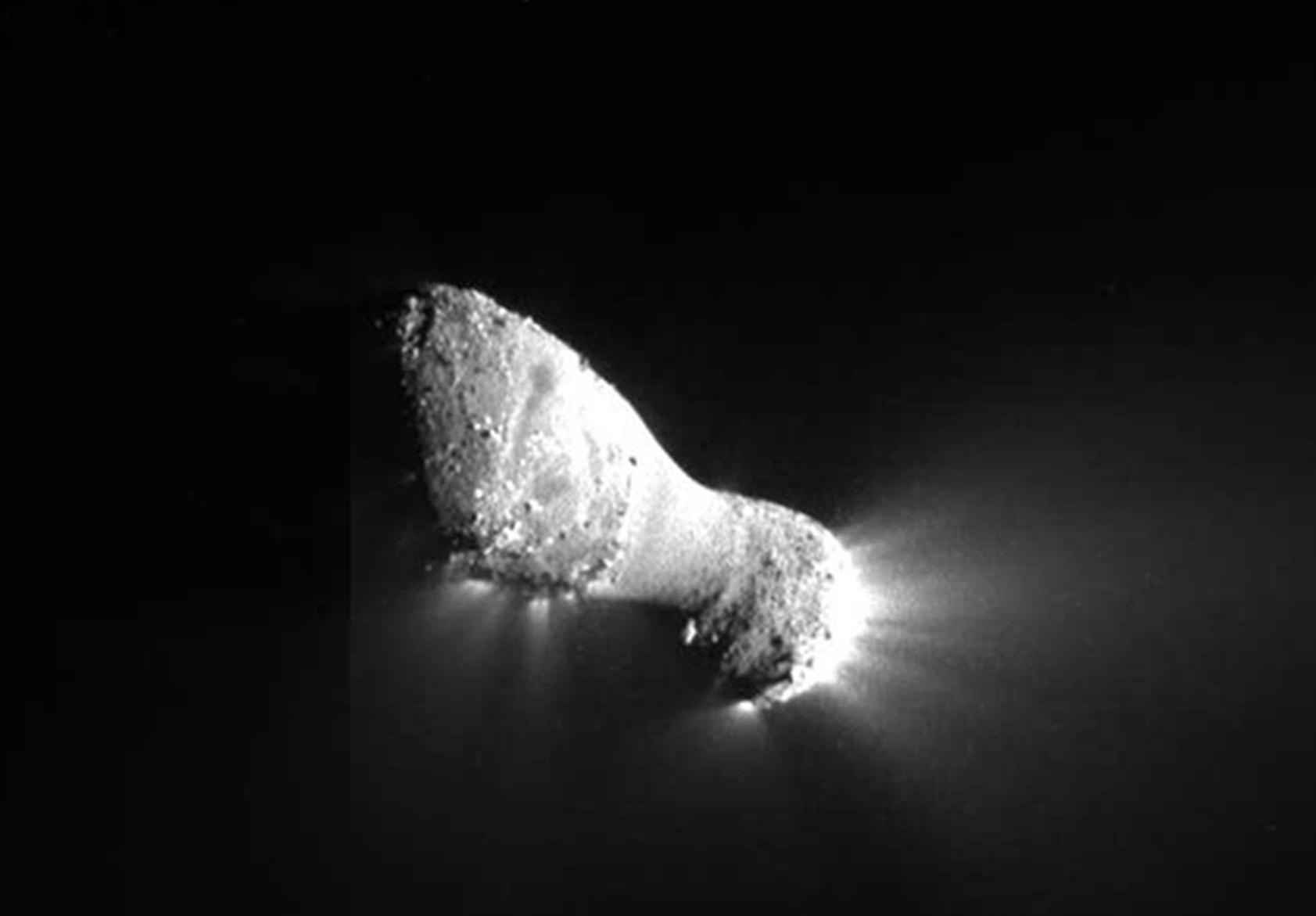
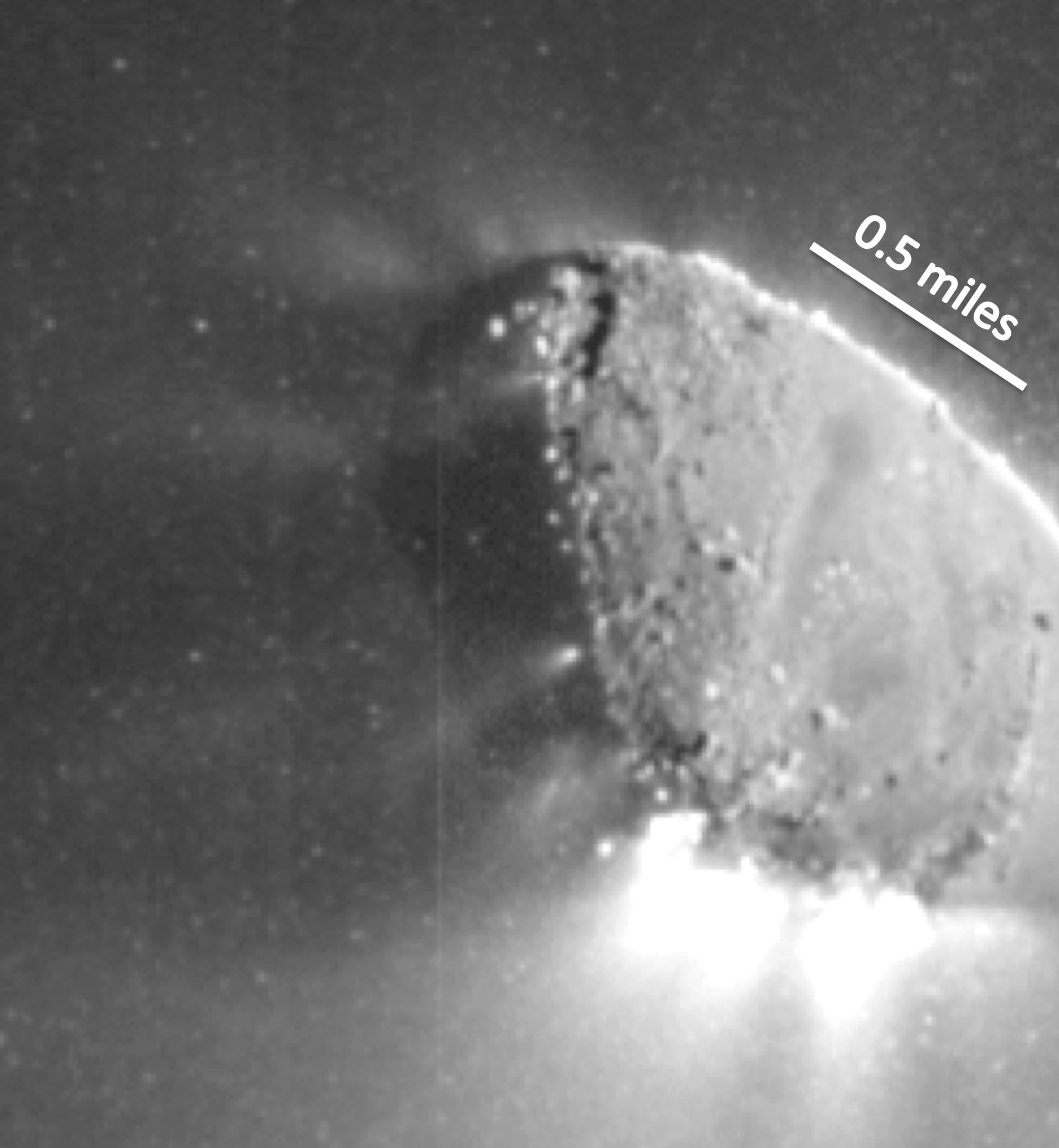
One of the most striking things comets do is produce jets. These jets form when newly generated gas breaks out through a weak spot on the surface of the nucleus. The effect is often compared to a geyser: material suddenly streams outward, carrying both gas and dust away from the comet.
The scientific driver behind this is sublimation, which means a substance changes directly from solid to gas without becoming liquid first. On comets, frozen materials can sublimate when sunlight warms them. In 2010, it was reported that sublimation of dry ice, meaning frozen carbon dioxide, can power jets flowing out of a comet nucleus.
This is not just theory. Infrared imaging of Comet Hartley 2 showed such jets emerging and carrying dust grains into the coma. Infrared light is light beyond red in the spectrum and is especially useful for revealing heat-related activity. In Hartley 2’s case, those observations gave scientists a direct look at how active jets can launch material off the nucleus.
The coma: the comet’s temporary atmosphere
When gas and dust stream off the nucleus, they create the coma, a huge, extremely thin atmosphere around the comet. Even though the nucleus itself may be small, the coma can grow to enormous size, stretching thousands or even millions of kilometers across.
The coma is generally made of water and dust, and when a comet is within 3 to 4 astronomical units of the Sun, water can make up as much as 90% of the volatile material flowing out. An astronomical unit, or AU, is the average distance between Earth and the Sun.
The coma is not a stable atmosphere like Earth’s. It is continuously replenished by outgassing from the nucleus. Sunlight and the solar wind then act on that material, helping shape the comet’s tails. But before all that material becomes part of a tail, it begins as a local cloud around the nucleus—and jets are one of the ways that cloud is fed.
How jets put a spin on a comet
Jets do more than make a comet look active. They can also physically push on the nucleus. When gas and dust blast out in one direction, the nucleus feels a reaction force in the opposite direction. If that push is off-center, it creates torque, a twisting force that changes the object’s spin.
On a comet, this can alter how fast the nucleus rotates or even change the orientation of its spin. Since comet nuclei are irregular and fragile, that extra twisting can be a big deal. Instead of behaving like solid, sturdy rocks, comets are loose mixtures of ice, dust, and rocky particles. Repeated thrust from jets may stress the nucleus over time.
Uneven heating is what starts this chain of events. Sunlight does not warm every part of a rotating comet equally. Some spots become active first, venting gas and dust through weak areas. Those active regions can then behave like natural thrusters, gradually spinning up the nucleus.
From spin to breakup
Jets can do more than merely tweak a comet’s rotation. They can help split a nucleus apart.
Comets are suspected of breaking up for several reasons, including thermal stress, internal gas pressure, and impact. Thermal stress means repeated heating and cooling can strain materials until they crack. Internal gas pressure can build beneath the surface and force material outward. Jets are closely tied to both ideas, because they are visible signs that gas is escaping and that the nucleus is not responding evenly to solar heating.
Some comets have been directly observed splitting apart. The breakup of comets is one of the clearest reminders that these bodies can be structurally weak. A nucleus that is repeatedly heated, vented, spun, and stressed may not hold together forever.
The episode’s core idea is exactly what makes comet science so dramatic: the same jets that create beautiful activity can also destabilize the object producing them.
Shoemaker–Levy 9: a comet falls to pieces
One of the most famous examples of cometary fragility is Comet Shoemaker–Levy 9. Discovered in 1993, it had already been broken into pieces during a close encounter with Jupiter in July 1992. Rather than remaining a single nucleus, it became a chain of fragments.
Then came the spectacle that made it historic. Over six days in July 1994, those fragments fell into Jupiter’s atmosphere. This was the first time astronomers observed a collision between two objects in the Solar System.
Shoemaker–Levy 9 offered an extraordinary view of what can happen when a fragile comet is pulled apart and its pieces continue on dramatically different fates. It turned the abstract idea of comet breakup into a directly observed event. Instead of a single glowing visitor, scientists watched fragment after fragment strike the giant planet.
Other comets that split apart
Shoemaker–Levy 9 is the most famous case, but it is not the only one. Comet splitting has been observed many times.
A significant disruption happened with 3D/Biela in 1846. The comet broke into two pieces during its passage through perihelion, the point in its orbit closest to the Sun. Both pieces were seen separately in 1852, but not after that. Later, spectacular meteor showers appeared in 1872 and 1885 when the comet should have been visible.
Comet 73P/Schwassmann–Wachmann also split during the period from 1995 to 2006. Some comets appear to be fragments of earlier parent comets. For example, 42P/Neujmin and 53P/Van Biesbroeck appear to be pieces of a once-shared object. Another example is the Liller comet family, a group linked to fragmentation episodes.
Some comets have also broken up during perihelion passage, including the great comets West and Ikeya–Seki. This pattern makes sense: near perihelion, heating is intense, outgassing rises, and physical stresses can increase sharply.
Why the Sun can be both artist and destroyer
The Sun is responsible for nearly everything visually dramatic about comets. Solar radiation warms the nucleus, drives outgassing, illuminates the coma, and helps create tails. But that same solar heating can also be destructive.
As lighter volatile materials escape, they leave behind darker surface material that absorbs even more heat. This can intensify outgassing in certain places. If gas escapes unevenly, jets become stronger in local spots. If the nucleus is weak, fractured, or loosely assembled, those concentrated forces can reshape it or break it apart.
For sungrazing comets, the risk is especially severe. These are comets that pass extremely close to the Sun at perihelion. Smaller sungrazers can be completely evaporated, while larger ones may survive multiple passages. Even then, the strong tidal forces they experience often lead to fragmentation.
Why this matters for understanding comets
Jets are not just surface fireworks. They reveal what is happening inside a comet and below its crust. Missions such as Deep Impact and EPOXI helped show that important volatile material can lie beneath the surface and feed visible activity. Hartley 2, in particular, offered a vivid example of dry-ice-driven jets carrying dust into the coma.
These observations matter because they connect appearance to physics. A comet’s spin, outgassing, coma, fragmentation, and lifetime are all related. The more material a comet loses, the more its structure and orbit can change over time. Eventually, many comets lose most of their volatile material and become dark, inert bodies that can resemble asteroids.
In that sense, comet jets are a clue to both life and death. They are a sign that the nucleus is active, but also a reminder that activity gradually strips a comet down. Sometimes that decline is slow. Sometimes it is violent.
Fragile worlds in motion
Comets are often celebrated for their beauty, but their real story is one of stress, motion, and instability. Uneven heating can turn frozen pockets into erupting jets. Those jets can throw dust into the coma, twist the nucleus through torque, and contribute to cracking or fragmentation. And when a comet finally breaks, the results can be spectacular—from fragment trains in space to impacts on a giant planet.
So the next time a comet is pictured as a serene object with a glowing tail, it is worth remembering what may be happening at its core: a dark, irregular nucleus venting gas like a cosmic geyser, spinning under its own thrust, and perhaps edging closer to coming apart.
Sources
Based on information from Comet.
More like this
Catch more cosmic chaos one swipe at a time — download DeepSwipe and let your curiosity blast off like a comet jet.