Full article · 7 min read
World War I: The War That Erased Empires
World War I did more than kill on a vast scale. It shattered political systems that had dominated Europe for generations and redrew the map in ways that shaped the rest of the 20th century. By the time the guns fell silent in November 1918, four major empires had disappeared: the German, Austro-Hungarian, Ottoman, and Russian empires. Along with them fell four ruling dynasties: the Hohenzollerns, the Habsburgs, the Ottomans, and the Romanovs.
That is why the conflict is often remembered not only as a military catastrophe, but as a turning point in world history. It destroyed old crowns, created new countries, and left behind a peace settlement so bitterly contested that it helped set the stage for another world war.
Four thrones fall
The war ended with military defeat abroad and political collapse at home across much of Europe. In Germany, the final months of 1918 brought a revolution. As confidence in Kaiser Wilhelm II evaporated and naval units revolted, a republic was proclaimed on 9 November 1918. Wilhelm abdicated shortly afterward, and Germany surrendered.
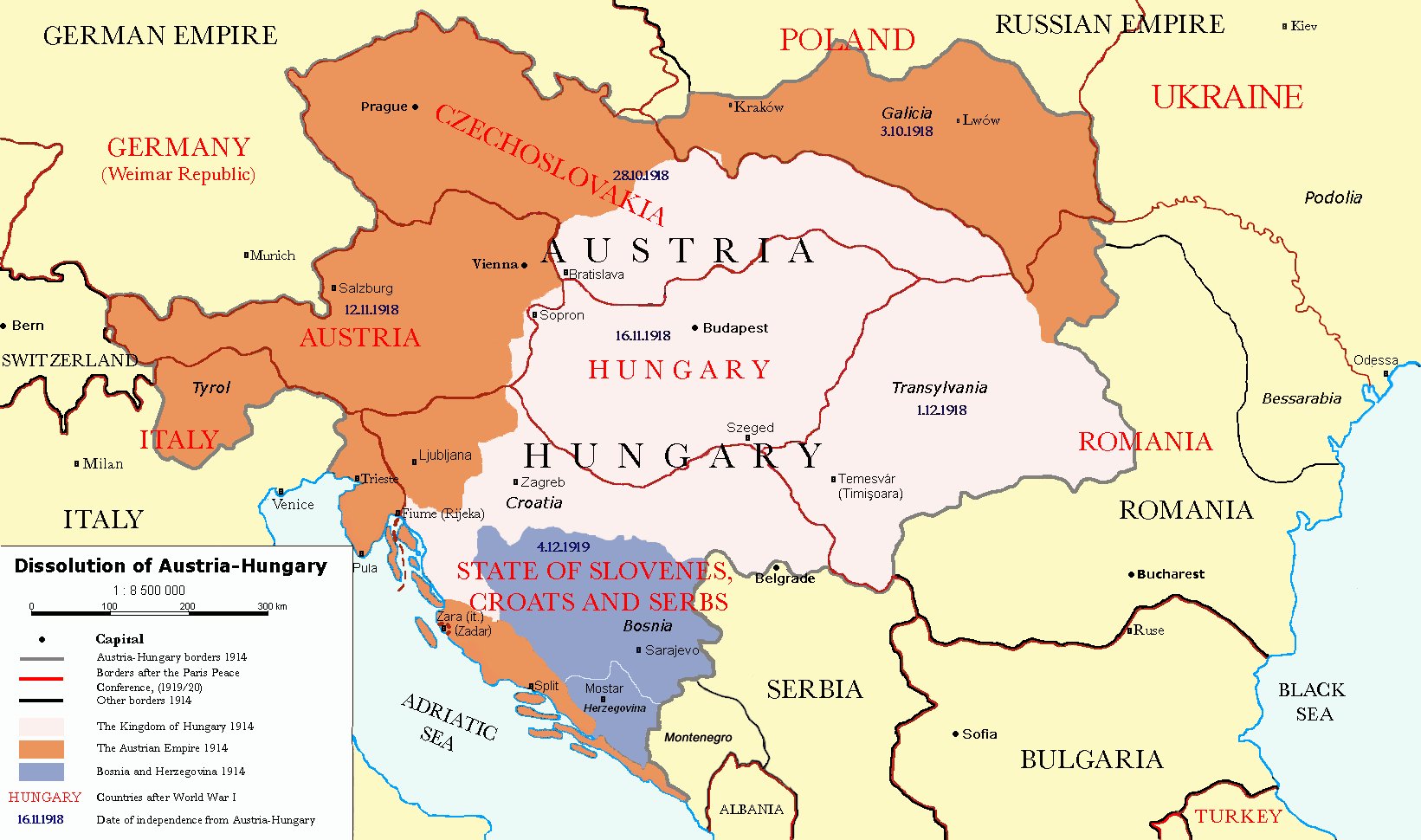
Austria-Hungary also came apart with stunning speed. The empire had long contained many peoples and regions under one crown, but as defeat loomed in late 1918, declarations of independence spread through places such as Budapest, Prague, and Zagreb. Its army disintegrated, and separate armistices followed the overthrow of Habsburg rule.
The Russian Empire had already been torn open by revolution. Russia suffered enormous casualties, while food shortages and political disorder undermined the state. In 1917, Tsar Nicholas II abdicated. Later that year, the Bolsheviks seized power and pushed Russia out of the war through the Treaty of Brest-Litovsk in March 1918.
The Ottoman Empire, meanwhile, capitulated on 30 October 1918. It had fought across multiple fronts, from Gallipoli to Mesopotamia and the Caucasus, while also carrying out large-scale ethnic cleansing of Armenian, Greek, and Assyrian Christian populations. Its defeat marked the end of another imperial order that had once stretched across vast territories.
In the aftermath, the collapse of these empires transformed the political landscape. What had once been imperial space became a patchwork of new and reconfigured states.
New maps overnight
One of the most dramatic consequences of the war was the creation of new countries and new borders. The peace settlements that followed did not simply punish the defeated powers; they also tried to reorganize Europe after the disappearance of old empires.
Poland re-emerged as an independent country after 123 years. Finland, Estonia, Latvia, and Lithuania emerged from the territory of the former Russian Empire. Czechoslovakia became a new nation by combining the Kingdom of Bohemia with parts of the Kingdom of Hungary. Yugoslavia began as the Kingdom of Serbs, Croats and Slovenes, built around Serbia and later renamed. Romania expanded, while Austria-Hungary was partitioned into successor states.
These changes were not minor adjustments. They represented a full remaking of the map of Central and Eastern Europe. Borders that had once reflected imperial control were replaced with new lines tied to independence, nationality, and diplomacy.
That did not mean the process was neat or peaceful. The settlements created winners and losers. Some peoples saw the treaties as long-awaited justice. Others saw them as humiliating or deeply unfair. Hungary, for example, lost a huge share of its territory and population. Germany lost significant territories and military power. Across the region, the end of empire often meant the beginning of fresh disputes over land, minorities, and national identity.
The Treaty of Versailles and the bitter clause
No postwar agreement became more famous, or more controversial, than the Treaty of Versailles. Signed with Germany on 28 June 1919, it formally ended the war between Germany and the Allied powers and laid out the framework for the postwar order.
One of its most contentious parts was Article 231, often called the War Guilt Clause. This clause stated that Germany and its allies had to acknowledge responsibility for the loss and damage suffered by the Allied and Associated governments and their nationals as a consequence of the war imposed by their aggression. In practical terms, it helped provide the legal basis for reparations, meaning payments demanded from the defeated side for war damage.
Reparations are financial penalties or obligations imposed after war. They can be paid in money or in goods. In Germany’s case, the treaty also stripped away territory, required disarmament, and imposed political and legal humiliation in the eyes of many Germans.
The reaction in Germany was fierce. Many Germans viewed the treaty as a diktat, meaning an imposed settlement rather than a negotiated peace. Resentment focused not only on reparations but on the broader sense that Germany had been legally condemned, militarily weakened, and politically shamed.
This atmosphere helped fuel one of the most poisonous political myths of the postwar years: the “stab in the back.” This was the false claim that the German army had not really been defeated on the battlefield, but had instead been betrayed by civilians, politicians, and internal enemies. The myth became central to German politics in the 1920s and 1930s, feeding denial, grievance, and revenge-minded nationalism.
Why the peace bred anger
The postwar settlement was supposed to create stability, but it often did the opposite. In Germany, bitterness over Versailles became a constant force in political life. The belief that the country had been unfairly treated mixed with anger over reparations and continued Allied occupation of the Rhineland.
The peace also left behind unresolved tensions elsewhere. New borders meant new minorities. Former imperial territories were divided among successor states. National self-determination, the idea that peoples should govern themselves, inspired many of the settlement’s decisions, but applying that principle consistently was difficult. As a result, the end of empire did not end political conflict.
Even where new states were celebrated, the wider continent remained unstable. The war had inflicted massive human loss, economic disruption, and social upheaval. The empires were gone, but no fully secure new order had taken their place.
The League of Nations and a peace that failed
The peace settlement did not rely only on treaties and border changes. It also created a new international institution: the League of Nations. The League was established on 28 June 1919 with the aim of maintaining world peace.
The basic idea was ambitious. Instead of allowing international disputes to slide toward war, states would cooperate through a common organization. In theory, this was a way to prevent another catastrophe like 1914–1918.
But the League failed to manage the instability of the interwar period. That failure mattered enormously. The inability to maintain peace, contain grievances, or stabilize the postwar world contributed to the chain of events that led to World War II in 1939.
So while World War I ended with armistices and treaties, the peace that followed never fully solved the problems unleashed by the war. The old empires were gone, but the new system remained fragile.
A war that changed the century
World War I is sometimes remembered for trenches, artillery, and the slaughter of battles like Verdun and the Somme. But its political aftermath was just as world-changing. It erased empires that had shaped Europe for centuries. It toppled dynasties that once seemed permanent. It produced new countries almost overnight. And it left behind a treaty system that many people saw as either justice or vengeance.
By destroying the German, Austro-Hungarian, Ottoman, and Russian empires, the war did not simply end an era. It created the unstable world that came after it. The map changed, crowns fell, and a new international order was attempted through the League of Nations. Yet the bitterness of Versailles, the spread of political myths, and the failure to secure lasting peace ensured that the end of one world war became the beginning of the road to another.
Sources
Based on information from World War I.
More like this
Empires fell and maps flipped — keep swiping through history’s biggest plot twists with DeepSwipe.


