Full article · 8 min read
The Wrong Turn in Sarajevo That Helped Ignite World War I
Few moments in history feel as brutally cinematic as the assassination of Archduke Franz Ferdinand in Sarajevo on 28 June 1914. A missed route, a stopped car, a young assassin in the right place at the worst possible time—and within weeks, Europe was at war.
But the killing itself was only the spark. The deeper story is how one street-corner attack set off a chain reaction among rival empires, military plans, alliances, and fears that had been building for years. What looked at first like a local Balkan crisis rapidly became the opening of the First World War.
The assassination: how a wrong turn changed history
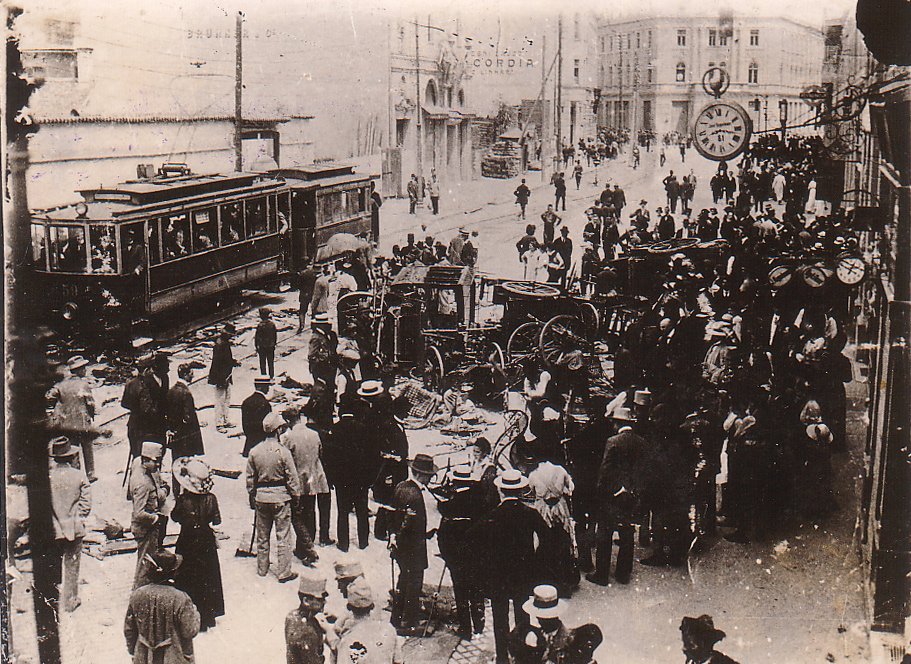
Franz Ferdinand, heir presumptive to Emperor Franz Joseph I of Austria, was visiting Sarajevo, the capital of recently annexed Bosnia and Herzegovina. Along the route of his motorcade stood several conspirators from Young Bosnia, including Gavrilo Princip, Cvjetko Popović, Nedjelko Čabrinović, Trifko Grabež, Vaso Čubrilović, and Muhamed Mehmedbašić. They were supplied with arms by extremists within the Serbian Black Hand intelligence organisation and hoped the Archduke’s death would help free Bosnia from Austrian rule.
The first attempt failed. Čabrinović threw a grenade at the Archduke’s car, injuring two aides instead. Other would-be assassins also missed their chance. It could have ended there.
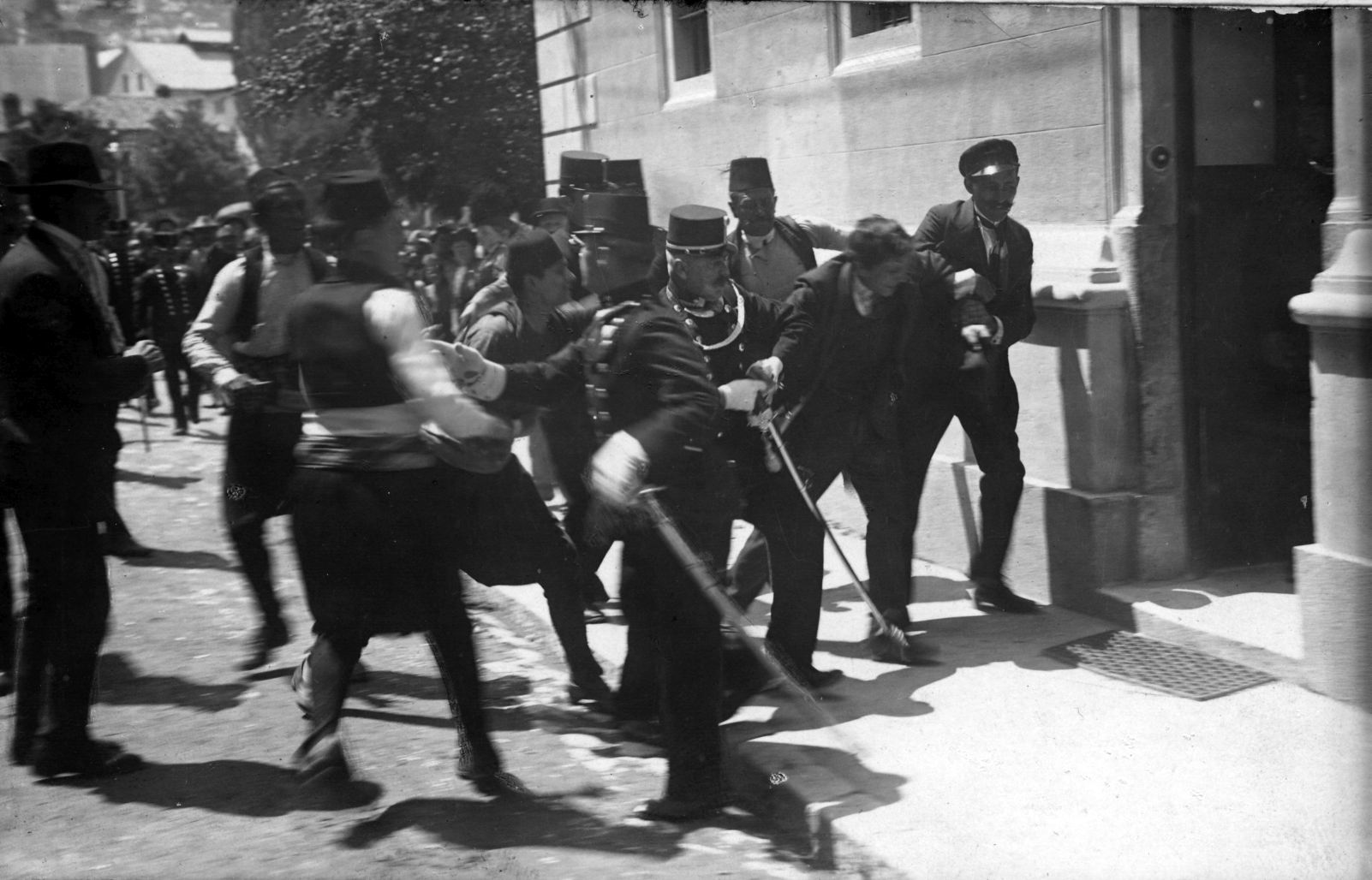
Then came the moment that has become legendary. About an hour later, after Franz Ferdinand went to visit the wounded officers in hospital, his car took a wrong turn into a street where Gavrilo Princip happened to be standing. Princip fired two pistol shots, fatally wounding both Franz Ferdinand and his wife, Sophie.
That wrong turn did not by itself make world war inevitable. But it gave powerful governments exactly the crisis they were prepared to exploit.
Why Sarajevo mattered so much
At first, the reaction in Vienna was not what later generations might expect. According to historian Zbyněk Zeman, the event almost seemed to make little impression in the city at first; crowds listened to music and drank wine as if nothing had happened. Yet the political effect soon became enormous.
Historian Christopher Clark described the assassination as having a “9/11 effect” in Vienna: a terrorist event charged with historic meaning that transformed political chemistry. In practical terms, that means a shocking act of violence hardened attitudes, narrowed the space for compromise, and made extreme responses seem justified.
This helps explain one of the strangest features of July 1914: leaders did not merely react emotionally. They reacted through systems of power that were already unstable.
The Balkans: the “powder keg of Europe”
The assassination happened in a region already notorious for tension. Before 1914, the Balkans had become a zone of resentment, nationalism, insecurity, and great-power rivalry.
Austria-Hungary saw the Balkans as essential to its survival and viewed Serbian expansion as a direct threat. Russia, meanwhile, considered itself the protector of Serbia and other Slav states, though its own goals in the region were complicated by wider strategic interests. The decline of Ottoman power added more uncertainty, as different states tried to gain influence or territory.
Several crises had already shaken the region:
- Austria annexed Bosnia and Herzegovina in the Bosnian Crisis of 1908–1909.
- The Italo-Turkish War of 1911–1912 exposed Ottoman weakness.
- The Balkan League defeated the Ottomans in the First Balkan War.
- The victors then turned on each other in the Second Balkan War of 1913.
Even countries that gained territory felt cheated. Serbia and Greece believed they had not received their rightful gains. Austria felt other powers dismissed its concerns. By 1914, the Balkans were widely seen as the “powder keg of Europe” because the region seemed capable of exploding into a much wider conflict.
From murder to ultimatum
After the assassination, Austro-Hungarian authorities encouraged anti-Serb riots in Sarajevo, and violent actions against ethnic Serbs spread to other cities in Bosnia and Herzegovina, Croatia, and Slovenia. Authorities in Bosnia and Herzegovina imprisoned about 5,500 prominent Serbs; between 700 and 2,200 of them died in prison. Another 460 Serbs were sentenced to death, and a predominantly Bosniak special militia called the Schutzkorps carried out persecution of Serbs.
Diplomatically, the crisis deepened fast. Austrian officials believed Serbian intelligence had helped organise Franz Ferdinand’s murder. They wanted to use the assassination as an opportunity to end Serbian interference in Bosnia and considered war the best way to do it, even though the Foreign Ministry had no solid proof of Serbian involvement.
On 23 July 1914, Austria-Hungary delivered an ultimatum to Serbia containing ten demands. An ultimatum is a final set of terms backed by the threat of serious consequences, usually war, if they are not accepted. These demands were intentionally made unacceptable enough to create a pretext for hostilities.
Serbia ordered general mobilisation on 25 July but accepted nearly all the terms. It rejected the parts that would have allowed Austrian representatives to suppress so-called subversive elements inside Serbia and take part in the investigation and trial of Serbian suspects. Austria-Hungary treated that as rejection, broke off diplomatic relations, ordered partial mobilisation, and declared war on 28 July 1914.
How a Balkan war became a world war
Once Austria-Hungary attacked Serbia, the alliance system and military timetables kicked in.
Russia ordered general mobilisation in support of Serbia on 30 July. Mobilisation means preparing a country’s armed forces for war, including calling up reservists, moving units, and activating transport systems. In 1914, mobilisation was not a minor signal. It often meant war was very close.
Germany, allied with Austria-Hungary, demanded that Russia stop its war measures. When the ultimatum expired, Germany declared war on Russia on 1 August. Germany also demanded French neutrality, but France refused and ordered general mobilisation.
German strategy had long assumed a war on two fronts, against France in the west and Russia in the east. The Schlieffen Plan called for using 80% of the German army to defeat France first, then shifting eastward against Russia. To do that quickly, Germany moved through Belgium rather than launching only a direct attack across the French frontier.
Britain’s entry followed this step. On 31 July, Britain asked both Germany and France to respect Belgian neutrality. France agreed. Germany did not reply. After Germany occupied Luxembourg, declared war on France, demanded free passage through Belgium, and invaded Belgium early on 4 August, Britain sent an ultimatum. When it expired without a response, Britain and Germany were at war.
That is the crucial escalation in simple form:
- Austria-Hungary declared war on Serbia.
- Russia mobilised in Serbia’s defence.
- Germany declared war on Russia and France.
- Britain entered after Germany invaded Belgium.
A regional crisis had become a continental war in days.
Why no one could stop the slide
The July Crisis was not just a diplomatic argument. It unfolded in a Europe already shaped by competing alliances and an arms race.
For decades, the balance of power had become more fragile. Germany and Austria-Hungary were linked in the Dual Alliance, which became the Triple Alliance when Italy joined. France and Russia formed the Franco-Russian Alliance. Britain settled disputes with France and Russia through the Entente Cordiale and the Anglo-Russian Convention, creating the Triple Entente.
These were not all identical in legal form, but together they made any local war dangerously contagious.
At the same time, military spending by the six major European powers rose by over 50% in real terms from 1908 to 1913. Germany had expanded its army by 170,000 troops in 1913. France extended compulsory military service from two years to three. Railway systems and transport infrastructure mattered because they allowed faster mobilisation. Once governments began moving armies, backing down became harder.
That is why the assassination mattered so much: it struck a system already under pressure from imperial rivalry, military planning, and mutual suspicion.
Germany’s rush and the trench deadlock
The next phase of the story matched the episode’s image of speed turning into paralysis. Germany’s opening offensive in the west was initially very successful. By the end of August 1914, the Allied left, including the British Expeditionary Force, was retreating, and the French offensive in Alsace-Lorraine had failed disastrously.
But Germany did not achieve the decisive breakthrough it wanted. As the German armies approached Paris, a gap opened between them. French and British forces counter-attacked and pushed the Germans back 40 to 80 kilometres. Both sides were exhausted.
They dug in.
After the First Battle of the Marne in September 1914, each side tried unsuccessfully to outflank the other in what became known as the “Race to the Sea.” By the end of 1914, the Western Front had become an uninterrupted line of entrenched positions from the Channel to the Swiss border.
A trench is a long, narrow ditch dug into the ground for protection from enemy fire. In World War I, trenches were reinforced defensive systems, often supported by barbed wire, machine guns, and artillery. These conditions made frontal attacks extremely costly and turned the western war into a bloody stalemate.
A single moment, and a much larger disaster
The assassination in Sarajevo is often remembered because it compresses history into a haunting scene: a wrong turn, two gunshots, and the fall of an empire’s heir. But its real significance lies in what followed. The murder triggered the July Crisis, gave Austria-Hungary a reason to confront Serbia, activated alliance commitments and war plans, and helped unleash one of the deadliest conflicts in history.
World War I lasted from 28 July 1914 to 11 November 1918. It became a global conflict involving Europe, the Middle East, parts of Africa, and the Asia-Pacific. It caused an estimated 30 million military casualties and 8 million civilian deaths from war-related causes and genocide.
So yes, a wrong turn in Sarajevo became famous. But the deeper truth is even darker: one wrong turn met a continent already pointed toward catastrophe.
Sources
Based on information from World War I.
More like this
Take a right turn into smarter scrolling—download DeepSwipe and turn one swipe into a world of knowledge.