Full article · 8 min read
Black Holes: The Photon Sphere and Shadow
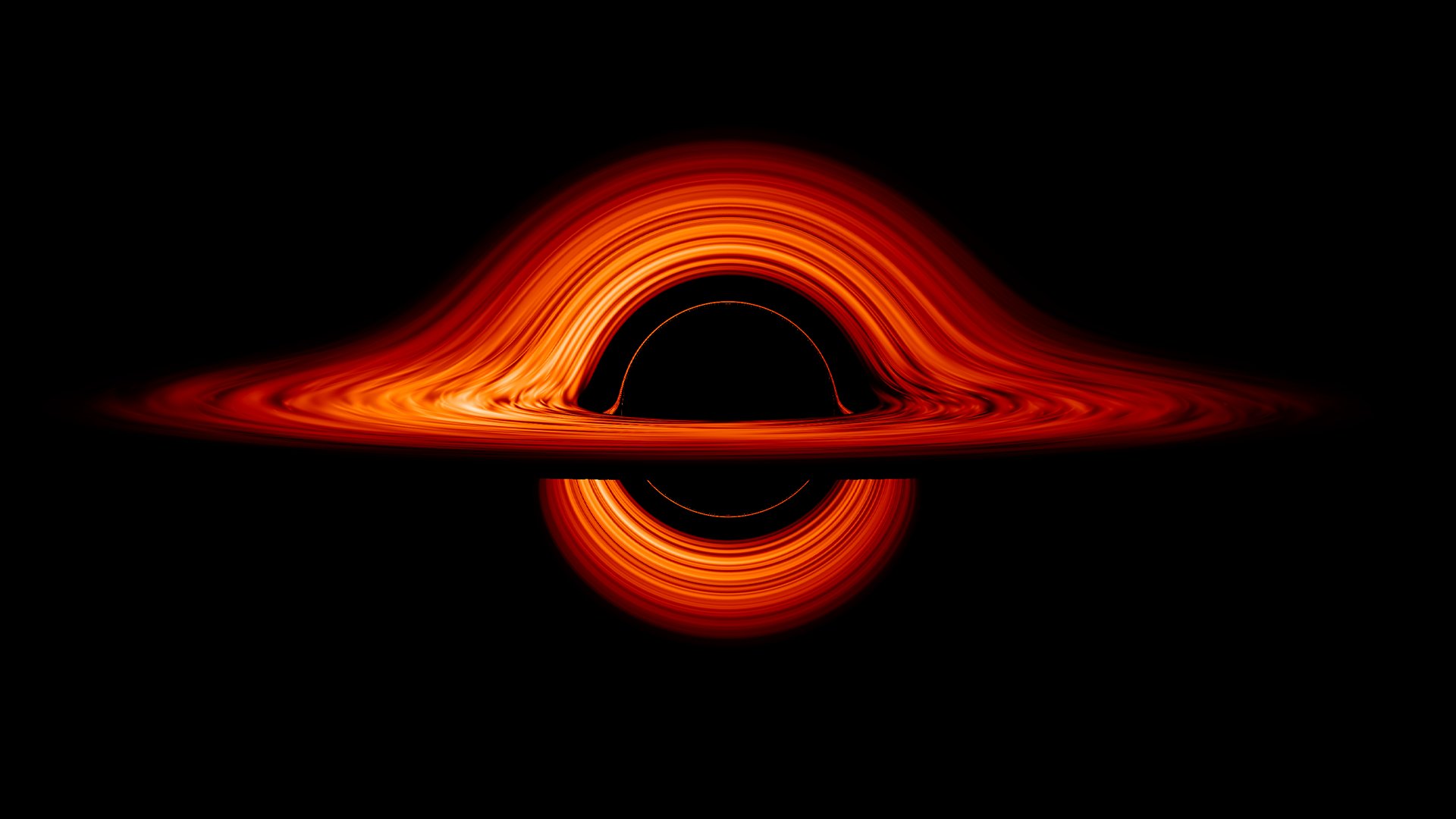
Black holes are famous for trapping light, but one of their strangest features lies just outside the point of no escape. Surrounding a black hole is a region where light can be bent so strongly that photons can circle the object itself. This is called the photon sphere, and it plays a central role in creating the dark silhouette, or shadow, that telescopes can observe.
That shadow is not the black hole alone. It is shaped by the extreme bending of light in the warped spacetime around it. Understanding the photon sphere helps explain why black holes can be “seen” even though they do not emit visible light themselves.
What is the photon sphere?
The photon sphere is a spherical boundary around a black hole where photons moving along just the right path can be bent completely around it. A photon is a particle of light, and in this region gravity curves its path so dramatically that light may orbit the black hole multiple times.
For a non-rotating Schwarzschild black hole, the photon sphere lies at a radius equal to 1.5 times the Schwarzschild radius. The Schwarzschild radius is the radius of the event horizon for a nonspinning, uncharged black hole. The event horizon is the boundary beyond which nothing, not even light, can escape.
This makes the photon sphere distinct from the event horizon. It is not the point of no return itself. Light can still escape from the photon sphere under the right conditions. But it is a dangerous boundary: light rays with impact parameters smaller than the radius of the photon sphere enter the black hole.
Why the photon sphere matters
The photon sphere marks the threshold between light that can still swing around the black hole and light that is doomed to fall in. Any light crossing the photon sphere on an inbound path will be captured by the black hole.
That is why the photon sphere helps define the visible edge of a black hole’s shadow. Since no light emerges from within the black hole, the shadow represents the limit of possible observations. Seen from far away, the black hole appears as a dark region outlined by light that has been bent and lensed by gravity.
This is one of the most striking consequences of general relativity, Albert Einstein’s theory that describes gravity as the curvature of spacetime. Near a black hole, spacetime is curved so intensely that even light, which normally travels in straight lines through empty space, is forced onto looping paths.
The black hole shadow
A black hole does not shine on its own, aside from the hypothetical Hawking radiation, which is far too weak to matter for astronomical imaging. So how can a black hole cast a shadow?
The answer lies in the bright material around it. Matter falling toward a black hole often forms an accretion disk, a disk-like structure of infalling gas and plasma. Friction heats this material, and it emits light and other electromagnetic radiation. Against that bright background, the black hole appears as a dark silhouette.
The photon sphere shapes this silhouette. Light from the glowing material around the black hole is deflected, concentrated, or swallowed depending on its path. The result is a shadow larger than the event horizon itself.
Only certain light can reach a distant observer. Light emitted from within the black hole cannot escape. Light from the photon sphere can still escape, but only if it is not on an inbound trajectory that carries it inward. Light that reaches us from this region must come from objects between the photon sphere and the event horizon. Some light emitted toward the photon sphere may even curve around the black hole and return to where it came from.
What the Event Horizon Telescope saw
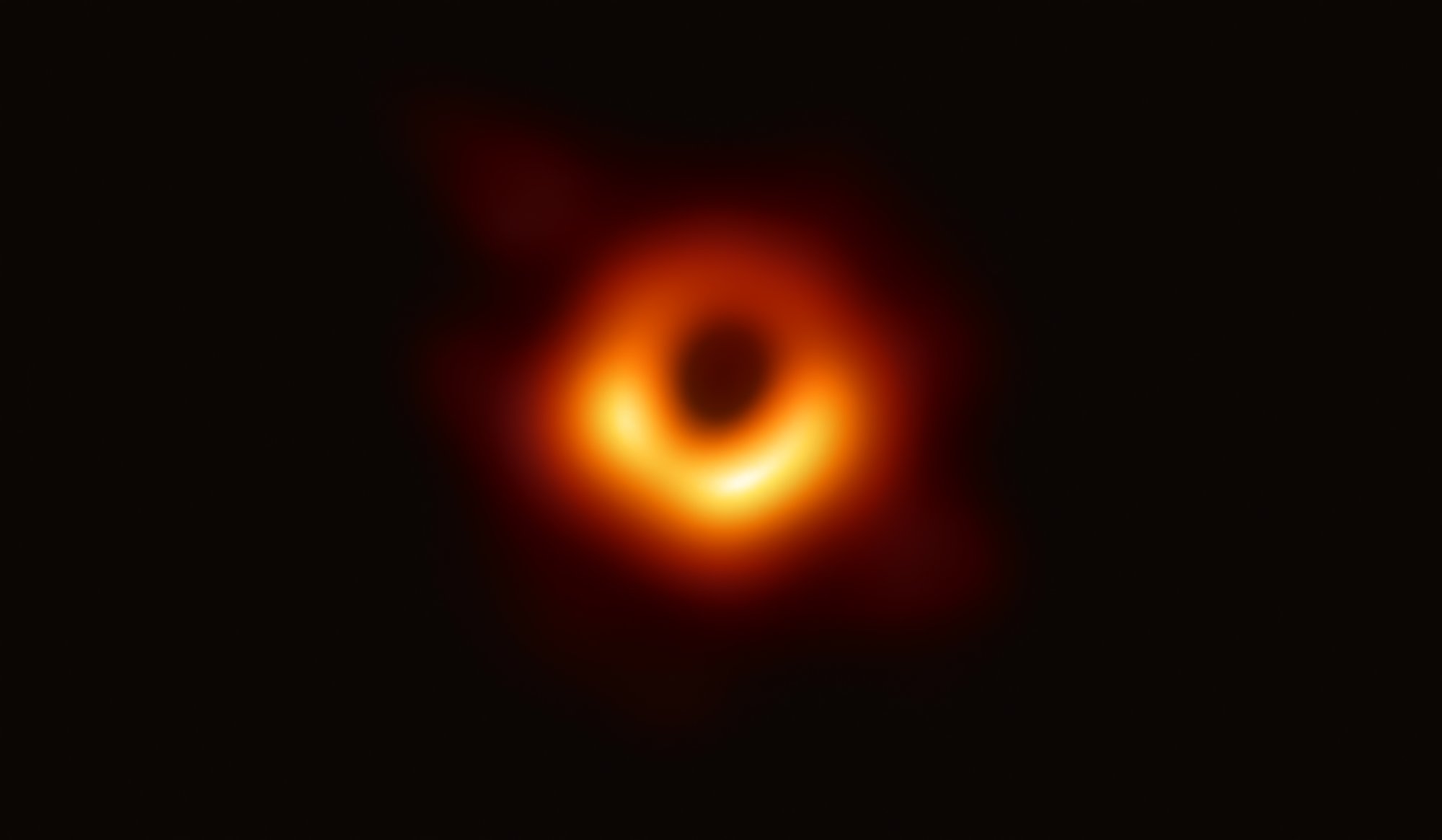
The Event Horizon Telescope, or EHT, is a global network of radio telescopes designed to observe black hole shadows. Because black holes such as Sagittarius A* and the one in Messier 87 have tiny apparent sizes in the sky, a single radio telescope would need to be roughly the size of Earth to resolve them clearly. By combining data from telescopes around the world, the EHT creates an effective Earth-sized aperture.
Using this method, scientists produced the first direct image of a black hole and its vicinity in 2019, based on observations of the supermassive black hole in Messier 87. In 2022, the collaboration released an image of Sagittarius A*, the supermassive black hole at the center of the Milky Way.
These images do not show the event horizon directly. Instead, they reveal the dark shadow and the bright surrounding emission shaped by gravity, including the effects associated with the photon sphere.
Rotating black holes warp the picture
Not all black holes are the same. Some spin, and spinning changes the geometry around them.
In a rotating, uncharged black hole, the radius of the photon sphere depends on two things: how fast the black hole is spinning, and whether the photon orbits in the same direction as the spin or against it.
Prograde light moves in the same direction as the black hole’s spin. Retrograde light moves in the opposite direction. For prograde photons, the photon sphere can lie closer to the black hole. For retrograde photons, it lies farther out.
For a rotating, uncharged black hole, the photon sphere for a prograde photon can be between 1 and 3 Schwarzschild radii from the center, while for a retrograde photon it can be between 3 and 5 Schwarzschild radii. The exact location depends on the black hole’s rotation.
This difference matters because it distorts the black hole’s silhouette. Instead of a perfectly symmetric appearance, a spinning black hole can produce an uneven shadow. The warped paths of prograde and retrograde light help shape what distant observers detect.
Why spin changes light paths
The reason spin matters is that near a rotating black hole, spacetime itself is dragged into rotation. This effect is called frame dragging. Rather than simply orbiting through static space, matter and light are carried along by the rotating geometry.
The region where this effect becomes so strong that nothing can remain still is called the ergosphere. It lies outside the event horizon and bulges outward around the equator. Matter and radiation can still escape from the ergosphere, but they cannot avoid being swept around by the spin of the black hole.
This dragging of spacetime helps explain why light orbiting in the same direction as the spin can stay closer in, while light orbiting against the spin is forced farther out. The result is a lopsided optical structure around the black hole.
Shadows during black hole collisions
The shadow becomes even more interesting when black holes are about to merge. The shadow of colliding black holes is expected to have characteristic warped shapes. These distortions could help scientists identify black holes in the process of merging.
Black hole mergers are also detectable through gravitational waves, ripples in spacetime produced when massive compact objects accelerate. In late 2015, the LIGO Scientific Collaboration and Virgo Collaboration made the first direct detection of gravitational waves from a black hole merger. Since then, hundreds more gravitational-wave events have been observed.
That means black hole collisions can be studied in more than one way: through the spacetime vibrations they send across the cosmos and, in some cases, through the changing appearance of the light around them.
Photon sphere vs event horizon
It is easy to confuse the photon sphere with the event horizon, but they are very different.
The event horizon is the defining boundary of a black hole. Once matter or light crosses it inward, escape is impossible. To a distant observer, an object falling toward the horizon appears to slow down, grow dimmer, and become increasingly red-shifted due to gravitational time dilation and gravitational redshift.
The photon sphere, by contrast, is outside that boundary. It is a region where light can orbit, at least temporarily, and where some light can still escape to distant observers. In practical terms, the photon sphere helps determine how the black hole looks, while the event horizon determines what can never come back.
A clue to invisible objects
Black holes are not detected by watching the holes themselves glow. They are inferred through their effects on nearby matter, light, and spacetime. The photon sphere is one of the clearest examples of this. It is part of the structure that turns an invisible object into something astronomers can study.
The bending of light around black holes is also a reminder that black holes are not cosmic vacuum cleaners that simply “suck in everything.” From far away, the gravitational field of a black hole is identical to that of any other body of the same mass. What makes black holes special is how compact they are, and how dramatically spacetime behaves close to them.
Near that compact core, light itself can be trapped into loops, shadows can be cast by darkness, and a region with no glow can become one of the most recognizable sights in modern astronomy.
Why this feature fascinates scientists
The photon sphere and black hole shadow sit at the crossroads of theory and observation. General relativity predicts these strange light paths. Radio telescopes now reveal their large-scale signatures. Rotating black holes add asymmetry, and collisions may produce even more exotic warped shadows.
In other words, black holes are not only places where light disappears. They are also places where light performs some of its most extraordinary tricks.
Sources
Based on information from Black hole.
More like this
Orbit deeper into the universe’s weirdest ideas—download DeepSwipe and chase more cosmic shadows every day.


