Full article · 7 min read
Sun Shape: Why the Sun Is Almost a Perfect Sphere
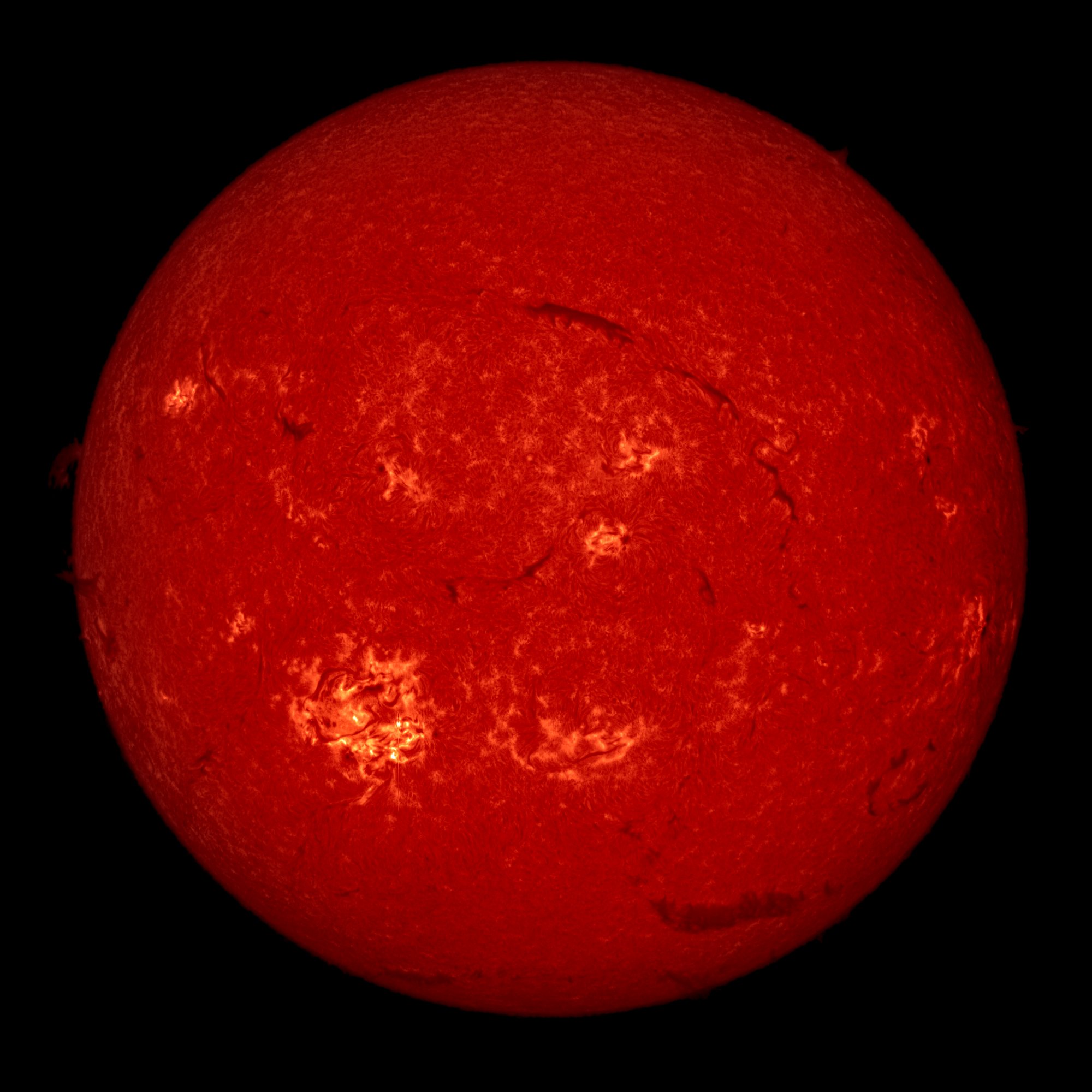
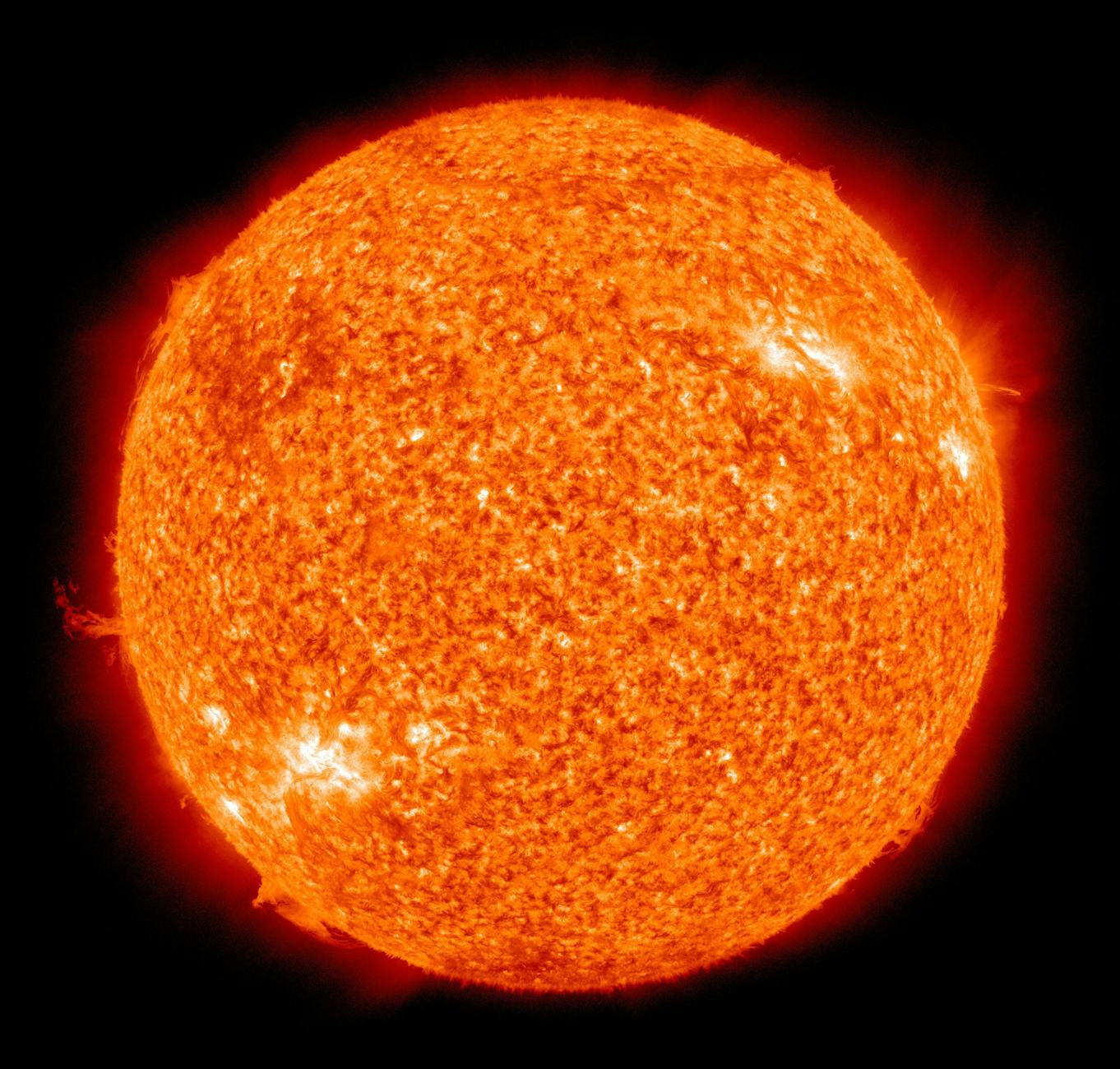
The Sun is a spinning, blazing sphere of hot plasma at the centre of the Solar System, so it seems natural to assume it should be noticeably squashed at the poles and wider around the equator. After all, rotation usually causes a body to bulge outward slightly at its middle. But the Sun turns out to be astonishingly round.
In fact, measurements show that the Sun is only about 8.2 parts per million out of round. That tiny departure from perfect roundness is called oblateness, which is the difference between the Sun’s equatorial radius and its polar radius. By this measure, the Sun is the natural object closest to a perfect sphere ever observed.
That is remarkable not just because the Sun rotates, but because it does not even rotate as a rigid solid body.
What “out of round” really means
When scientists talk about the shape of the Sun, they usually compare two distances: the radius at the equator and the radius at the poles. If the equatorial radius is slightly larger, the Sun is said to be oblate, meaning a little flattened from top to bottom.
For the Sun, that flattening is extremely small. The measured oblateness is about 8.2 × 10⁻⁶, or roughly 8 parts per million. In ordinary language, that means the Sun differs from a perfect sphere by only a tiny fraction.
This is especially striking because the Sun is enormous. Its diameter is about 1,391,400 kilometres, around 109 times that of Earth. Yet despite that immense size and its constant rotation, the visible body of the Sun remains almost perfectly spherical.
Why spinning objects usually bulge
Rotation tends to make an object wider at the equator. That happens because material around the equator is moving fastest as the body spins, which pushes outward and can create a slight bulge.
The Sun does rotate, and not uniformly. Its equator rotates faster than its poles, a behaviour called differential rotation. The rotational period is about 25.6 days at the equator and about 33.5 days at the poles when measured relative to the stars. Seen from Earth, the apparent rotation period at the equator is about 28 days.
This uneven rotation is linked to convective motion, which is the movement of hot material rising and cooler material sinking, and to the Coriolis force caused by rotation. With all that motion going on, you might expect a more obviously distorted shape. But the Sun’s actual bulge remains incredibly small.
Measuring the Sun’s shape is surprisingly difficult
You might think checking whether the Sun is round would be easy. It fills the sky as a clean, bright disk. But making a precision measurement is extremely hard.
One problem is Earth’s atmosphere. Atmospheric distortion blurs and warps observations, so the best measurements must be made from satellites. Another challenge is that the effect being measured is tiny, which means the instruments and methods have to be extraordinarily precise.
High-precision measurements from the Solar Dynamics Observatory and the Picard satellite showed that the Sun’s oblateness is even smaller than expected. Those results helped establish just how close the Sun is to a mathematically perfect sphere.
The Sun has no hard edge
Part of the difficulty comes from the fact that the Sun is not a solid ball with a crisp surface. It has no definite boundary. Instead, its density decreases with height above the photosphere.
The photosphere is the Sun’s apparent visible surface, the layer from which most sunlight escapes into space. When scientists define the Sun’s radius for shape measurements, they usually mean the distance from the centre to the edge of the photosphere.
So even the idea of the Sun’s “surface” is a practical definition rather than a rigid shell. That makes the precision of the roundness measurements even more impressive.
The most spherical natural object ever observed
The headline result is extraordinary: the Sun is the natural object closest to a perfect sphere ever observed.
That is not just a poetic statement. It comes directly from the measured oblateness. The shape remains so stable that the oblateness value stays constant even when solar irradiation changes. In other words, variations in the Sun’s output do not noticeably alter this overall roundness.
The gravitational pull of the planets also does very little. Planetary tidal effects are weak and do not significantly affect the Sun’s shape. So although the planets tug on the Sun and even cause it to move around the Solar System barycentre, they do not meaningfully distort its form.
Why this mattered for astronomy
The Sun’s shape was once tied to an important scientific puzzle: the perihelion precession of Mercury.
Mercury does not trace exactly the same closest approach point to the Sun on every orbit. That point shifts over time, a phenomenon known as perihelion precession. At one time, it was proposed that the Sun’s oblateness might be large enough to explain this motion.
But Albert Einstein proposed that general relativity could explain Mercury’s precession even if the Sun were spherical. Later, when precise measurements showed the Sun’s oblateness was smaller than expected, that possibility became even weaker. The shape of the Sun turned out not to be enough to account for the effect.
So the Sun’s near-perfect roundness helped rule out one explanation and supported a deeper understanding of gravity.
A star that rotates, churns, and still stays round
The Sun is not calm inside. Its core is where nuclear fusion produces almost all of its power. Above that lies the radiative zone, where energy moves outward mainly through radiation. Above that is the convection zone, where hot plasma rises and cooler plasma sinks in a constantly moving pattern.
Near the surface, these convective motions leave visible imprints called solar granulation. The Sun also has a magnetic field that varies across its surface and changes over time through the solar cycle. Sunspots, solar flares, coronal mass ejections, and the solar wind all reflect a star that is active and dynamic.
Yet despite this internal churning, differential rotation, and magnetic activity, its overall shape remains almost perfectly spherical.
That contrast is part of what makes the Sun so fascinating. It is an active, seething, magnetically complex star, but from the outside its geometry is almost unbelievably smooth.
The Sun is not a solid object like a planet
One reason the Sun’s shape feels counterintuitive is that we often picture it as if it were a giant spinning ball of solid matter. But the Sun is made mostly of hydrogen and helium, and its visible layers are plasma, a hot state of matter in which particles are ionised.
Its photosphere contains mostly hydrogen and helium, with much smaller amounts of heavier elements such as oxygen, carbon, neon, and iron. The Sun formed about 4.6 billion years ago from collapsing matter in a molecular cloud, and it is currently a G-type main-sequence star.
Every second, the Sun’s core fuses about 600 billion kilograms of hydrogen into helium and converts about 4 billion kilograms of matter into energy. That energy moves outward through the Sun’s layers and eventually escapes as radiation.
So the object whose shape seems so simple is, in reality, a vast, hot, layered star powered by fusion and governed by complex flows of energy and motion.
Round, but not motionless
Even though the Sun is nearly a perfect sphere, it is far from still. It rotates counterclockwise as viewed from above its north pole. It orbits the centre of the Milky Way at an average speed of about 230 km/s. It also moves around the Solar System barycentre because of the gravitational pull of the planets.
And its own atmosphere extends far beyond the visible disk. Above the photosphere lie the chromosphere and corona, and beyond that the solar wind fills the heliosphere, dominating a huge region of space.
All of this makes the Sun’s near-perfect roundness even more impressive. It is not a frozen sphere. It is a rotating, evolving, energy-producing star with a vast atmosphere and powerful magnetic behaviour.
The surprising lesson of the Sun’s shape
The Sun teaches a nice scientific lesson: even familiar objects can be more surprising than they appear.
From Earth, the Sun looks like a simple glowing circle. But precise measurement reveals something astonishing. Despite spinning faster at the equator than at the poles, despite convection, magnetic fields, and a turbulent plasma interior, the Sun is almost perfectly spherical.
Its oblateness is only about 8 parts per million. That tiny flattening is so small that the Sun stands as the closest natural thing to a perfect sphere ever observed.
For a star that powers life on Earth, drives climate and weather, and dominates nearly all the mass in the Solar System, that is one more reason to look at it with renewed wonder.
Sources
Based on information from Sun.
More like this
Chase the most perfect sphere in nature — then keep orbiting great facts with DeepSwipe. Download the app and brighten your daily scroll.


