Full article · 7 min read
Black Holes: How We See the Invisible
Black holes do not shine on their own, and by definition they do not let light escape once it passes the event horizon, the boundary beyond which there is no return. So how can astronomers study something that is supposed to be invisible?
The answer is wonderfully indirect. Black holes reveal themselves by what they do to their surroundings. They bend light, stir gas into blazing disks, fling matter into jets, tug stars into rapid orbits, and shake spacetime itself when they collide. Modern astronomy has learned to read all of these clues.
This is why black holes are among the clearest examples of “seeing the invisible.” Scientists have now imaged the shadow of a black hole, detected the gravitational waves from black hole mergers, and measured the mass of the giant black hole at the center of the Milky Way.
Why black holes are hard to observe
A black hole is an extremely compact astronomical body whose gravity is so strong that nothing, including light, can escape from within its event horizon. That makes the black hole itself dark. The horizon cannot be directly imaged in the ordinary sense, so astronomers must rely on evidence from outside it.
That evidence can be spectacular. Matter falling toward a black hole often forms an accretion disk, a flattened disk of hot gas and plasma spiraling inward. Friction heats this material so strongly that it can emit large amounts of radiation, especially X-rays. In some cases, the area around a black hole becomes one of the brightest places in the universe.
Black holes can also influence nearby stars. If a visible star orbits an unseen object, the star’s motion can reveal the hidden object’s mass and location. And when two black holes merge, they send out gravitational waves, tiny distortions in spacetime that travel across the cosmos.
Imaging a black hole’s shadow
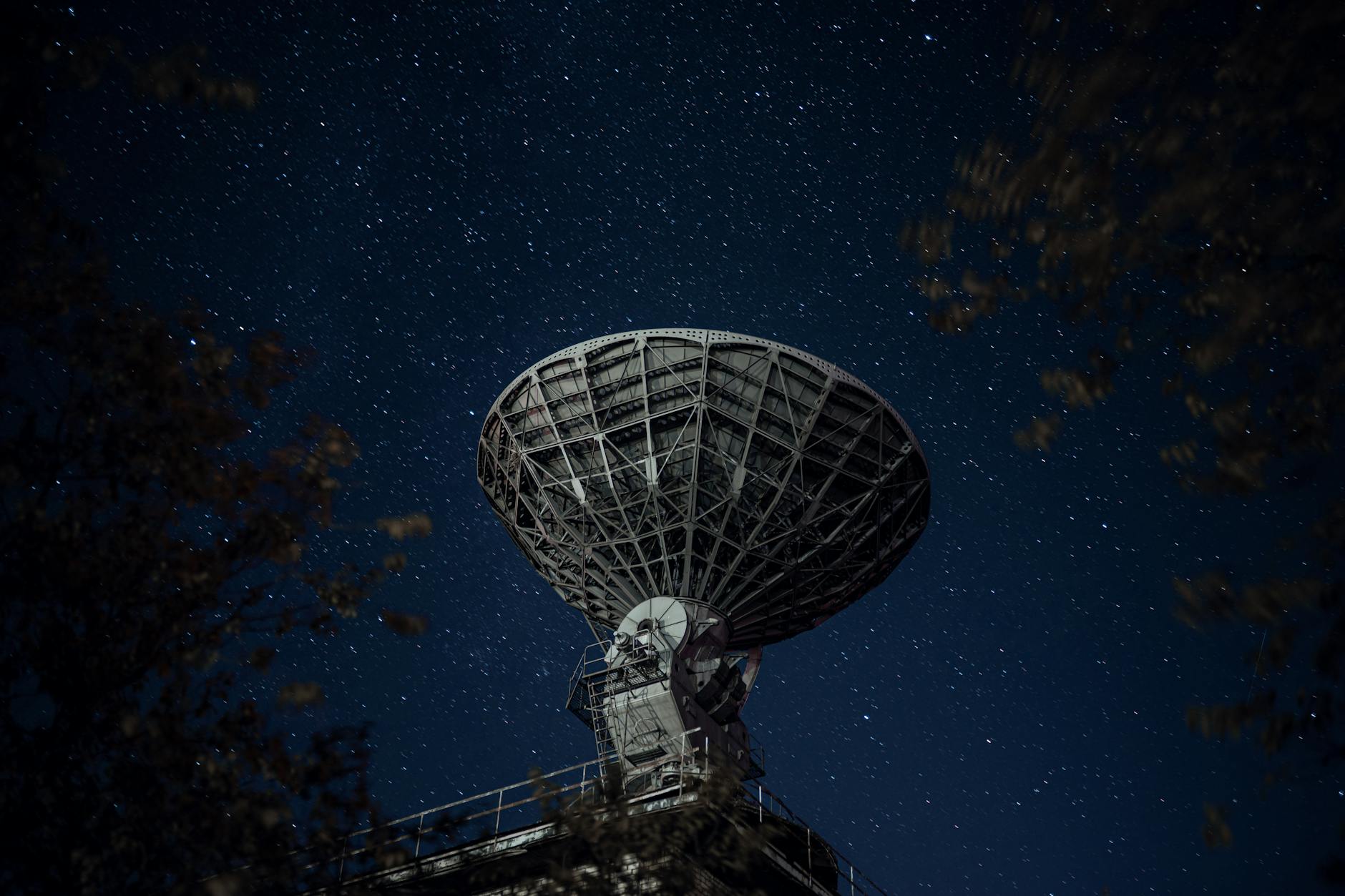
One of the most dramatic milestones in astronomy came from the Event Horizon Telescope, or EHT. Rather than being a single instrument, it is a global system of radio telescopes that work together. By combining observations from radio dishes around the world, the EHT creates an effective telescope about the size of Earth.
Why go to such extremes? Because the apparent size of a black hole’s immediate surroundings in the sky is incredibly small. To distinguish features near the black hole using radio wavelengths, astronomers need extremely high angular resolution, meaning the ability to separate very tiny details.
The EHT used this technique to produce the first direct image of a black hole and its vicinity, published on 10 April 2019. That image showed the supermassive black hole in the center of Messier 87, often called M87*. In 2022, the collaboration released an image of Sagittarius A*, the black hole at the center of the Milky Way.
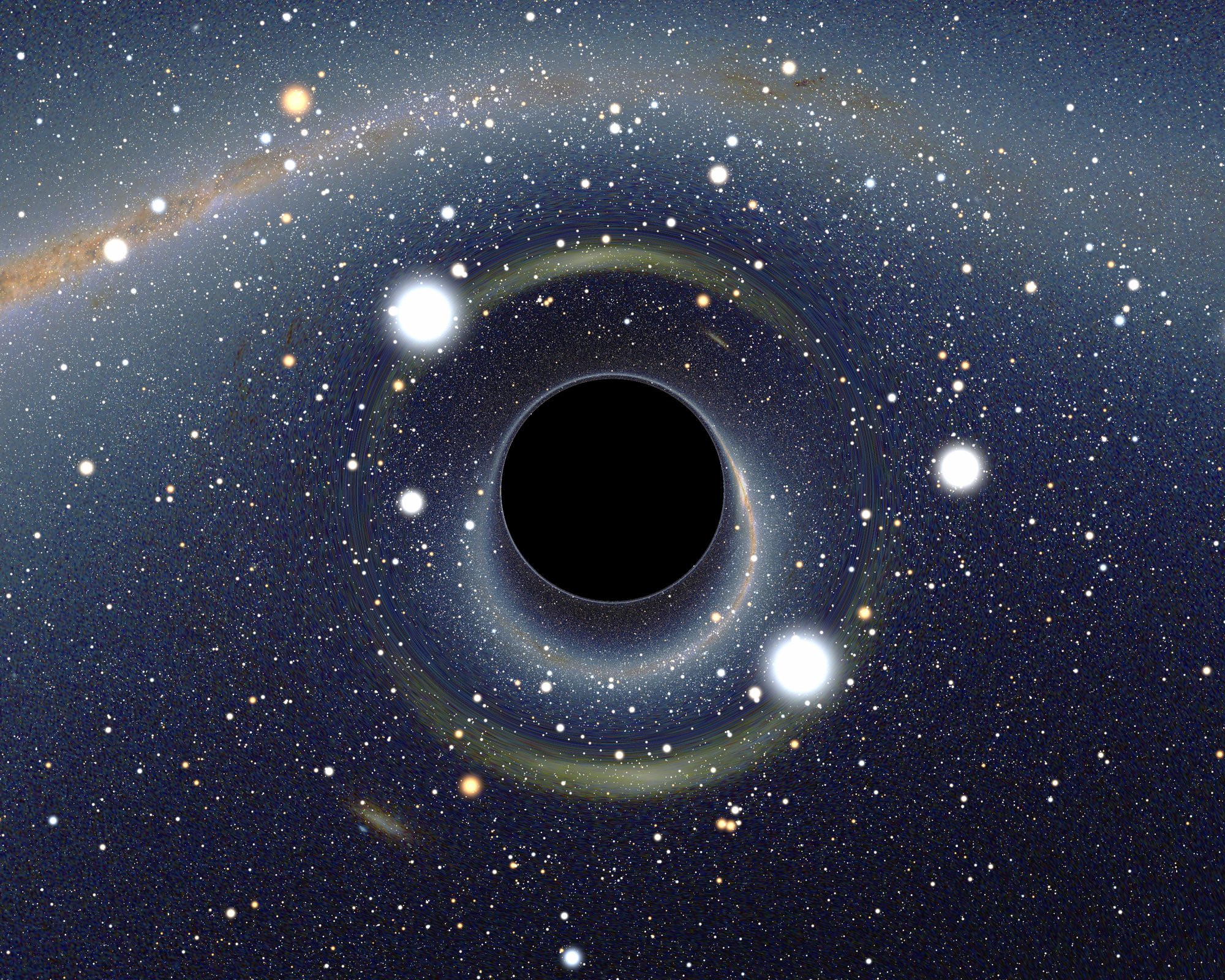
What the EHT sees is not the event horizon itself, but the black hole’s shadow. This shadow is connected to the photon sphere, a region where light can be bent so strongly that it may orbit the black hole. From a great distance, that extreme bending creates a dark central silhouette surrounded by glowing emission from nearby matter.
In simple terms, the shadow is the black hole’s outline against bright background material. It is one of the most powerful visual signatures that a black hole is really there.
Why the shadow matters
The shadow is important because black holes themselves do not emit visible signals in the normal way. A black hole’s presence must be inferred from its effect on matter and radiation nearby. The EHT images offer exactly that kind of evidence.
For Sagittarius A*, the image provided further confirmation that the compact radio source at the Milky Way’s center is indeed a black hole. For decades, astronomers had already built a strong case from the motions of nearby stars. The shadow image added a striking new line of support.
Listening to black holes collide
Black holes do not just reveal themselves through light. They also announce themselves through gravitational waves.
Gravitational waves are ripples in spacetime. They are produced when massive objects move in especially violent ways, such as two black holes spiraling together and merging. When such a wave passes through Earth, it changes distances by tiny amounts.
Observatories such as LIGO and Virgo are built to detect these minute distortions. They use gravitational-wave interferometry, in which a laser beam is split into two long perpendicular arms. The beams reflect from mirrors and then recombine. Normally they cancel in a predictable way. But if a gravitational wave passes through, it slightly changes the effective lengths of the arms, producing a measurable signal.
This method is extraordinarily sensitive because gravitational waves are extremely weak by the time they reach Earth. The observatories therefore use tunnels several kilometres long and carefully control sources of noise.
In late 2015, the LIGO Scientific Collaboration and Virgo Collaboration made the first direct detection of gravitational waves, called GW150914. It was also the first direct observation of a black hole merger. At the moment of merger, the two black holes had masses of about 30 and 35 times the mass of the Sun and were roughly 1.4 billion light-years away.
Since that first breakthrough, hundreds more gravitational-wave events have been observed by LIGO and Virgo.
What mergers tell us
Gravitational waves do more than confirm that black holes collide. By analyzing the signal, scientists can infer properties of the black holes involved, including their masses and spins.
Spin means angular momentum, or how rapidly a black hole rotates. Black holes are not just simple dark spheres sitting still in space. Many rotate, sometimes very quickly, and that rotation affects the spacetime around them.
Because the gravitational-wave signal carries information about the inspiral and merger, it allows astronomers to estimate the properties of the original pair and the merged remnant. This is one reason gravitational-wave astronomy has become such a powerful new tool: it lets scientists study black holes even when there is little or no light to observe.
Weighing the giant at the center of the Milky Way
Long before the image of Sagittarius A* was released, astronomers had strong evidence for a supermassive black hole at the center of our galaxy.
Since 1995, astronomers have tracked the proper motions of stars near the Milky Way’s center. These stars orbit an invisible object located at the radio source Sagittarius A*. By fitting the stars’ paths to Keplerian orbits, astronomers concluded that an enormous amount of mass must be packed into a very small region.
One of the best-known stars in this work is S2, which completed a full orbit. Using orbital data like this, astronomers refined the mass of Sagittarius A* to about 4.3 million times the mass of the Sun, confined within less than 0.002 light-years.
That is the key logic behind “weighing” a black hole. You may not see the black hole directly, but you can measure how strongly it pulls on nearby stars. The faster and tighter the orbits, the more mass must be concentrated at the center.
These observations do not merely indicate a heavy object. They point to a supermassive black hole because there is no other plausible way to confine so much invisible mass into such a small volume.
Light, motion, and spacetime ripples
Taken together, black hole astronomy rests on three great detection strategies.
First, there is light. Matter around black holes can become intensely hot and luminous in accretion disks, jets, and other energetic structures. The EHT uses radio light from these surroundings to map the black hole’s shadow.
Second, there is motion. The orbits of stars around Sagittarius A* reveal the presence and mass of the unseen central object.
Third, there are ripples in spacetime. Gravitational-wave observatories detect black hole mergers by measuring the passing distortions these events create.
Each method probes something slightly different. Imaging shows the black hole’s immediate environment. Orbital measurements reveal its gravitational influence over time. Gravitational waves capture black holes in motion during their most violent encounters.
The invisible made measurable
Black holes were once treated as mathematical curiosities. Today, they are measured, imaged, and detected across multiple branches of astronomy.
The shadow of M87* showed that an Earth-sized virtual telescope could map the silhouette of a black hole. Gravitational-wave detections proved that black holes merge and send detectable signals across immense distances. And the stars around Sagittarius A* let astronomers weigh the dark giant in the Milky Way’s core at about 4.3 million solar masses.
So even though black holes themselves do not let light escape, they are not beyond observation. Their gravity writes signatures into light, motion, and spacetime itself. In that sense, black hole astronomy is one of science’s greatest triumphs: turning the invisible into evidence.
Sources
Based on information from Black hole.
More like this
Chase the shadow and catch the cosmos — download DeepSwipe and spot invisible wonders one swipe at a time.