Full article · 8 min read
Black Holes and the Event Horizon: the One-Way Boundary You Wouldn’t Feel
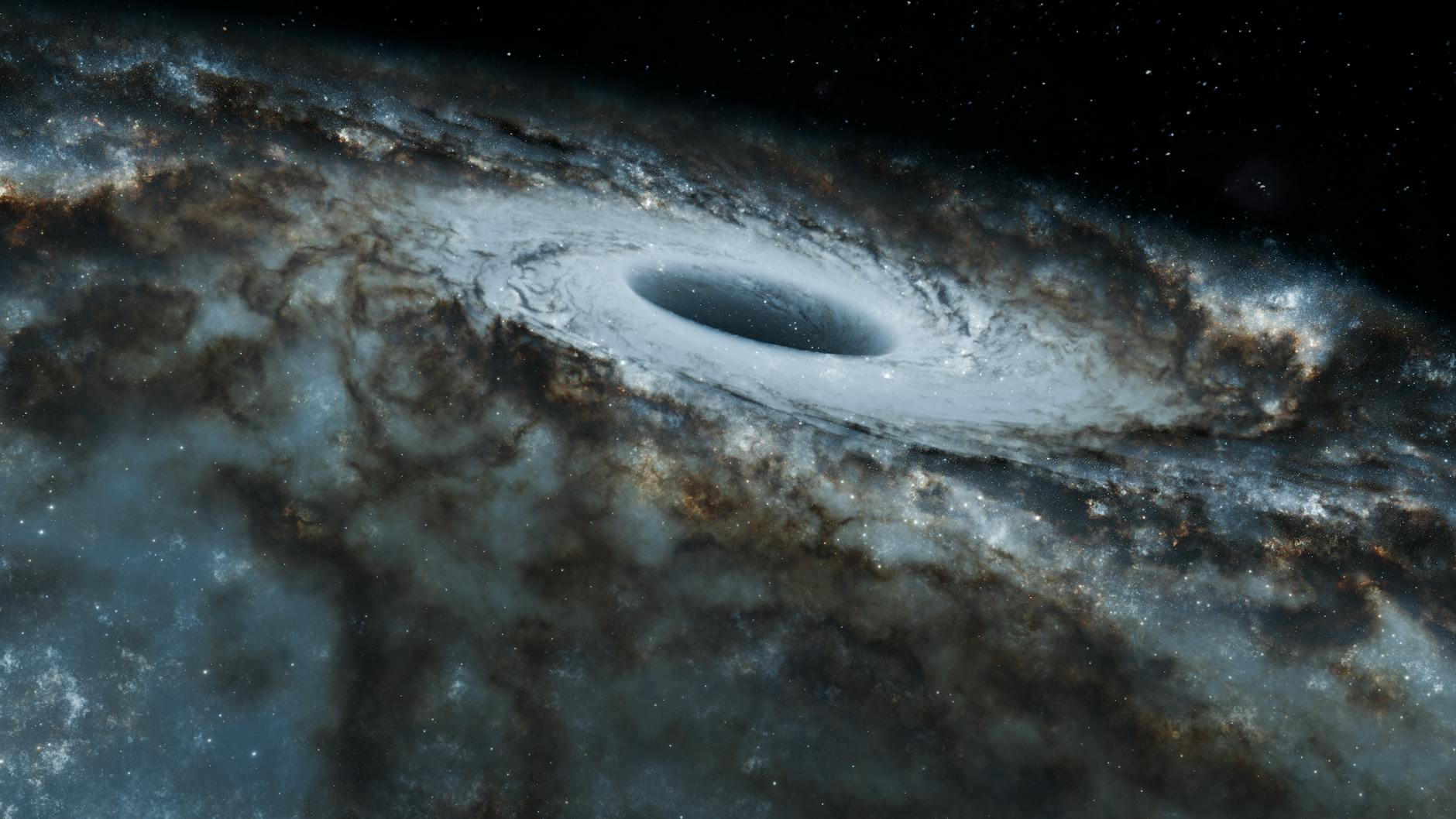
A black hole is so compact that its gravity prevents anything, even light, from escaping. The feature that makes a black hole a black hole is the event horizon: a boundary beyond which signals and objects can only move inward.
That idea sounds dramatic, but one of the strangest parts is how undramatic the crossing itself would be. In general relativity, crossing the event horizon produces no locally detectable change. There is no cosmic wall, no visible line painted across space, and no sudden jolt announcing that you have passed the point of no return. Yet once you cross it, your future is fixed.
What the event horizon actually is
The event horizon is often described as the “boundary of no escape.” That is a useful phrase because it captures the core idea: once something is inside, no information-carrying signal can get back out.
This includes light. Since light is the fastest thing that can carry information outward, if even light cannot escape, then nothing else can either.
In 1958, David Finkelstein identified the Schwarzschild surface as an event horizon and called it “a perfect unidirectional membrane.” That image remains one of the clearest ways to think about it. Things can cross inward, but causal influence cannot come back out to affect the outside universe.
This is why the event horizon is so central to black hole physics. A black hole is not just an object with a lot of mass. It is a region of spacetime with a one-way boundary.
Why you wouldn’t notice crossing it
This is the part that feels most counterintuitive. In general relativity, an observer falling into a black hole would not notice anything special at the exact moment of crossing the event horizon. Their own clock ticks normally. Their local surroundings do not suddenly announce, “You are now inside.”
That result follows from Einstein’s view of gravity. General relativity describes gravitation as the curvature of spacetime, meaning space and time themselves are shaped by mass and energy. According to this theory, the event horizon is not a physical surface like a solid shell. It is a boundary in spacetime.
Because of Einstein’s equivalence principle, it is impossible to determine the location of the event horizon from purely local observations. In simple terms, if you are falling freely, you cannot perform some small nearby test and discover that you are exactly at the horizon.
So the crossing can be perfectly ordinary from your own point of view, even though it is extraordinary from the point of view of the wider universe.
Two observers, two very different stories
Black holes produce one of the wildest splits in perspective in physics.
For the person falling in, the journey continues in finite time. They cross the horizon and keep moving inward.
For a distant observer, things look very different. A clock near a black hole appears to tick more slowly than one farther away. This effect is called gravitational time dilation. Light leaving the infalling object also becomes redder and dimmer, an effect called gravitational redshift.
As a result, someone watching from afar would see the infalling object appear to slow down as it approached the horizon. It would seem to freeze just above it, becoming dimmer, redder, and harder to detect. The object does not appear to cleanly pop through the horizon from that distant point of view.
For an object falling from half a Schwarzschild radius above the event horizon, it would fade from view within one hundredth of a second. The outside observer would see it flatten onto the black hole visually, joining all the material that had ever fallen in.
This does not mean the object “really” stops in its own experience. It means the geometry of spacetime causes the outside view and the falling view to diverge dramatically.
The Schwarzschild radius, explained simply
The Schwarzschild radius is the radius of the event horizon for a non-spinning, uncharged black hole. It depends directly on the black hole’s mass: the more massive the black hole, the larger the event horizon.
For a nonspinning, uncharged black hole, the Schwarzschild radius is proportional to mass and is approximately 2.95 kilometers for each solar mass. A solar mass means the mass of the Sun.
This matters because it shows that black holes are not all tiny. A more massive black hole has a larger event horizon. And that changes what the surroundings near the horizon are like.
The horizon is not the singularity
People often talk about black holes as if the event horizon and the center are the same thing. They are not.
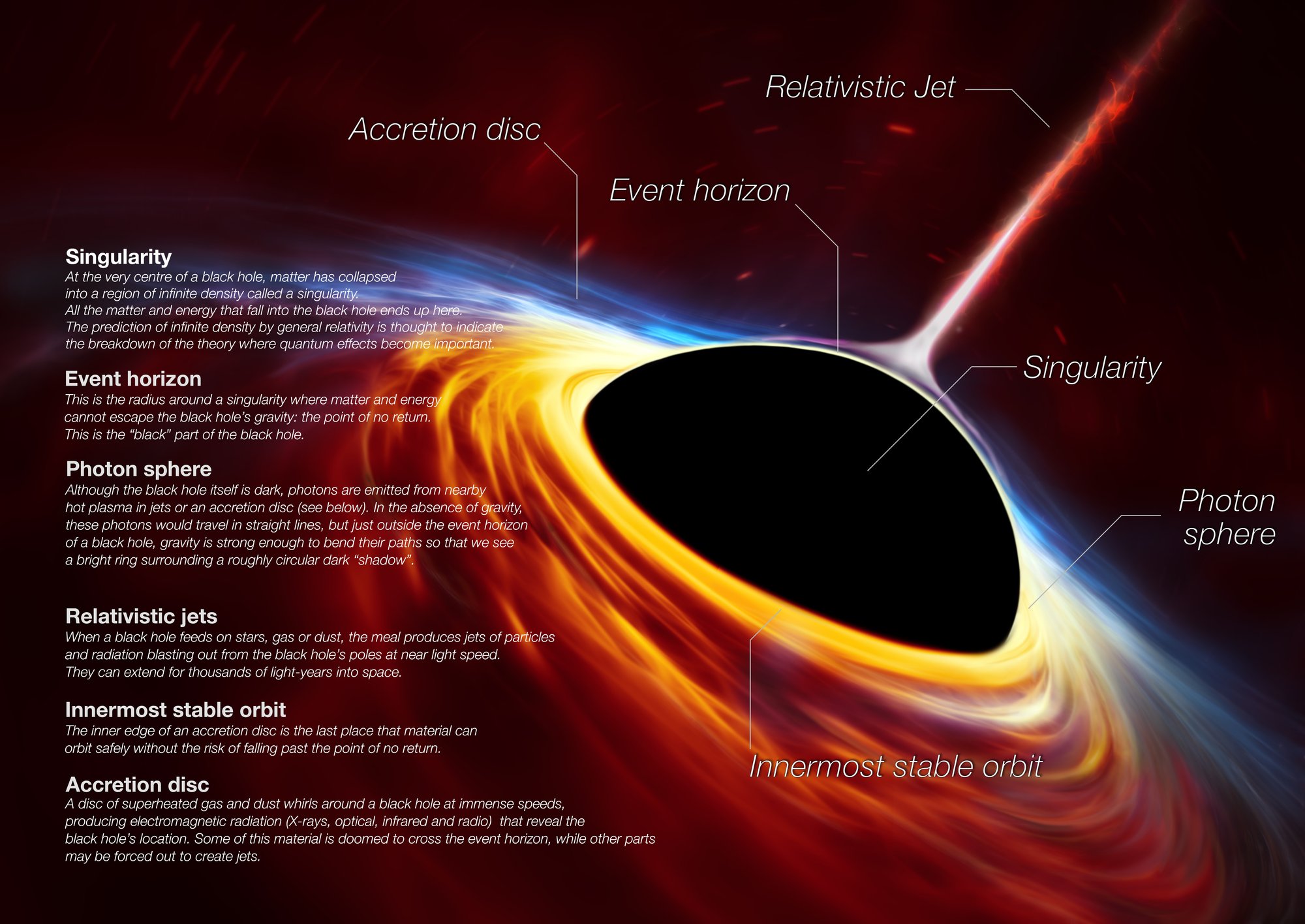
The event horizon is the outer one-way boundary. Deep inside, general relativity predicts a singularity, where the curvature of spacetime becomes infinite. For a non-rotating black hole, that singularity takes the form of a point. For a rotating black hole, it is predicted to form a ring singularity.
A singularity is where the mathematical description breaks down. The theory predicts infinite curvature and effectively infinite density in zero volume. That is why many physicists expect that some future theory, often called quantum gravity, will change the story.
Quantum gravity means a theory that would unite quantum mechanics, which describes nature on the smallest scales, with general relativity, which describes gravity and large-scale spacetime. At present, no consensus exists on exactly how that deeper theory should describe the inside of a black hole.
Once inside, what happens?
For a non-rotating black hole, crossing the event horizon means you cannot avoid being carried toward the singularity. According to general relativity, once inside, all future-directed paths lead inward.
As an infalling observer gets deeper inside, tidal forces grow stronger. Tidal forces are differences in gravitational pull from one part of an object to another. Near a black hole, those differences can become extreme enough to stretch and squeeze matter. This effect is sometimes called spaghettification, or the noodle effect.
Eventually, in the classical picture given by general relativity, the infalling object reaches the singularity and is crushed into an infinitely small point.
That said, the same physics also signals its own incompleteness. Since the singularity is precisely where the theory predicts infinities, many researchers view it as a sign that general relativity is being pushed beyond where it can be the final word.
Why the event horizon matters so much in astronomy
Black holes are hard to observe directly because they do not themselves emit ordinary electromagnetic radiation. That makes the event horizon especially important: it is the defining feature that separates black holes from other compact objects.
Astronomers usually infer black holes from their effects on surrounding matter and light. Gas falling inward can form an accretion disk, a flattened disk of hot infalling plasma. Friction heats that material and makes it glow, often strongly in X-rays. If stars orbit an invisible compact object, their motions can reveal the object’s mass and location.
This is how black hole candidates are identified in binary systems and in galactic centers.
At the center of the Milky Way, stars orbit the radio source Sagittarius A*. Their motions showed that a huge amount of invisible mass is packed into a very small region. The best estimate given is about 4.3 million solar masses. Later, the Event Horizon Telescope image of Sagittarius A* provided further confirmation that it is indeed a black hole.
The Event Horizon Telescope also produced the first direct image of a black hole and its vicinity in Messier 87’s galactic center, published in 2019. What is observed is not the horizon itself, but the black hole shadow created by how light behaves near it.
The horizon, the photon sphere, and the shadow
Another easy confusion is between the event horizon and the photon sphere.
The photon sphere is a boundary where photons moving on just the right paths can be bent all the way around the black hole. For a Schwarzschild black hole, the photon sphere lies at 1.5 times the Schwarzschild radius. Light can still escape from the photon sphere under the right conditions, but light that crosses it on an inbound trajectory is captured.
Seen from far away, the photon sphere helps create the black hole’s shadow. That shadow marks the limit of possible observations because no light emerges from within the black hole.
So when people talk about “seeing” a black hole, what they usually mean is seeing the bright material around it and the dark shadow associated with the extreme bending and trapping of light near the horizon.
A concept that changed from curiosity to reality
Black holes were not always accepted as real astrophysical objects. For a long time they were treated as mathematical curiosities. The first exact solution of general relativity that would characterize a black hole was found in 1916, but it took decades before physicists began interpreting it as a real region from which nothing can escape.
The modern concept of black holes was sharpened in 1939 by Robert Oppenheimer and Hartland Snyder, who modeled an imploding star. Later, Finkelstein’s event horizon picture helped reconcile the outside perspective with the infalling one. By the 1960s and 1970s, black holes became mainstream subjects of research.
That shift from abstract equations to observable cosmic objects is one of the most dramatic transitions in modern science.
The one-way door at the heart of a black hole
The event horizon is one of the most unsettling ideas in physics because it combines calm local experience with absolute global consequence. You could cross it and feel nothing unusual in that instant. But from that moment on, no signal from you could ever return to the outside universe.
That is what makes the event horizon more than just a boundary. It is the ultimate one-way door: invisible, undetectable in the moment, and final in everything that follows.
Sources
Based on information from Black hole.
More like this
Cross the knowledge horizon — download DeepSwipe and fall into fascinating facts, no escape required.