Full article · 8 min read
Saturn: the giant planet that’s lighter than water
Saturn sounds like it should be impossibly heavy. It is the sixth planet from the Sun, the second largest planet in the Solar System, and more than 95 times as massive as Earth. Yet its average density is so low that, in a simple comparison, it is the only planet with a density lower than water.
That strange combination is what makes Saturn so memorable: enormous in size, massive in total, but surprisingly light for its volume.
What does “less dense than water” actually mean?
Density is a measure of how much mass is packed into a given volume. In the metric system, it is often written in grams per cubic centimeter, or g/cm3. Water has a density of about 1 g/cm3. Saturn’s average density is about 0.69 g/cm3, roughly 30% less than water.
That does not mean Saturn is made of liquid water, or that it has a simple floating relationship like an everyday object dropped into a tub. It means that when you average out all of Saturn’s material across its immense volume, the result is lower than the density of water.
This is especially striking because Saturn is huge. Its average radius is about nine times that of Earth. Even so, its material is spread out in a way that keeps the whole planet relatively low in average density.
Why Saturn is so low-density
The main reason is composition. Saturn is a gas giant made predominantly of hydrogen and helium. These are the lightest common elements, and they dominate the planet.
Saturn does not have a definite surface like Earth. Instead, its outer layers are gaseous, and deeper inside, pressure increases so much that hydrogen changes form. Standard models describe a small rocky core surrounded by hydrogen and helium, including deep layers of liquid and metallic hydrogen.
So Saturn is not a hollow ball of gas, and it is not uniformly fluffy all the way through. In fact, conditions become extreme toward the center. Temperature, pressure, and density all rise steadily inward. The core is thought to be dense and rocky, and Saturn’s interior may reach about 11,700 °C at the core.
But even with that dense center, the planet as a whole still averages out to a remarkably low density because the bulk of Saturn’s enormous volume is made of hydrogen and helium.
A giant that bulges in the middle
Saturn’s shape also helps tell the story. Because it rotates quickly, the planet is not a perfect sphere. It is an oblate spheroid, meaning it is flattened at the poles and bulges at the equator.
Its equatorial radius is 60,268 km, while its polar radius is 54,364 km. That means the equator is more than 10% farther from the center than the poles are. Among the giant planets, Jupiter, Uranus, and Neptune are less oblate.
This bulging shape is a clue that Saturn is not rigid like a rocky planet. Its rapid rotation and fluid-rich structure allow it to spread outward around the equator.
Low density does not mean weak in every way
Saturn’s low average density can make it sound gentle, but that would be misleading. This planet still has immense gravity overall.
At the equator, the effective surface gravity is 8.96 m/s2, which is lower than Earth’s. That happens because Saturn’s rapid rotation and equatorial bulge reduce the effective pull there. But escaping Saturn is another matter entirely.
The escape velocity near the equator is nearly 36 km/s, much higher than Earth’s. Escape velocity is the speed needed to break free from a world’s gravity. So even though Saturn’s average density is low, its sheer size and mass make it difficult to leave.
That is the twist at the heart of Saturn: low-density does not mean low-power.
Bigger than it seems, lighter than Jupiter
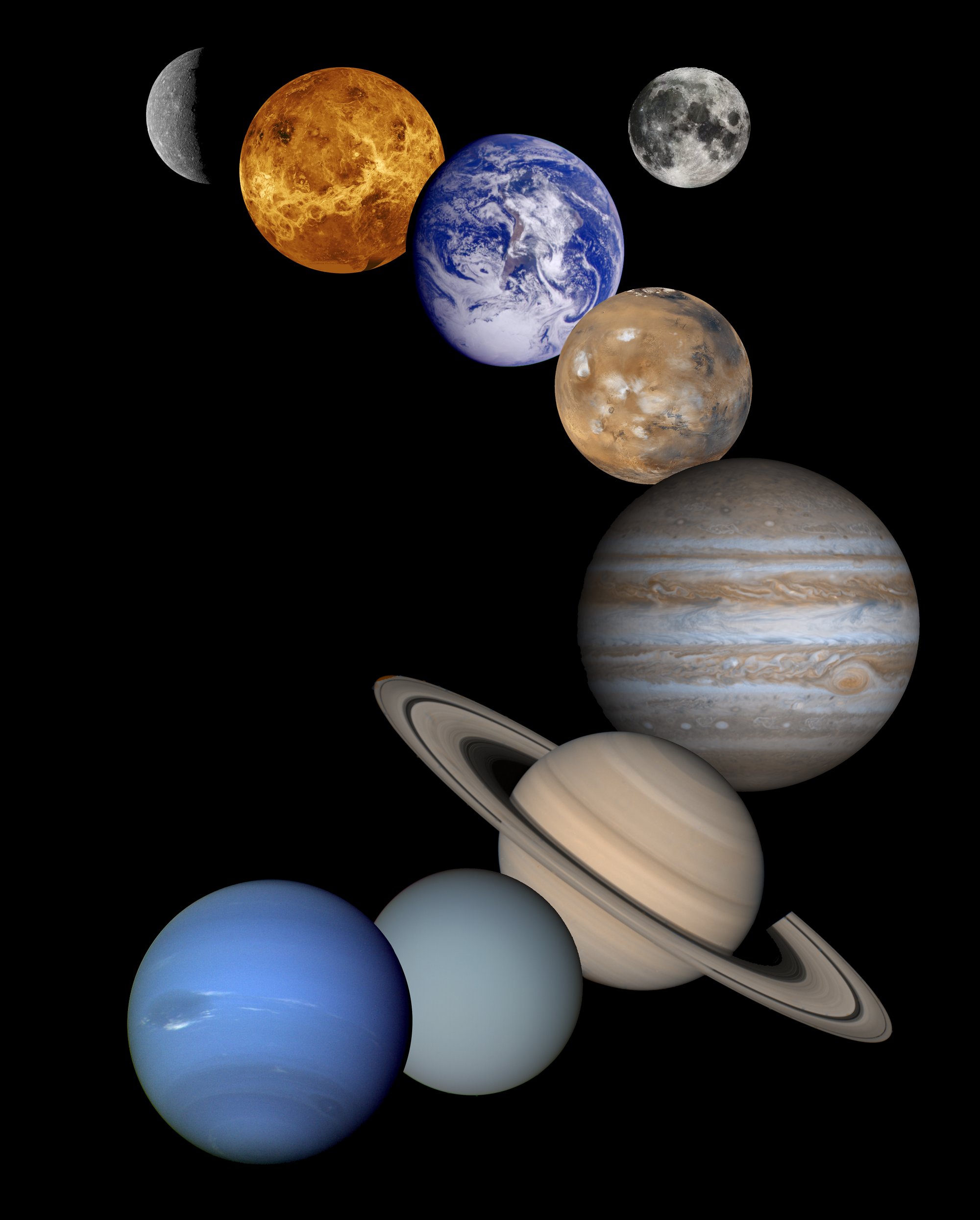
Saturn is often compared with Jupiter, the Solar System’s largest planet. Saturn is almost as big as Jupiter, but it has less than a third of Jupiter’s mass.
That comparison shows just how spread out Saturn’s material really is. Saturn is vast, but less compact than Jupiter.
Even so, Saturn is still a planetary heavyweight. Jupiter’s mass is 318 times Earth’s, and Saturn’s is 95 times Earth’s. Together, Jupiter and Saturn contain 92% of the total planetary mass in the Solar System.
So Saturn is “light” only in an average-density sense. In total mass, it is one of the dominant worlds of the Solar System.
What Saturn is like inside
Saturn’s interior is thought to have several layers. At the center is a rocky core. Around that lies a deep metallic hydrogen layer, then an intermediate layer of liquid hydrogen and liquid helium, and finally an outer layer of gas.
Metallic hydrogen is hydrogen under such extreme pressure that it behaves like a metal. This layer is important because electrical currents there are thought to generate Saturn’s magnetic field.
Saturn’s magnetic field is weaker than Earth’s in field strength at the equator, but because Saturn is so large, its magnetic moment is about 580 times that of Earth. The field at Saturn’s equator is about one twentieth as strong as Jupiter’s.
Its magnetosphere, the region dominated by its magnetic field, helps deflect particles from the solar wind. Saturn also produces aurorae, like Earth does.
A pale yellow world with fast winds
Saturn’s appearance is much calmer than Jupiter’s at first glance. Its outer atmosphere is generally bland and low in contrast, although long-lived features can appear.
The planet has a pale yellow hue caused by ammonia crystals in its upper atmosphere. Its atmosphere is mostly molecular hydrogen and helium, with trace amounts of ammonia, acetylene, ethane, propane, phosphine, and methane.
Saturn’s cloud bands are similar to Jupiter’s, but fainter and broader near the equator. The upper clouds are made of ammonia ice, while deeper layers may contain ammonium hydrosulfide and water clouds.
And despite its soft appearance, Saturn is windy. Wind speeds can reach 1,800 km/h, making them the second fastest among the planets, after Neptune.
Strange weather on a low-density giant
Saturn can produce dramatic weather. One famous event is the Great White Spot, a short-lived storm that appears roughly once every Saturnian year, about every 30 Earth years, around the northern hemisphere’s summer solstice. Major storms were observed in 1876, 1903, 1933, 1960, 1990, and 2010.
The planet also has extraordinary polar features. Around the north pole is a persistent hexagonal wave pattern at about 78° north latitude. Each side of the hexagon is about 14,500 km long, longer than Earth’s diameter. The structure rotates with a period of 10 hours 39 minutes 24 seconds.
At the south pole, Cassini observed a hurricane-like storm with a clearly defined eyewall. The south polar vortex has winds of 550 km/h and may have been present for billions of years.
Saturn’s rings make the contrast even better
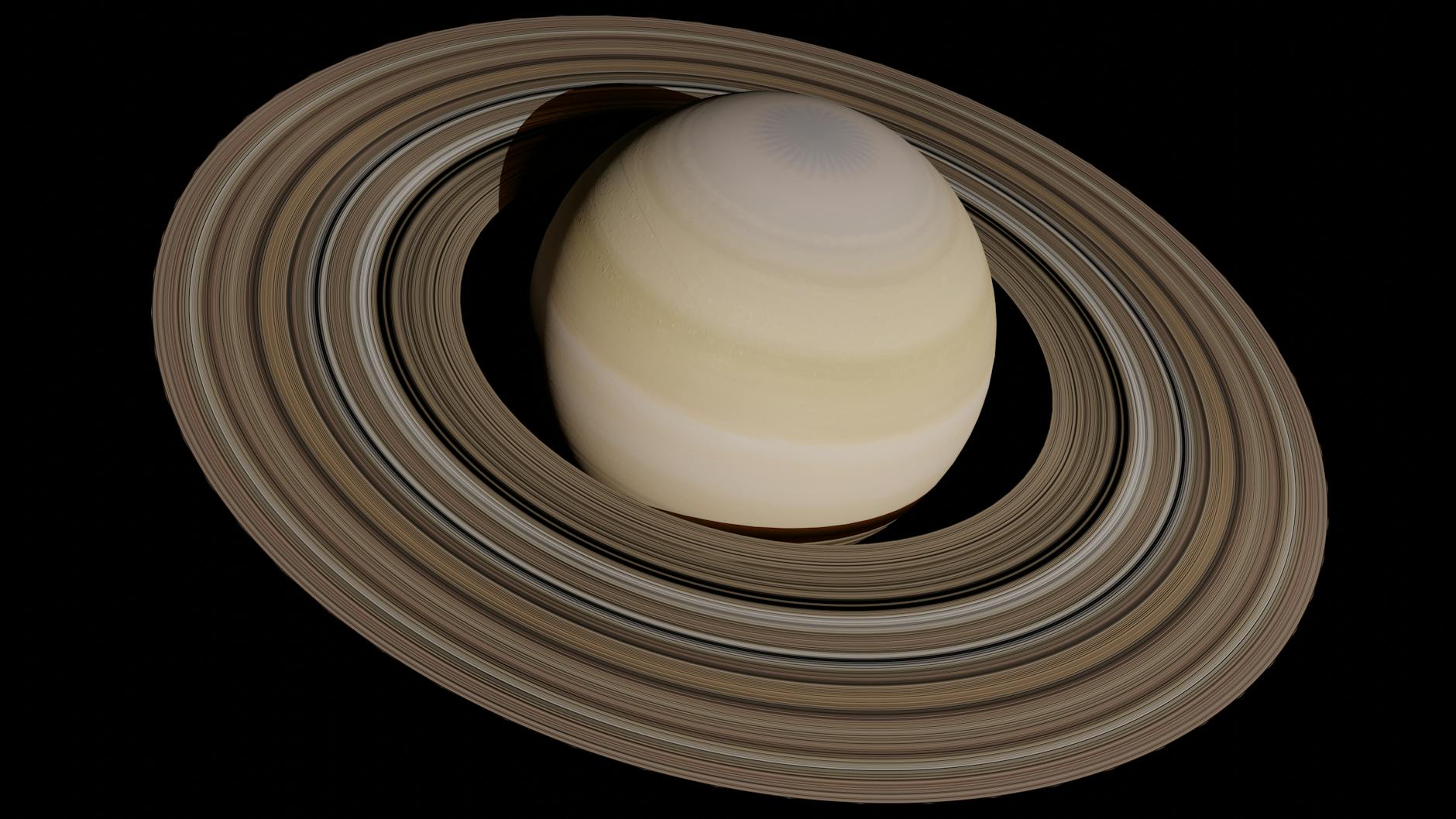
Saturn’s low density is only one reason it stands out. The other is its spectacular ring system.
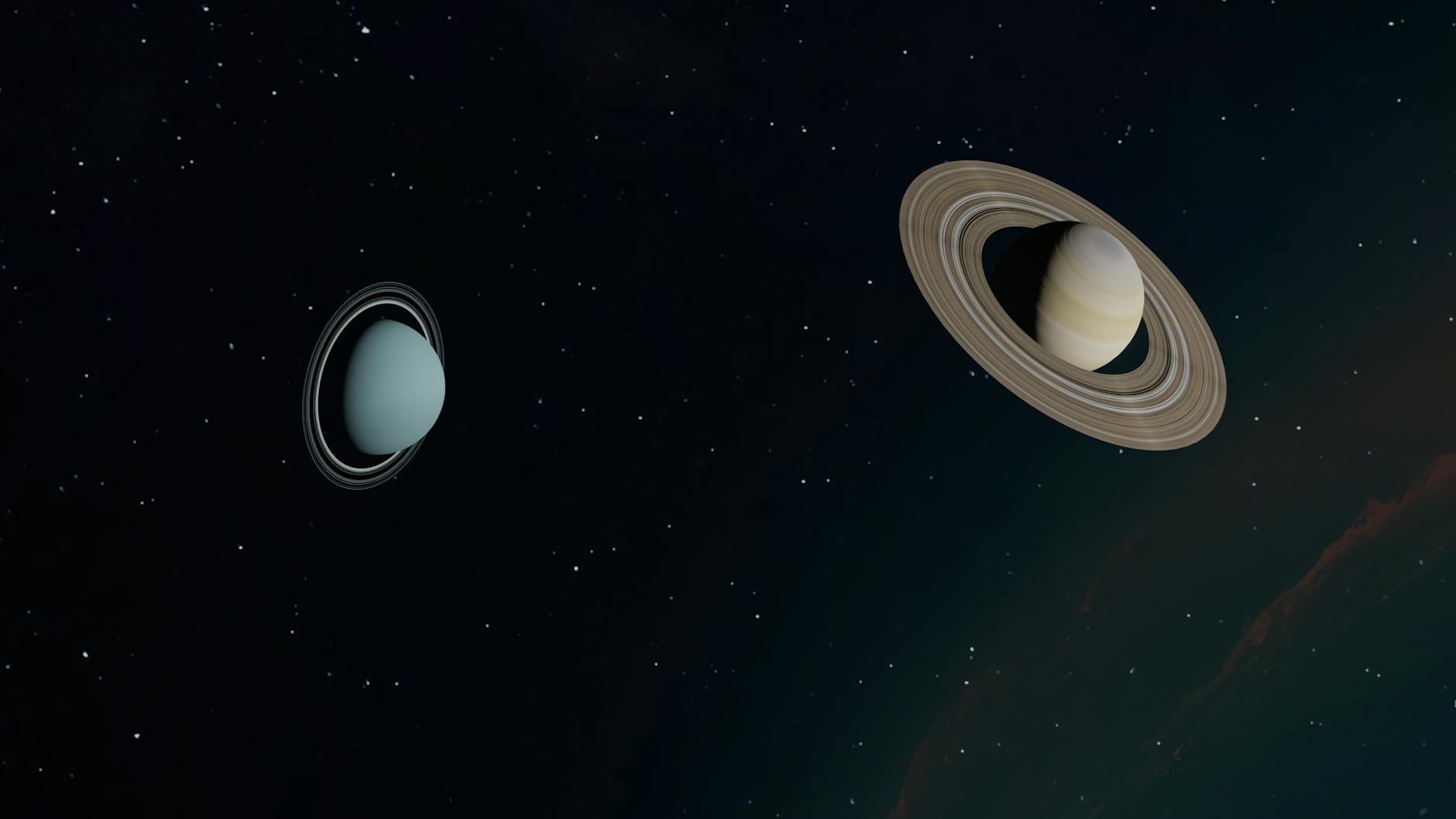
The rings stretch from 6,630 to 120,700 km outward from Saturn’s equator, yet average only about 20 meters in thickness. They are composed mainly of water ice, with smaller amounts of rocky debris, dust, tholin impurities, and about 7% amorphous carbon coating. Ring particles range from tiny dust specks to chunks up to 10 meters across.
Although other giant planets also have rings, Saturn’s are the largest and most visible. Some moons, including Pandora and Prometheus, act as shepherd moons, helping confine the rings.
The contrast is part of Saturn’s charm: a giant planet with low average density, wrapped in a ring system that looks delicate but spans enormous distances.
A world of many moons
Saturn has at least 274 known moons, with 63 officially named, plus hundreds of moonlets in the rings that are not counted as true moons.
Its largest moon, Titan, is the second largest moon in the Solar System and is bigger than Mercury, though less massive. Titan is the only moon in the Solar System with a substantial atmosphere, and it is also the only satellite known to have hydrocarbon lakes.
Another moon, Enceladus, has drawn attention because Cassini found plumes containing salt-rich particles, suggesting an ocean-like source beneath the surface. A 2015 flyby found most of the ingredients needed to sustain life forms that live by methanogenesis.
These moons add another layer to Saturn’s identity. It is not just a low-density giant; it is the center of a vast and varied planetary system.
Why Saturn’s “lightness” is so fascinating
Saturn challenges intuition. We tend to connect size with heaviness and compactness. Saturn breaks that mental shortcut.
It is immense, ringed, fast-spinning, and massive enough to help dominate the Solar System’s planetary mass. Yet, averaged over its whole volume, it is less dense than water.
That is what makes Saturn one of the best examples of how planetary science can overturn everyday expectations. A world can be gigantic without being tightly packed. A planet can have lower density than water while still holding onto a huge atmosphere, generating a magnetic field, whipping up storms, and requiring nearly 36 km/s to escape.
Saturn is, in every sense, a heavyweight giant with a lightweight average.
Sources
Based on information from Saturn.
More like this
Go light on scrolling and heavy on learning—download DeepSwipe and explore giant facts, one swipe at a time.