Full article · 7 min read
Sun Rotation: Why the Sun Doesn’t Spin Like a Solid Ball
The Sun may look like a smooth, steady disk in the sky, but it is anything but rigid. Unlike a solid planet or a spinning toy ball, the Sun is a huge sphere of hot plasma, and different parts of it rotate at different speeds. That strange behavior helps explain why our star is so dynamic.
In fact, the Sun’s equator rotates in about 25.6 days, while the poles take about 33.5 days. That means the middle of the Sun laps the higher latitudes over time. Seen from Earth as our planet orbits the Sun, the apparent rotation period at the equator is about 28 days.
This uneven spin is called differential rotation. It is one of the key clues to how the Sun works beneath its visible surface and how it generates the magnetic activity that produces sunspots, flares, and other dramatic solar events.
The Sun Is Not a Solid Object
A major reason the Sun rotates unevenly is that it is not solid. The Sun is a massive sphere of hot plasma, made mostly of hydrogen and helium. Plasma is a state of matter in which gas is so hot that its particles are electrically charged.
Because the Sun is made of this flowing, shifting material rather than rigid rock or metal, its different regions are free to move in different ways. The equator spins faster, while the poles rotate more slowly.
The Sun’s visible “surface” is called the photosphere. This is the layer from which sunlight escapes into space. It is not a hard shell, but the apparent visible surface of the Sun. Above and below it, solar material is constantly moving.
What Causes the Uneven Spin?
The Sun’s differential rotation is caused by convective motion due to heat transport and by the Coriolis force produced by the Sun’s rotation.
Convective motion means hot material rises and cooler material sinks. In the Sun’s convection zone, which extends from about 0.7 solar radii to near the surface, solar plasma circulates in great moving cells. This churning motion carries energy outward.
The Coriolis force is the effect that makes moving material curve in a rotating system. On the Sun, that effect helps shape the flow of plasma and contributes to the different rotation speeds at different latitudes.
This outer region of the Sun is not calm. The thermal columns in the convection zone leave patterns on the surface called solar granulation at small scales and supergranulation at larger ones. These motions are part of the reason the Sun behaves more like a restless, rotating fluid than a spinning solid body.
A Hidden Boundary: The Tachocline
One of the most intriguing regions inside the Sun is the tachocline. This is the transition layer between the radiative zone and the convection zone.
The radiative zone rotates more uniformly, while the convection zone shows differential rotation. Where these two regimes meet, there is a large shear, meaning neighboring layers slide past one another at different rates.
That matters because this layer is thought to play a major role in generating the Sun’s magnetic field through a magnetic dynamo, also called the solar dynamo. In simple terms, a dynamo is a process that turns motion inside an electrically conducting fluid or plasma into magnetism.
So the Sun’s uneven spin is not just a curious detail. It may be deeply connected to the magnetic field that drives much of solar activity.
The Young Sun Was Likely Much Faster
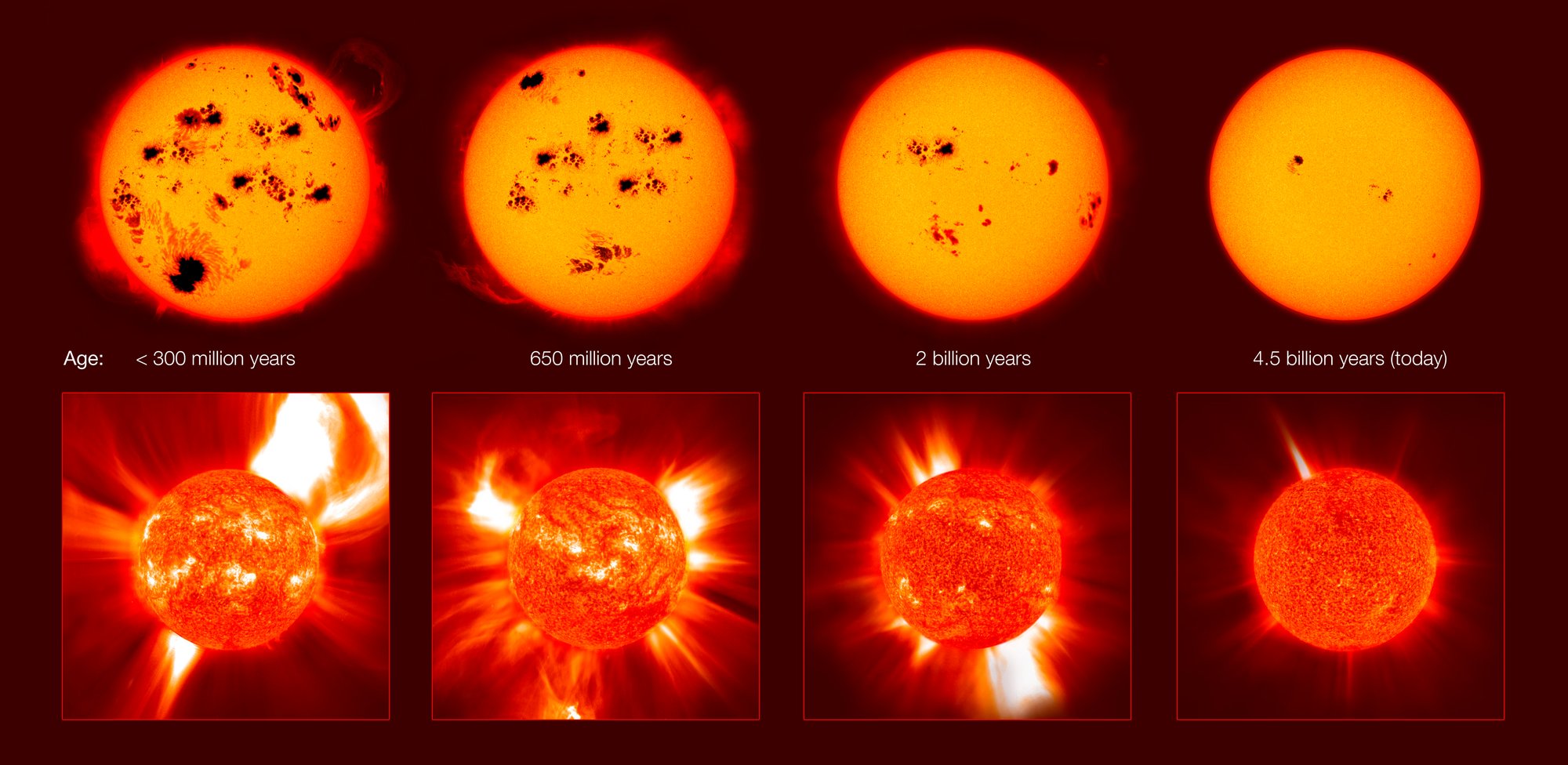
The Sun we know today is middle-aged, roughly halfway through the main-sequence portion of its life. But evidence from surveys of solar analogues, stars very similar to the Sun, suggests that the early Sun rotated up to ten times faster than it does now.
That faster spin likely made the young Sun much more active. Its surface would have produced greater X-ray and ultraviolet emission, and sunspots may have covered 5% to 30% of the surface.
Ultraviolet, often shortened to UV, is a form of light with more energy than visible light. X-rays are even more energetic. Stronger emission at those wavelengths is a sign of a more active and magnetically intense star.
Over time, the Sun’s rotation slowed through magnetic braking. This happens because the Sun’s magnetic field interacts with the outflowing solar wind, gradually draining rotational energy.
The solar wind is a continuous outward flow of particles from the Sun. As it streams into space, it carries the Sun’s magnetic field with it. That long-term interaction helps reduce the Sun’s spin rate over billions of years.
The Core May Still Be Spinning Faster
Even though the Sun’s surface has slowed dramatically since its youth, the deep interior may still preserve a trace of that earlier rapid rotation.
Data analysis has favored the idea that the core rotates faster than the radiative zone outside it. One striking possibility is that the core rotates about once per week, around four times the mean surface rotation rate.
That makes the core a kind of time capsule. While the outer layers have been braked over billions of years, the innermost region may have retained some memory of the Sun’s youthful spin.
The core is the central powerhouse of the Sun, extending from the center to about 20–25% of the solar radius. It reaches a temperature close to 15.7 million kelvin and is the only region that produces an appreciable amount of thermal energy through fusion.
Fusion in the core mainly happens through the proton–proton chain, which converts hydrogen into helium. Every second, the Sun’s core fuses about 600 billion kilograms of hydrogen into helium and converts about 4 billion kilograms of matter into energy.
That means the Sun’s spinning interior is also the place where its immense energy is generated.
Rotation, Magnetism, and Sunspots
The Sun’s uneven spin is tightly linked to its magnetic behavior. The magnetic field varies across the Sun’s surface and over time, and its most prominent rhythm is the roughly 11-year solar cycle, during which the number and size of sunspots rise and fall.
Sunspots are dark patches on the photosphere where concentrations of magnetic field inhibit the convective transport of heat from the solar interior to the surface. Because they are slightly cooler than the surrounding photosphere, they appear dark.
Differential rotation helps shift magnetic energy between different magnetic field structures over the course of the solar cycle. At one phase, buoyant upwelling in the convective zone can force magnetic fields through the photosphere, creating pairs of sunspots with opposite magnetic polarities.
This is one reason the Sun’s rotation matters so much: it helps shape the magnetic engine behind visible solar activity.
Why This Matters for Earth
The Sun’s magnetic activity is not just an abstract astrophysics topic. It can affect Earth directly.
Solar flares and coronal mass ejections tend to occur around sunspot groups. High-speed streams of solar wind are emitted from coronal holes. These events can contribute to auroras at moderate to high latitudes and can disrupt radio communications and electric power.
Changes in solar irradiance over the 11-year solar cycle have also been correlated with changes in sunspot number. Solar activity influences space weather conditions around Earth, making the Sun’s rotation part of a much bigger story about how our star affects the Solar System.
A Star Full of Motion
The Sun may appear steady from 150 million kilometers away, but beneath that familiar glow is a deeply layered, unevenly spinning star. Its equator outruns its poles. Its outer layers churn with convection. Its interior includes a sharp transition region where different rotational behaviors meet. And deep inside, its core may still be spinning with a relic speed from the Sun’s much wilder youth.
The result is a star that is constantly in motion, constantly reshaping its own magnetic field, and constantly reminding us that even the most familiar object in the sky is far more complex than it first appears.
Sources
Based on information from Sun.
More like this
Catch the Sun’s twisty secrets one swipe at a time—download DeepSwipe and spin up your daily dose of knowledge.