Full article · 8 min read
Nanban Shock: How Portuguese Traders, Guns, Jesuits, and Nagasaki Changed Japan
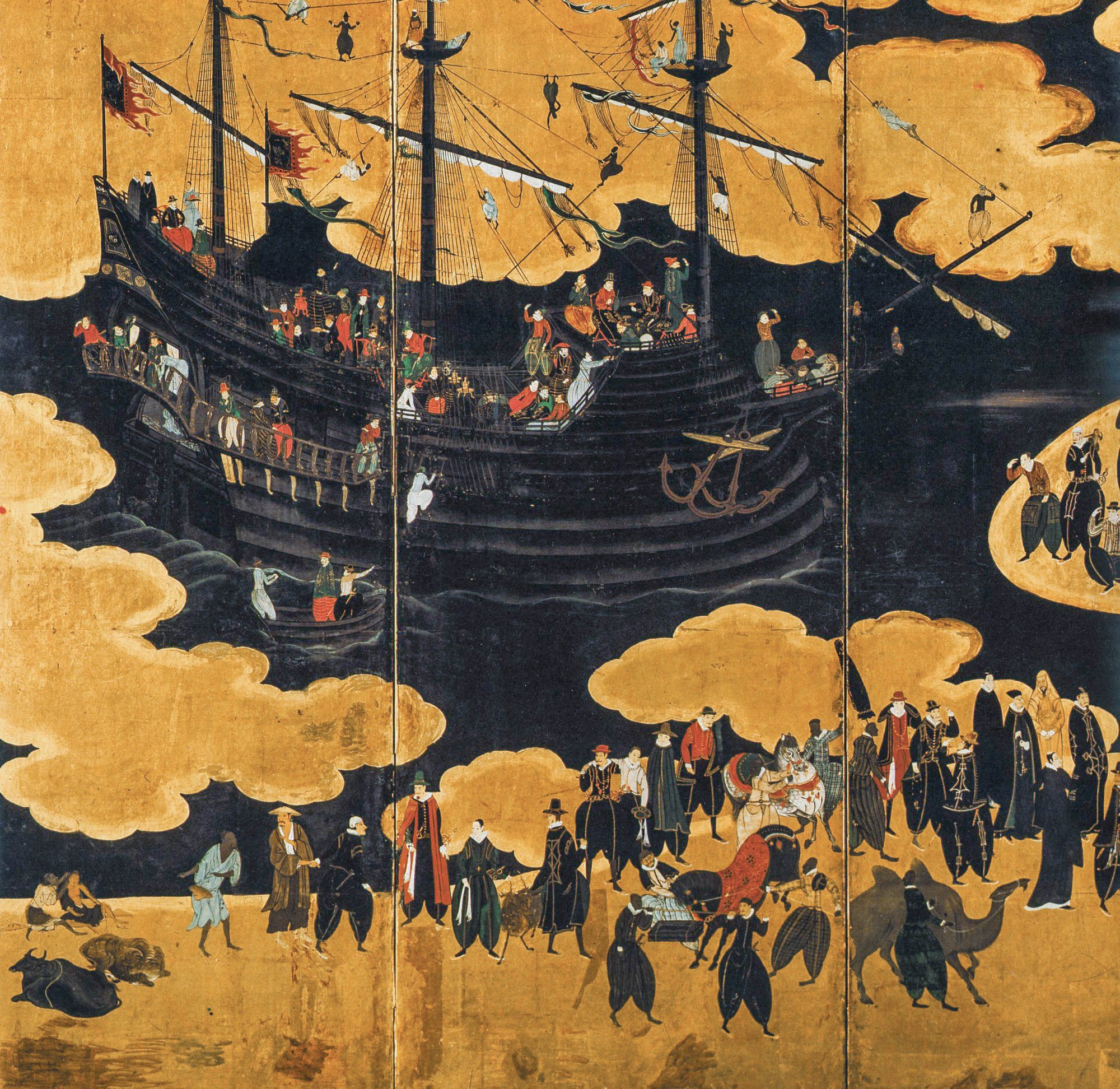
In 1543, a trading ship was blown off course and landed on Tanegashima, a Japanese island just south of Kyushu. On board were three Portuguese traders, the first Europeans known to set foot in Japan. What followed was not just a curious first contact. It was a period of rapid exchange in weapons, religion, trade, language, and warfare that left a deep mark on Japanese history.
This era is often remembered for dramatic contrasts: foreign merchants arriving in the middle of civil war, firearms spreading with astonishing speed, missionaries preaching Christianity, and a small fishing village named Nagasaki growing into a major port. It was a moment when Japan was neither fully open nor yet tightly closed, but intensely selective, experimental, and politically fragmented.
The arrival at Tanegashima
When the Portuguese landed in 1543, Japan was in a violent age of competing daimyō. A daimyō was a feudal lord who controlled land and armed followers. Because the country was divided among rival powers, any military advantage mattered.
The Portuguese brought one of the most important new tools of the age: the musket. Firearms were not just exotic curiosities. They quickly became practical weapons in Japanese warfare. The speed of adoption was striking. By 1556, daimyōs were using about 300,000 muskets in their armies.
That number captures the scale of the transformation. In little more than a decade, imported weaponry had become a major feature of conflict inside Japan. This was not passive contact. Japanese rulers were actively absorbing and deploying what they found useful.
Why firearms mattered so much
The sixteenth century was a time of near-constant struggle among regional lords. In that setting, the musket offered obvious advantages. It could be supplied to large forces and used to strengthen armies already fighting for territory, survival, and prestige.
The Portuguese impact was significant even in these early years of limited contact because firearms altered the balance of power among competing domains. Ongoing warfare made Japan unusually receptive to military technology from abroad. Rather than resisting the new weapons on principle, many daimyō sought them out.
This helps explain why the spread of muskets was so fast. Japan was not meeting Europe from a position of peace and detachment. It was meeting it during a civil-war era in which every lord wanted an edge.
Cannon and the first sea clashes
The exchange did not stop at handheld firearms. Portuguese ships also became involved in military actions around Japan.
In 1561, forces under Ōtomo Sōrin attacked Moji Castle in alliance with the Portuguese. The Portuguese provided three ships, a crew of about 900 men, and more than 50 cannons. This is regarded as the first bombardment of Japan by foreign ships. It was a dramatic sign that contact with Europe had moved far beyond trade goods and into direct military cooperation.
Just a few years later came another milestone. In 1565, the Battle of Fukuda Bay became the first recorded naval battle between Europeans and the Japanese. In that clash, the daimyō Matsura Takanobu attacked two Portuguese trade vessels at Hirado port.
This early confrontation shows how quickly the relationship became complicated. The Portuguese were traders and missionaries, but they were also armed outsiders whose presence affected local rivalries. European ships were not floating marketplaces alone; they were political and military actors in a fragmented landscape.
Christianity enters a divided Japan
The Portuguese also brought Christianity, which gained a substantial following in Japan. By one account from this period, it reached 350,000 believers. In 1549, the Jesuit missionary Francis Xavier arrived in Kyushu, helping launch one of the most remarkable religious encounters in Japanese history.
Jesuits were members of a Catholic religious order known for missionary work and education. In Japan, they did not operate in isolation from politics. Their success depended heavily on local lords, trade networks, and regional protection.
Some daimyō saw value in welcoming missionaries and Portuguese merchants at the same time. Conversion could align a domain more closely with profitable trade. During the civil wars, several competing lords hoped to attract Portuguese ships and commerce to their own territories.
That meant religion, commerce, and warfare often overlapped. A lord might support Christianity not only out of belief, but also because access to foreign merchants could bring wealth, weapons, and influence.
Nagasaki: from fishing village to Jesuit-backed port
No place better symbolizes this transformation than Nagasaki.
The Portuguese first moved through a number of domains. They had stayed on lands belonging to Matsura Takanobu, in Hirado, and also in the province of Bungo under Ōtomo Sōrin. In 1562, they moved to Yokoseura after Ōmura Sumitada offered to become the first lord to convert to Christianity, taking the name Dom Bartolomeu. But in 1564, rebellion instigated by Buddhist clergy led to the destruction of Yokoseura.
That instability pushed events toward Nagasaki. In 1571, Dom Bartolomeu, or Ōmura Sumitada, granted land in the small fishing village of Nagasaki to the Jesuits. They divided it into six areas and used it to receive Christians exiled from other territories as well as Portuguese merchants.
The Jesuits built a chapel and a school there under the name São Paulo. By 1579, Nagasaki had four hundred houses, and some Portuguese had married locally. In 1580, fearing the city might fall into the hands of a rival, Ōmura Sumitada decided to place Nagasaki directly under Jesuit control.
This was an extraordinary development. A modest coastal settlement had become a Christian-backed trade center, shaped by diplomacy, local conflict, and international commerce.
Language, printing, and the first Western-language Japanese dictionary
Nagasaki was not only a port of guns and goods. It also became a place of language learning and printing.
The Jesuits came to realize that mastering Japanese would help them achieve more conversions. That practical need led to a notable cultural milestone: Jesuits such as João Rodrigues produced a Japanese dictionary. Published in Nagasaki in 1603, it was the first Japanese dictionary of a Western language, which in this case was Portuguese.
That achievement says a great deal about the depth of contact. Dictionaries are not created in moments of mere curiosity. They appear when people expect sustained exchange and need tools for teaching, translating, persuading, and negotiating.
So the Nanban era was not just about weapons and ports. It also involved the slow work of understanding speech, recording vocabulary, and building a bridge between very different worlds.
Trade, maps, and a wider world
The relationship between Japan and Portugal also expanded cultural horizons. In 1568, the Portuguese cartographer Fernão Vaz Dourado produced the first map made in the West that represented Japan. Direct commercial and cultural exchange was beginning to place Japan into a wider global picture.
At the same time, this contact remained selective and unstable. The Portuguese were allowed to trade and create colonies where they could convert people to Christianity, but their position depended on local conditions and fragile alliances. Rebellion, war, and rivalry could quickly reshape where they were welcome.
This made the period dynamic but precarious. Openings appeared suddenly, then narrowed just as suddenly.
From openness to fear and control
The age of Portuguese and Jesuit influence unfolded amid the wider reunification of Japan. As powerful warlords gradually brought the fractured country back under centralized rule, attitudes toward foreign religion and outside influence changed.
Later rulers grew increasingly wary of Christianity. During the Tokugawa period, Christianity came to be seen as a potential threat. After the Christian-led Shimabara Rebellion of 1638, it was completely outlawed.
The Tokugawa shogunate then implemented sakoku, or the “closed country” policy, under which Japanese people were not allowed to travel abroad, return from overseas, or build ocean-going vessels. The only Europeans permitted on Japanese soil were the Dutch, who were confined to a single trading post on Dejima at Nagasaki from 1634 to 1854.
In that sense, the Nanban shock helps explain what came later. The very intensity of early contact with Europeans—guns, missions, trade privileges, and political entanglements—helped create the fears that later drove strict control and isolation.
Why this episode still fascinates
This slice of Japanese history is so compelling because it compresses enormous changes into a few decades. A storm-blown arrival at Tanegashima led to the spread of muskets on a massive scale. Trade ties turned ports into power centers. Missionaries built schools and chapels. A fishing village became Nagasaki, one of the most important gateways between Japan and the outside world. And language contact became deep enough to produce a landmark dictionary.
Then, almost paradoxically, this period of intense exchange helped set the stage for exclusion. The openness of the sixteenth century was followed by fear, repression, and tightly managed foreign contact under the Tokugawa shogunate.
That dramatic arc is what gives the Nanban era its force. It was not simply the story of Europe arriving in Japan. It was the story of Japan choosing, adapting, resisting, and eventually restricting contact on its own terms.
Sources
Based on information from History of Japan.
More like this
From muskets to missionaries, history hits fast — download DeepSwipe and keep your curiosity loaded.