Full article · 7 min read
Kofun Megatombs and the Rise of Yamato
Long before Japan’s courtly capitals and samurai governments, power was being built out of earth itself. In the Kofun period, rulers signaled their authority through enormous burial mounds called kofun. These monuments were not just graves. They were statements of labor, hierarchy, belief, and political ambition.
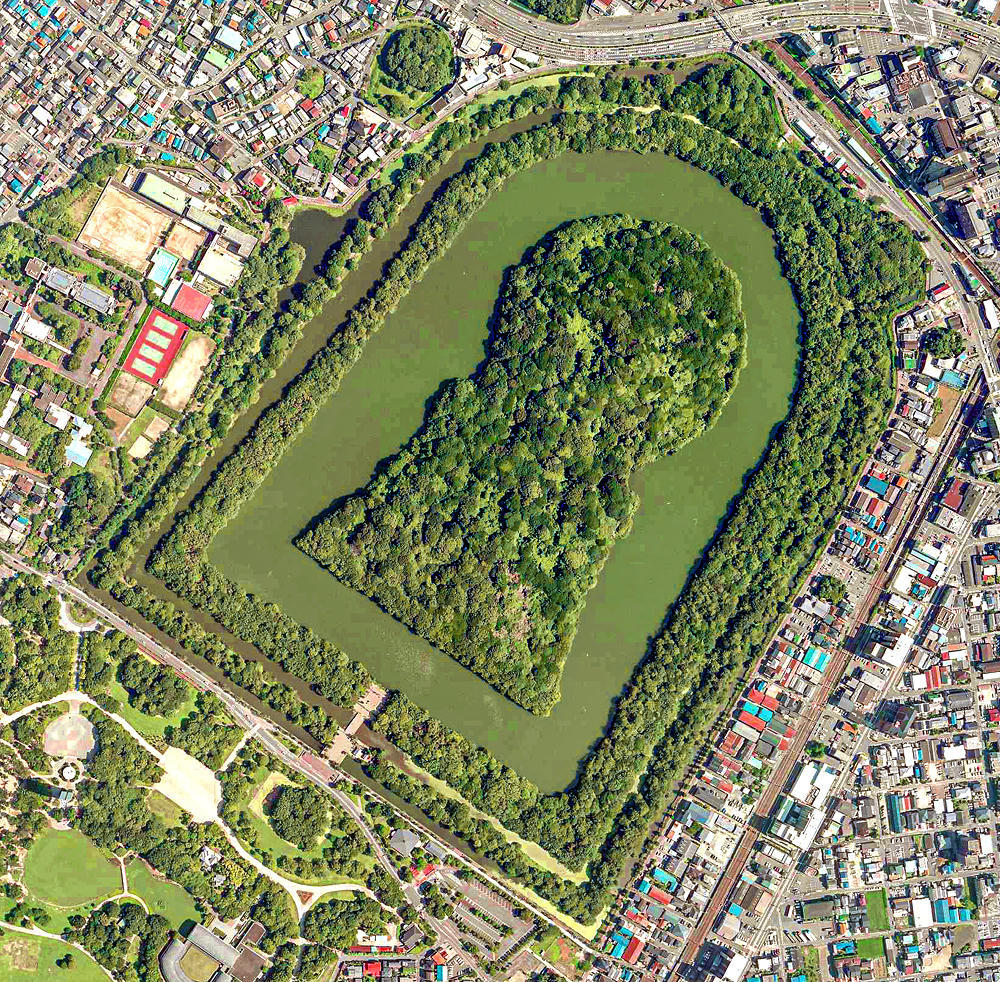
Among them, the most famous example is the Daisenryō Kofun, a colossal keyhole-shaped tomb commonly accepted as the burial place of Emperor Nintoku. At 486 meters in length, it ranks among the most striking monuments of ancient Japan. It is said to have taken huge teams of laborers fifteen years to complete. A project on that scale reveals more than engineering skill. It points to leaders powerful enough to command land, resources, and thousands of hands.
What is a kofun?
The word kofun refers to burial mounds constructed from around 250 AD onward. These mounds became the defining symbol of the period now named after them. Their forms varied, but some of the most famous were built in a distinctive keyhole shape when seen from above.
These tombs marked the graves of powerful leaders at a time when Japan was gradually unifying under a single territory. The sheer size of many kofun shows that ancient political authority was becoming far more centralized and visible. A ruler who could organize the construction of a massive tomb was also a ruler demonstrating control over people, land, and production.
The Daisenryō Kofun is the clearest example of this idea. A mound almost half a kilometer long is hard to think of as a mere burial site. It was a landscape project, an unmistakable display of elite power that would have dominated its surroundings.
Why the keyhole shape matters
The article identifies Daisenryō as a keyhole-shaped burial mound, one of the most recognizable forms of kofun. Even without written explanations from the builders, the shape itself suggests deliberate planning and shared ritual ideas. These were not casual earthworks. They were designed monuments with formal symbolism.
What makes the keyhole form so compelling is its scale and precision. Constructing one would have required surveying, coordinated labor, and a leadership structure capable of sustaining a long-term project. If Daisenryō really took fifteen years to complete, that means its builders maintained political stability and workforce organization over a remarkably long period.
In practical terms, this also tells us something about the society behind the tomb. Monument building on this scale usually reflects social ranking, because not everyone receives such treatment in death. The tomb becomes evidence that some leaders had risen far above local rivals.
Haniwa: the clay figures around the tombs
Kofun were often surrounded by and filled with haniwa, clay sculptures that are one of the most distinctive features of the period. The article notes that many were shaped like warriors and horses.
Haniwa were not random decorations. Their presence around and within the mounds reinforced the prestige of the buried elite. Warriors suggest force, protection, and status. Horses imply mobility, military strength, and aristocratic power. Together, they turn the tomb into a stage for authority, even after death.
Because these clay figures were placed in large numbers, they also show that kofun were carefully curated spaces. The tomb mound was not just piled earth. It was part of a broader ritual landscape filled with symbolic objects.
The fact that warrior and horse figures appear so prominently also fits the broader picture of emerging ruling power in ancient Japan. As leaders competed, conquered, and absorbed rivals, imagery of military strength would have carried enormous meaning.
The rise of the Yamato center
At the center of this growing political order was Yamato, located in the Kinai region of central Japan. Kinai refers to the central area around what later became some of Japan’s most important historical centers. From there, the rulers of the Yamato state expanded their authority across Japan.
These Yamato rulers were a hereditary line of emperors, meaning power passed through a ruling family. That line continues to the present day and is described as the world’s longest dynasty. This gives the Kofun period extraordinary historical weight: it represents the era when the roots of Japan’s imperial line became tied to an expanding political center.
But Yamato did not build its power through conquest alone. The rulers also expanded by persuading local leaders to accept their authority in exchange for positions of influence in government. This was a politically savvy method. Instead of destroying every rival, Yamato could absorb regional elites into a broader system.
Many of the powerful local clans who joined this state became known as uji. In effect, authority was being woven into a network. Yamato’s rulers stood at the center, but they ruled through relationships with local power holders as well as through military force.
More than force: recognition and state-building
The rise of Yamato was not just an internal story. Its leaders sought and received formal diplomatic recognition from China. Chinese records refer to five successive leaders known as the Five Kings of Wa. Wa was an early name used for Japan in Chinese texts.
This recognition matters because it shows that the Yamato polity was becoming visible beyond the archipelago. Diplomatic acknowledgment from a major neighboring civilization gave added legitimacy to its rulers.
The Kofun period also saw important contributions from craftsmen and scholars from China and the Three Kingdoms of Korea. They helped transmit continental technologies and administrative skills to Japan. Administrative skills means practical knowledge for governing, recording, organizing, and managing a more complex political system. In other words, rising power was not only about tombs and armies. It was also about learning how to run a state.
A dynasty with deep roots
The idea of the “world’s longest dynasty” can sound almost mythical, but here it refers to the hereditary imperial line associated with Yamato rule. The Kofun period is therefore a key chapter in understanding how rulership in Japan gained continuity.
That continuity did not mean complete control from the start. Ancient Japan was still a patchwork of regional powers, competing alliances, and local identities. Yet the Yamato rulers were establishing something unusually durable: a line of authority that outlasted shifting capitals, court factions, warrior governments, and centuries of transformation.
The kofun themselves helped express that continuity. Monumental tombs linked rulers to ancestry and sacred legitimacy. By burying leaders in grand mounds visible across the landscape, the emerging state was making memory physical.
Before the chronicles: the Yamato–Izumo struggle
Not all of early Japan’s power struggles were neatly recorded. Historians agree that there was a major struggle between the Yamato federation and the Izumo Federation centuries before written records.
That detail is especially fascinating because it hints at a lost age of rivalry before the historical narrative becomes clear. Izumo, based in western Honshu, represented another power center with its own political weight. If Yamato and Izumo were locked in major conflict, then the eventual rise of Yamato was not inevitable. It was the outcome of competition.
This also helps explain why kofun matter so much. In a world with limited written evidence, monuments become a kind of political testimony. A giant burial mound tells us that some leaders had already reached remarkable levels of organization and prestige. The struggle between federations may be poorly documented in text, but the earthworks remain.
Why these tombs still fascinate
Kofun megatombs capture a dramatic moment in Japanese history: the transition from a landscape of many local powers to one increasingly centered on Yamato rule. They combine architecture, ritual, politics, and sheer spectacle.
The Daisenryō Kofun stands out because of its immense size, its famous keyhole form, and its traditional association with Emperor Nintoku. Haniwa figures add another layer, filling these sites with images of warriors and horses that projected elite authority. And behind the monuments lies the bigger story: a hereditary imperial line emerging from Yamato in the Kinai region, expanding through conquest, alliance, and political integration.
Even more intriguing is the sense of mystery that remains. Historians can point to the major struggle between Yamato and Izumo, but much of that contest unfolded before written records. That gap leaves room for wonder. The tombs endure precisely because they are both evidence and enigma.
They are giant clues from a formative age, when power in Japan was being shaped not only in battle and diplomacy, but in mounds of earth large enough to outlast empires.
Sources
Based on information from History of Japan.
More like this
Unearth more mind-sized monuments from history — download DeepSwipe and keep digging into the past.


