Full article · 8 min read
Earth’s World Ocean, Measured
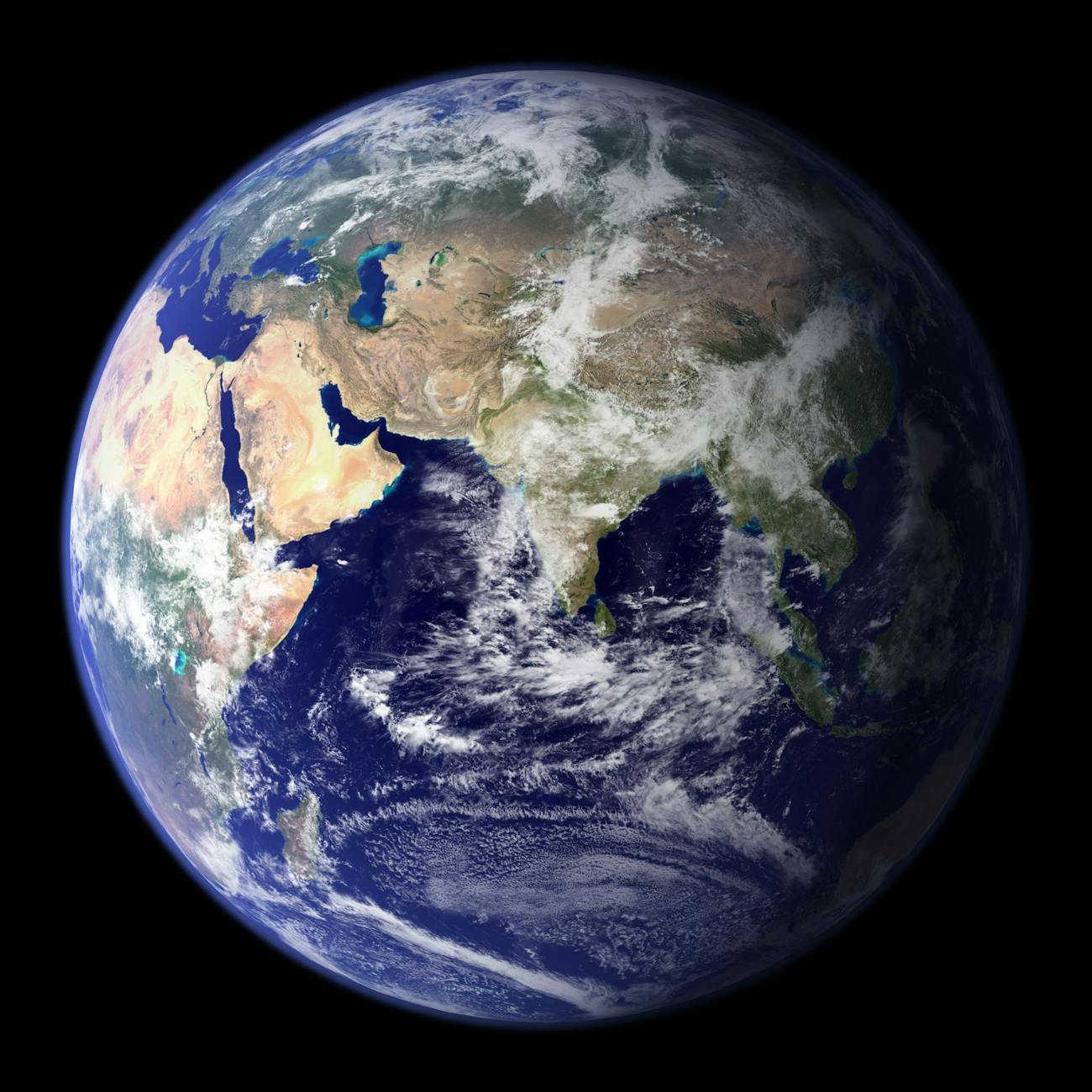
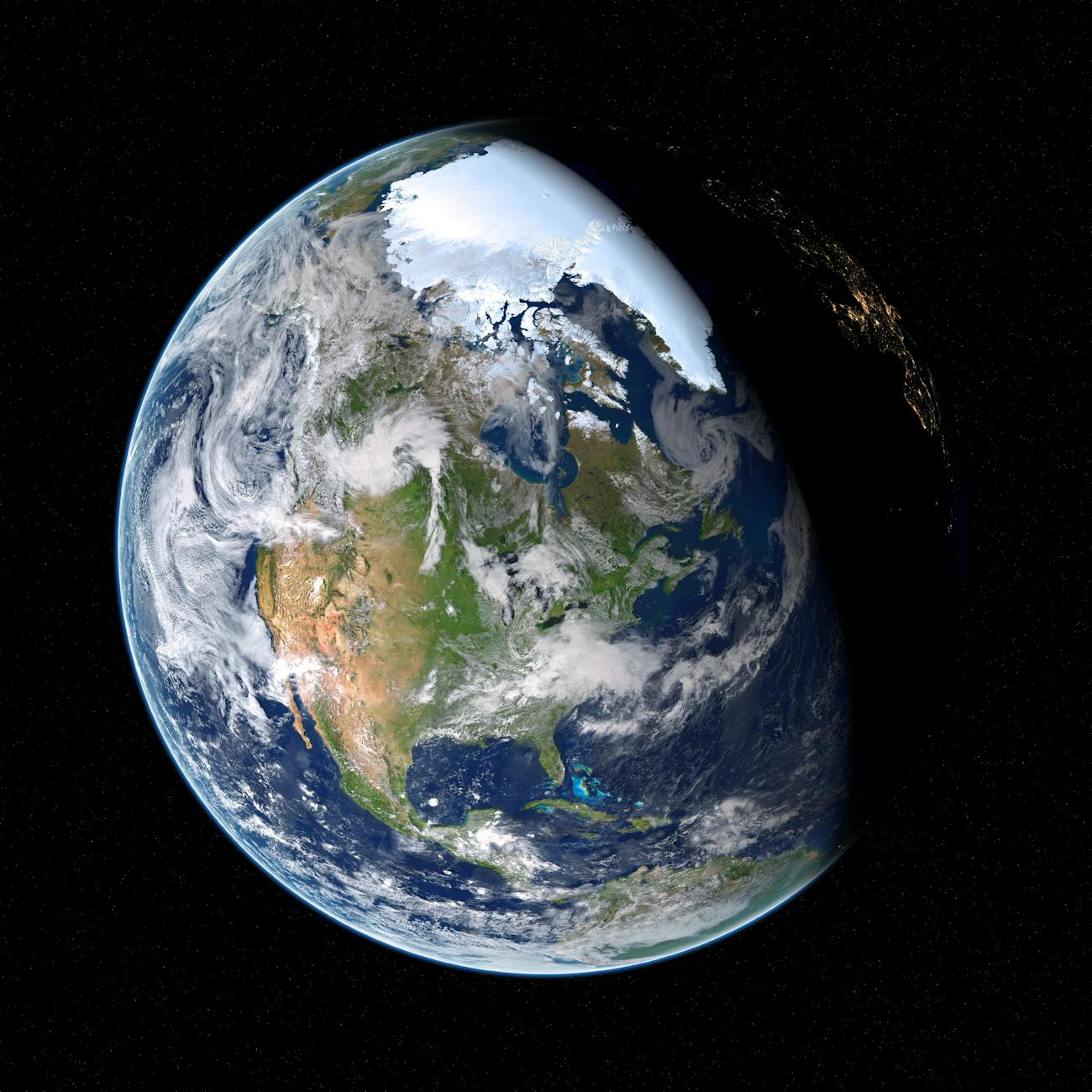
Earth is often called the blue planet, and the numbers behind that nickname are astonishing. The planet’s surface is dominated by a single connected body of salt water often called the world ocean. It covers 70.8% of Earth’s crust, contains almost all of Earth’s water, and plays a central role in climate, weather, and life itself.
If you zoom out far enough, land starts to look like a thin interruption in a planetary ocean. And if Earth’s surface were smoothed into an even sphere, the result would be even more dramatic: the entire planet would lie beneath a global ocean roughly 2.7 to 2.8 kilometers deep.
That simple thought experiment reveals something profound. Earth is not just a planet with oceans. It is, in a very real sense, an ocean world.
If Earth were perfectly smooth
Earth is not actually smooth, of course. Its surface includes mountain ranges, plains, plateaus, trenches, and the raised masses of continents. But if all of that topography were leveled out so that the crustal surface sat at one uniform elevation, the existing ocean water would spread across the entire globe.
The depth of that all-covering ocean would be about 2.7 to 2.8 kilometers. That figure helps show both how much water Earth has and how uneven the planet’s surface really is.
In reality, the ocean does not sit atop a perfectly regular bowl. It fills vast oceanic basins and lies beside continents that rise above sea level. The ocean floor itself is also far from flat. It includes abyssal plains, seamounts, submarine volcanoes, oceanic trenches, submarine canyons, oceanic plateaus, and a globe-spanning mid-ocean ridge system.
So the “smooth Earth” ocean depth is not the same thing as the actual average depth of today’s oceans. It is a useful planetary average that strips away the roughness of the real surface and lets you picture Earth’s water in one clean measurement.
The ocean by the numbers
The world ocean covers an area of 361.8 million square kilometers. Its mean depth is 3,682 meters, and its estimated volume is about 1.332 billion cubic kilometers. That is an extraordinary amount of water, especially when considered as part of Earth’s total mass: the oceans together have a mass of approximately 1.35 × 10^18 metric tons.
Almost all of Earth’s water is in this salty global ocean. About 97.5% of Earth’s water is saline, meaning salty, while only 2.5% is fresh water. Of that fresh water, most is not easily available at the surface. About 68.7% of it is locked up as ice in ice caps and glaciers. Roughly 30% is groundwater, and only about 1% is surface water, spread across a small fraction of Earth’s land.
This means the familiar water people often interact with directly—rivers, lakes, and accessible surface fresh water—is only a tiny sliver of the planet’s total water inventory.
The ocean’s saltiness is also measurable in a neat, memorable way. The average salinity of Earth’s oceans is about 35 grams of salt per kilogram of seawater, which is the same as about 3.5% salt. Salinity matters because it affects ocean chemistry, the behavior of marine life, and the movement of heat through the sea.
Most of that salt was released from volcanic activity or extracted from cool igneous rocks. Over immense spans of time, those dissolved materials accumulated in the ocean.
One ocean, many named parts
Although people usually talk about five oceans—the Pacific, Atlantic, Indian, Southern, and Arctic—they are all part of one connected world ocean. These names help describe regions, but the water itself is continuous.
That single ocean sits over Earth’s oceanic crust and defines much of the planet’s appearance. In Earth’s early history, the ocean may even have covered the whole planet completely.
The connected nature of the ocean matters because water, heat, dissolved gases, and salt can move through it on a global scale. That helps make the ocean one of the great engines of Earth’s climate system.
Why the ocean matters for climate
The ocean is not just a storage tank for water. It is also a giant heat reservoir. A heat reservoir is something that can absorb and store large amounts of heat energy. Because the oceans hold so much water, they can take in heat and release it more slowly than land does.
This helps moderate climate. Places near oceans often have cooler summers and warmer winters than inland places because nearby seawater stores heat and influences the air above it.
The ocean also works together with the atmosphere. Differences in captured solar energy between regions help drive atmospheric and ocean currents. Ocean heat content and currents are important factors in climate, including the thermohaline circulation, which distributes thermal energy from equatorial oceans toward polar regions.
Shifts in ocean temperature distribution can also trigger major weather changes. One example named in climate science is the El Niño–Southern Oscillation.
The ocean is deeply tied to the water cycle as well. Water evaporates from the surface, enters the atmosphere as water vapor, condenses into clouds, and later falls as precipitation. That precipitation supports life on land, feeds rivers, and often returns to the ocean. This cycle is one of the fundamental systems that shapes Earth’s surface and sustains the biosphere.
The ocean stores more than water
The oceans are a reservoir of dissolved atmospheric gases, and those gases are essential for the survival of many aquatic life forms. That makes the ocean not only a physical feature of Earth, but also a major part of the planet’s living system.
Earth’s abundance of liquid water is one of the characteristics that sets it apart in the Solar System. Other worlds may have atmospheric water vapor or signs of large liquid reservoirs beneath thick frozen layers, but Earth stands out for sustaining stable liquid surface water on a global scale.
That fact connects directly to life. Earth is the only astronomical object known to harbor life, and its ocean world character is a major reason why.
Polar twist: sea ice at the edge
At Earth’s polar regions, the ocean surface is covered by seasonally variable amounts of sea ice. In the Arctic, that sea ice spans an area about as big as the United States.
Sea ice is frozen ocean water, and its extent changes with the seasons. At the poles it can connect with polar land, permafrost, and ice sheets, contributing to the formation of polar ice caps.
But there is a troubling trend: Arctic sea ice is quickly retreating as a consequence of climate change.
That retreat is part of a wider pattern of environmental change. Human activities have increased greenhouse gases in the atmosphere, contributing to global warming. Among the linked effects are the melting of glaciers and ice sheets, rising sea levels, increased risk of drought and wildfires, and migration of species toward colder areas.
Ocean depth versus Earth’s shape
Earth is shaped more like an ellipsoid than a perfect sphere, bulging slightly at the equator because of rotation. On top of that, the planet’s surface has large local variations. Mountains rise high above sea level, while trenches plunge far below it.
Scientists use concepts such as topography and the geoid to describe Earth’s shape more precisely. Topography means the arrangement of surface features such as mountains, valleys, plains, and basins. A geoid is an idealized shape used as a reference for measurements, roughly corresponding to mean sea level across the globe.
These ideas help explain why the actual ocean has a mean depth of 3,682 meters while the “perfectly smooth Earth” ocean would be shallower at 2.7 to 2.8 kilometers. The real planet has continents sticking up and ocean basins reaching down, so the existing water is distributed unevenly across a very irregular surface.
Earth as an ocean world
Calling Earth an ocean world is not poetic exaggeration. It is a data-driven description.
Most of the planet’s surface is ocean. Most of the planet’s water is in that ocean. The ocean regulates climate, stores heat, contains dissolved gases vital to aquatic life, powers the water cycle, and helps make Earth habitable.
Seen this way, continents are important, but they are not the main feature. The defining visual and environmental fact of Earth is the world ocean.
And when you imagine the whole planet smoothed flat and still ending up beneath kilometers of seawater, the scale of that truth becomes impossible to ignore.
A planet defined by water
Earth’s ocean is both familiar and almost absurdly vast. It is shallow compared with the size of the planet, yet deep enough to hide mountain-sized features below its surface. It is salty, dynamic, and globally connected. It reaches into climate, geology, biology, and the daily weather above your head.
The numbers make it real: 70.8% of the surface covered by water, a mean ocean depth of 3,682 meters, 97.5% of Earth’s water in saline form, and a hypothetical world-blanketing ocean 2.7 to 2.8 kilometers deep if the planet were perfectly smooth.
That is not just a statistic sheet. It is the outline of what Earth fundamentally is: a rocky planet whose most planet-defining feature is water.
Sources
Based on information from Earth.
More like this
Dive deeper than 3,682 meters without getting wet — download DeepSwipe and explore bite-sized wonders of our ocean world.