Full article · 7 min read
Earth’s Hydrogen Escape: The Tiny Leak That Helped Transform the Air
Earth’s atmosphere can feel permanent and sealed in place, but it is not. At the outer edge of the atmosphere, some particles can escape into space. Among them, hydrogen is especially important because it is so light. Over immense stretches of time, that slow loss may have helped push Earth’s atmosphere away from its earlier chemical state and toward the oxygen-rich world familiar today.
That sounds like a small detail with small consequences. In fact, it connects to one of the biggest changes in Earth’s history: how the planet became a place with abundant oxygen, an ozone layer, and surface conditions that allowed life to expand and diversify.
The atmosphere is not a perfect container
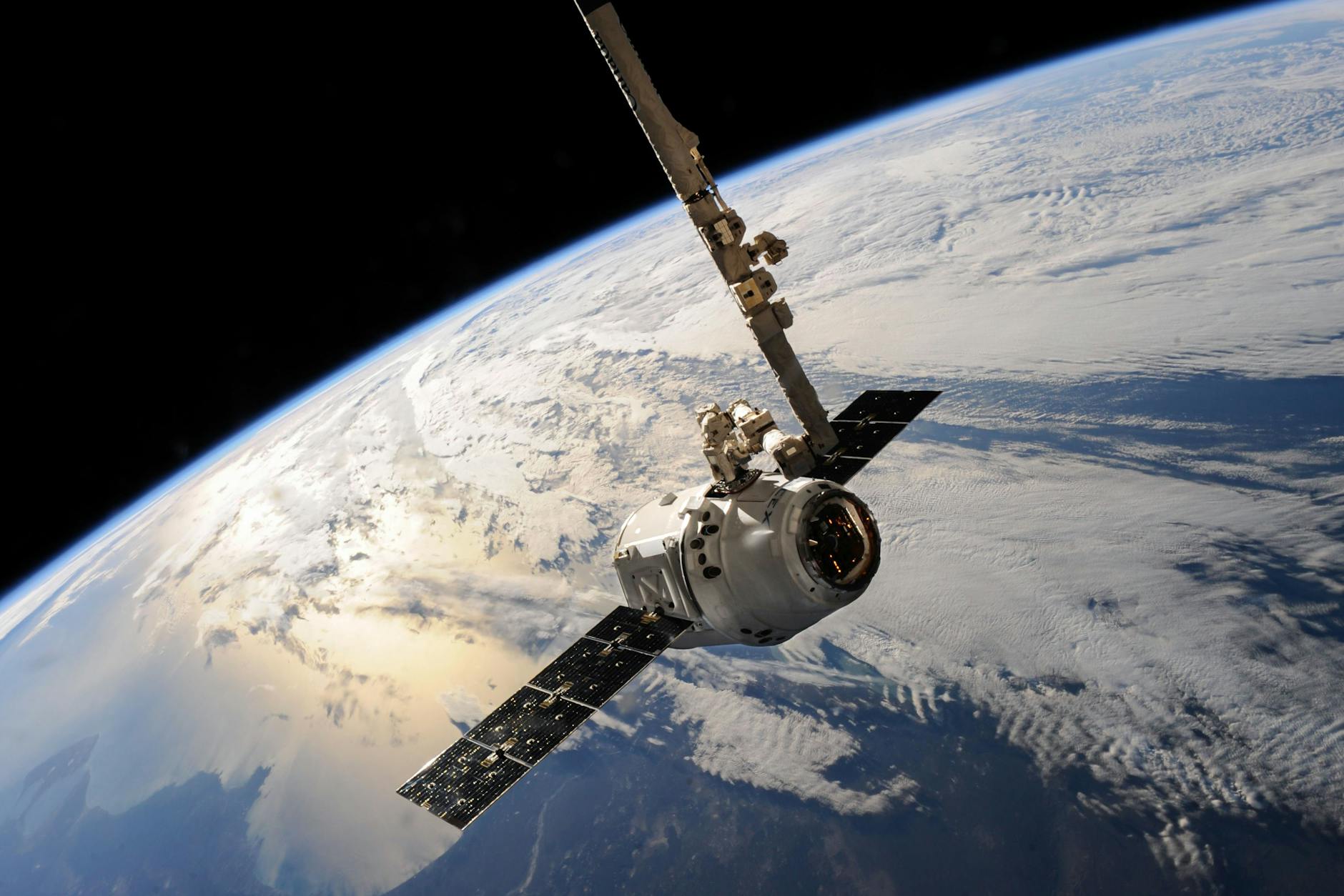
Earth’s atmosphere grows thinner with height and gradually fades into outer space. Far above the troposphere, stratosphere, mesosphere, and thermosphere, the atmosphere becomes so sparse that some molecules can gain enough speed to break free from Earth’s gravity.
This is what escape velocity means here: a particle moves fast enough that Earth can no longer hold onto it gravitationally. The loss is slow but steady, not a dramatic venting of air into space. Over human timescales it is negligible. Over geological timescales, it matters.
The most important gas in this story is hydrogen. Because hydrogen has a low molecular mass, it can reach escape velocity more readily than heavier gases. In other words, if any atmospheric ingredient is likely to slip away, hydrogen is among the best candidates.
Why hydrogen matters chemically
Hydrogen was not just another gas leaving the atmosphere. Its departure had chemical consequences.
Hydrogen is associated with what chemists call reducing agents. A reducing agent is a substance that donates electrons in chemical reactions. In broad terms, reducing conditions work against the build-up of free oxygen. As long as reducing agents are plentiful, oxygen tends to get tied up in other compounds instead of accumulating freely in the air.
So when hydrogen escaped to space, Earth was slowly losing some of those reducing influences. That helped shift the atmosphere and surface from an initially reducing state toward the oxidizing state associated with modern Earth.
An oxidizing atmosphere is one in which oxygen and other oxidizers are more available to react with materials. That chemical transition was a major turning point in Earth’s natural history.
Photosynthesis supplied oxygen, but hydrogen loss helped clear the way
The rise of oxygen in Earth’s atmosphere was not caused by hydrogen escape alone. Photosynthesis was crucial.
According to the history of life on Earth, photosynthesis evolved and allowed living organisms to harvest the Sun’s energy directly. The resulting molecular oxygen, O2, accumulated in the atmosphere. Later, through interaction with ultraviolet solar radiation, some of that O2 was converted into ozone, O3, in the upper atmosphere.
But there is an important twist: a source of oxygen was not enough by itself. The widespread accumulation of oxygen also depended on the loss of reducing agents such as hydrogen. In that sense, hydrogen escape may have been a necessary precondition for Earth’s atmosphere to become oxygen-rich on a large scale.
This makes the process especially fascinating. Life helped create oxygen, but the planet’s ability to slowly leak lightweight hydrogen into space may have influenced whether that oxygen could persist and build up.
The ozone layer changed what life could do
Once oxygen became abundant enough, ozone formed in the upper atmosphere. The ozone layer is a region rich in O3 that blocks ultraviolet solar radiation.
That protection was a huge deal for life. Ultraviolet radiation is harmful, and the ozone layer partially shields Earth’s surface from it. This helped permit life on land. The atmosphere was no longer just a blanket of gas; it had become a protective filter.
Earth’s atmosphere already performs many life-supporting roles. It transports water vapor, provides useful gases, causes many small meteors to burn up before they strike the ground, and moderates temperature through the greenhouse effect. The ozone layer added another vital service: reducing dangerous ultraviolet radiation at the surface.
So the chain is strikingly elegant:
- photosynthesis generated oxygen,
- hydrogen escape reduced the atmosphere’s reducing power,
- oxygen could accumulate more broadly,
- ozone formed from oxygen,
- and the surface became safer for life.
A slow leak with planetary-scale consequences
One reason this story is so compelling is the mismatch in scale. The physical process itself is subtle. Individual molecules at the top of the atmosphere gain enough speed and drift away. No one standing on Earth would notice it. Yet over vast stretches of time, that slow loss may have influenced the chemical identity of the whole planet.
This is a recurring theme in Earth science: gradual processes can create dramatic outcomes. Plate tectonics slowly moves continents. Erosion slowly reshapes landscapes. Atmospheric change slowly alters climate and habitability. Hydrogen escape belongs to that same category of quiet but consequential processes.
The atmosphere that surrounds Earth today is primarily nitrogen and oxygen. A dry atmosphere is composed of about 78.084% nitrogen and 20.946% oxygen, with argon and trace gases making up the rest. That composition is the result of a very long history involving geology, the evolution of life, solar radiation, and the chemistry of the upper atmosphere.
What happens in the modern atmosphere
In today’s oxygen-rich atmosphere, hydrogen still matters, but in a different way. Most hydrogen does not simply rise unchanged to the top and escape. Instead, much of it is converted into water before it has the opportunity to leave Earth. The article also notes that most current hydrogen loss comes from the destruction of methane in the upper atmosphere.
That means the atmospheric chemistry of modern Earth differs from the earlier conditions under which hydrogen escape helped drive a large planetary transition. The process still exists, but the context has changed.
This is another reminder that Earth is dynamic. Its atmosphere has not always been what it is now, and the same physical mechanism can have different effects at different times in the planet’s history.
Earth’s upper atmosphere is where the transition to space begins
To picture this process, it helps to understand the structure of the atmosphere. The lower atmosphere contains most of the air’s mass, but above it lie the stratosphere, mesosphere, and thermosphere. Beyond these layers, the exosphere thins into the magnetosphere.
The magnetosphere is the region dominated by Earth’s magnetic field, which deflects much of the solar wind. That magnetic shield is crucial for protecting the planet from much destructive solar and cosmic radiation. But even with this protection, the very outermost atmosphere is still a frontier zone where some particles can be lost to space.
That edge region is not a hard shell. It is more like a gradual fading boundary, where gravity still works, but the grip on the lightest particles becomes weak enough that some can escape.
Why this matters for the story of life on Earth
Earth is the only known astronomical object to harbor life, and its habitability depends on a remarkable set of conditions: liquid surface water, a dynamic atmosphere, protection from much harmful radiation, and long-term climate regulation. The history of atmospheric oxygen is part of that larger story.
Life has profoundly altered Earth’s atmosphere and surface over time. One of the biggest examples is the Great Oxidation Event, when oxygen became a far more important part of the atmosphere. The details of that transformation include biology, chemistry, and physics working together.
Hydrogen escape is a beautiful example of that interplay. It was not a biological innovation like photosynthesis. It was not a dramatic catastrophe like an asteroid impact. It was simply the upper atmosphere allowing some of the lightest particles to leave. Yet that physical leak may have helped determine what kinds of life could eventually thrive on Earth’s surface.
In that sense, Earth’s air was shaped not only by what was added to it, but also by what quietly disappeared.
The big takeaway
Hydrogen escape shows how planetary habitability can hinge on details that are easy to overlook. The atmosphere slowly leaks. Hydrogen escapes more easily than heavier gases. That escape removes reducing agents, helping Earth shift from a reducing state to an oxidizing one. Photosynthesis then built up oxygen, and oxygen in turn enabled the formation of the ozone layer that shields the surface from ultraviolet radiation.
A tiny leak at the top of the sky helped change the chemistry of an entire world.
And from that change came a planet where life could spread across land, seas, and countless ecosystems under a far safer sky.
Sources
Based on information from Earth.
More like this
Let your curiosity escape velocity too — download DeepSwipe and launch into bite-sized knowledge every day.