Full article · 8 min read
Earth’s Magnetic Shield and the Glowing Mystery of Auroras
Earth is wrapped in an invisible protective system that helps make the planet far more hospitable than it would otherwise be. Deep below the surface, motion inside the planet helps generate a magnetic field. Far above the surface, that field extends into space and forms a vast magnetic bubble called the magnetosphere. When streams of charged particles from the Sun slam into this shield, some are deflected away. Others can be funneled into the upper atmosphere, where they help create one of Earth’s most beautiful natural displays: auroras.
This hidden shield is not static or perfectly calm. It shifts, wobbles, and has even reversed its polarity in the past. Understanding how it works reveals a dramatic link between Earth’s deep interior, outer space, and the shimmering lights of the polar sky.
The engine in Earth’s core
The main part of Earth’s magnetic field is generated in the core. More specifically, it is tied to processes in Earth’s liquid outer core. This is where a dynamo process operates.
A dynamo, in this context, is a process in which motion in electrically conductive material helps produce magnetic and electrical field energy. In Earth, the energy comes from convection in the core. Convection means material moves because of differences in heat and composition. Hotter or differently composed material rises or shifts, while cooler material sinks or moves in another direction. In the outer core, those motions help convert kinetic energy, the energy of motion, into the magnetic field that extends around the planet.
Earth’s interior is layered. Beneath the mantle lies the liquid outer core, and below that is the solid inner core. The outer core’s low viscosity means it can flow much more readily than the solid layers above it. That flowing metal-rich region is central to the magnetic field that protects the planet.
What the magnetosphere actually is
Earth’s magnetic field does not stop at the atmosphere. It stretches out into space and creates the magnetosphere, the region around Earth where the planet’s magnetic field dominates the behavior of many charged particles.
The magnetosphere acts as a defensive boundary against the solar wind, which is a flow of ions and electrons streaming from the Sun. These particles are charged, meaning they respond strongly to magnetic fields. As a result, many are deflected rather than allowed to strike the planet directly.
The shape of the magnetosphere is not perfectly round. Solar wind pressure compresses the day-side magnetosphere to about 10 Earth radii. On the night side, the magnetosphere is pulled out into a long tail. So Earth’s magnetic shield is more like a windsock-shaped magnetic domain than a neat sphere.
A bow shock forms ahead of the day side because the solar wind moves faster than the speed at which disturbances can travel through it. This creates a kind of space-weather shock front in front of Earth’s magnetic barrier.
Within the magnetosphere are several distinct regions of charged particles. The plasmasphere contains low-energy particles that largely follow magnetic field lines as Earth rotates. The ring current contains medium-energy particles that drift relative to the geomagnetic field. The Van Allen radiation belts contain high-energy particles whose motion is much more random, though still trapped by the magnetosphere.
Why this shield matters so much
Earth’s magnetic field is not just an interesting physical feature. It plays a major protective role. Earth’s magnetosphere is capable of deflecting most of the destructive solar wind and cosmic radiation.
That matters because Earth also has a dynamic atmosphere that supports surface conditions suitable for life. The magnetic field and atmosphere are separate systems, but together they help make the planet more livable. The atmosphere protects the surface from most meteoroids and harmful ultraviolet light at entry, while the magnetosphere helps reduce the impact of charged particles arriving from space.
There is also evidence that Earth’s magnetic field was established by about 3.5 billion years ago, and this helped prevent the atmosphere from being stripped away by the solar wind. That gives the magnetic field an especially important place in Earth’s natural history.
How auroras begin
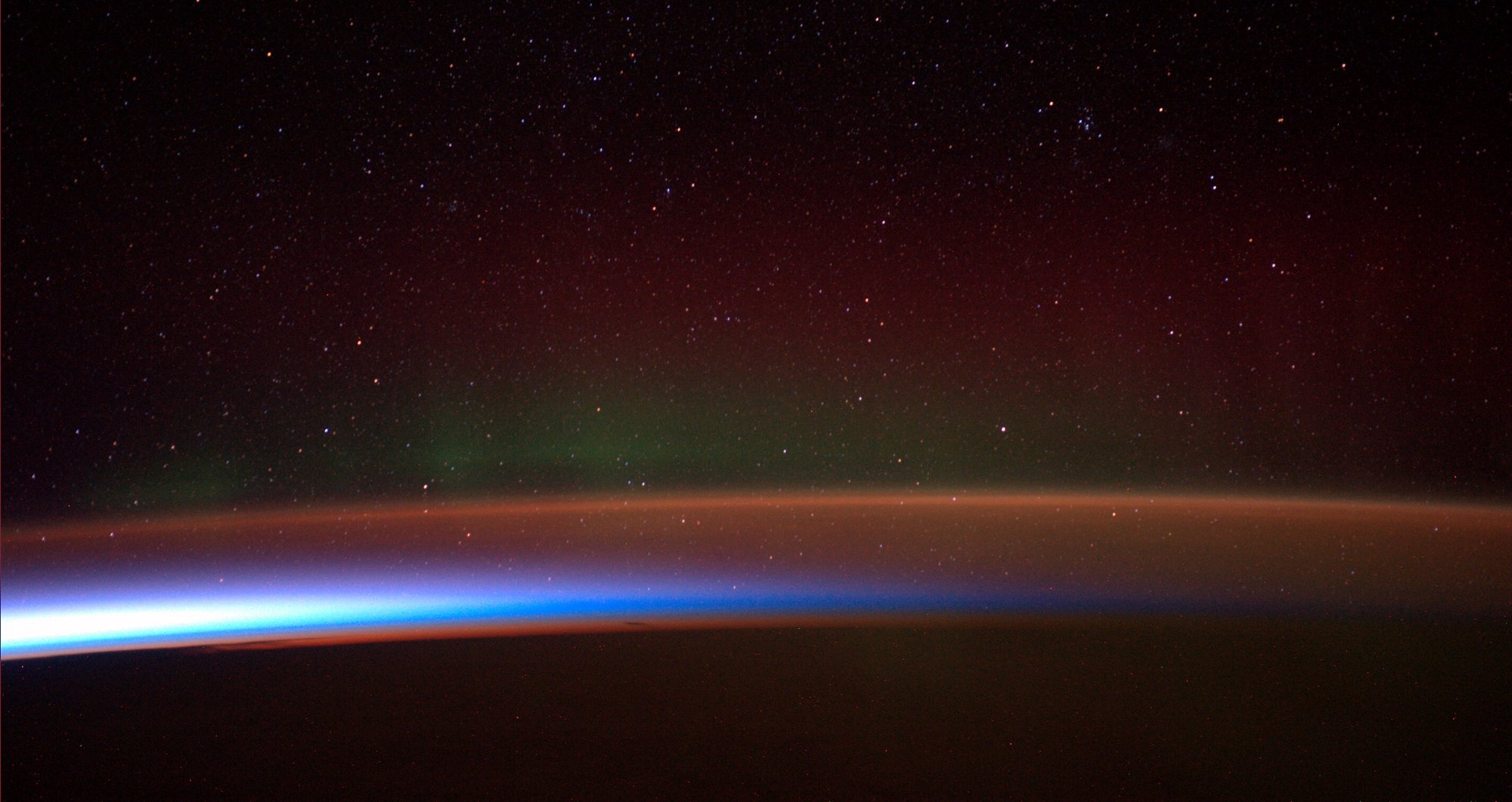
Auroras are among the most visible signs that Earth’s magnetic field is interacting with the Sun. They happen when charged particles are redirected from the magnetosphere into Earth’s upper atmosphere.
During magnetic storms and substorms, particles can be deflected from the outer magnetosphere and especially from the magnetotail, the stretched-out night-side tail of the magnetosphere. These particles then travel along magnetic field lines into Earth’s ionosphere.
The ionosphere is a charged region of the atmosphere. When incoming particles reach it, they can excite and ionize atmospheric atoms. To excite an atom means to give it energy. When that atom releases the energy, it can emit light. That glowing process is what produces an aurora.
So the familiar polar lights are not just pretty weather in the sky. They are the visible result of energy from space being channeled by Earth’s magnetic field into the upper atmosphere.
Why auroras appear near the poles
Auroras are strongly associated with high latitudes because Earth’s magnetic field guides incoming charged particles along field lines toward polar regions. The article notes that when particles are directed into the ionosphere during magnetic disturbances, auroras can result. Since the field geometry channels particles most effectively toward the magnetic polar zones, the most dramatic displays are usually seen there.
That is why the northern and southern high latitudes are famous for these luminous curtains and arcs. The lights are linked less to ordinary clouds or storms and more to the structure of Earth’s magnetic environment.
A magnetic field that never sits still
Earth’s magnetic field may feel permanent on a human timescale, but it is restless.
The magnetic field is approximately a dipole, meaning it behaves somewhat like a bar magnet with two poles. Those poles are located close to Earth’s geographic poles, but they do not stay fixed. Convection movements in the core are chaotic, and this causes the magnetic poles to drift.
This ongoing change is part of what is called secular variation, the gradual change of the main magnetic field over time. The field strength itself also changes. At the equator, the magnetic-field strength at Earth’s surface was given as 3.05×10⁻⁵ tesla at epoch 2000, and the dipole moment was decreasing by nearly 6% per century, though it still remained stronger than its long-term average.
The field also occasionally undergoes a reversal, when the magnetic poles change alignment. These reversals happen at irregular intervals averaging a few times every million years. The most recent reversal occurred approximately 700,000 years ago.
That means Earth’s magnetic shield has a long history of change, even if it appears steady during a single human lifetime.
Magnetic poles versus geographic poles
It is easy to confuse magnetic poles with geographic poles, but they are not the same thing.
Geographic poles are defined by Earth’s rotation axis, the points where the axis meets the surface. Magnetic poles are tied to the structure of the magnetic field generated in the core. Because the field changes through time, the magnetic poles wander.
This wandering is one sign that Earth’s magnetic field is generated by active processes deep inside the planet rather than by a fixed permanent magnet.
Earth’s shield as part of a bigger planetary system
The magnetic field is just one of several systems that shape conditions on Earth. The atmosphere, oceans, climate system, and interior all interact in different ways.
Earth has a liquid outer core, moving tectonic plates, a dynamic atmosphere, and abundant liquid surface water. It is the only astronomical object known to harbor life. The magnetic shield fits into that broader picture by helping protect the planet from harmful space-weather effects.
Even the aurora is a reminder that Earth is not isolated. Energy from the Sun reaches the planet not only as light and heat, but also as streams of charged particles. The magnetosphere mediates that connection, usually by deflecting particles, and sometimes by directing them into the upper atmosphere in luminous displays.
The beauty and the warning in the sky
Auroras are often seen as spectacles of beauty, and rightly so. But they also reveal something more dramatic: Earth is constantly interacting with a turbulent space environment.
When magnetic storms and substorms intensify, more particles can be driven into the ionosphere, increasing auroral activity. In other words, those glowing polar skies are evidence that the magnetic shield is active, dynamic, and under pressure from the Sun.
The same field that creates beautiful lights is also part of the reason Earth is protected from much of the solar wind. Auroras are the visible edge of an invisible planetary defense system.
An invisible force field with a deep origin
From the liquid outer core to the upper atmosphere, Earth’s magnetic field connects the planet’s hidden interior to phenomena visible from the ground. Convection in the core powers a dynamo. The dynamo generates a magnetic field. That field creates the magnetosphere, which deflects many charged particles from the solar wind. And when some of those particles are funneled into the ionosphere during magnetic disturbances, atmospheric atoms glow, producing auroras.
It is one of Earth’s most astonishing chains of cause and effect: flowing material thousands of kilometers beneath your feet helps paint shifting light across the polar sky.
And despite its protective power, this shield is anything but rigid. Its poles wander. Its strength changes. Its polarity has even flipped in the past. Earth’s magnetic field is an invisible force field, but also a living planetary process—one that quietly guards the world while occasionally announcing itself in ribbons of light.
Sources
Based on information from Earth.
More like this
Chase the aurora without leaving your couch — download DeepSwipe and let your curiosity light up.