Full article · 7 min read
World War II: How Midway Changed the Pacific War
In the first half of World War II, Japan seemed unstoppable across the Pacific and Southeast Asia. By the end of April 1942, Japan and Thailand had almost conquered Burma, Malaya, the Dutch East Indies, Singapore, and Rabaul, inflicting severe losses on Allied troops and taking many prisoners. Japanese forces had also struck across a huge area with near-simultaneous offensives beginning in December 1941, including Pearl Harbor, the Philippines, Guam, Wake Island, Malaya, Thailand, and Hong Kong.
Then came Midway.
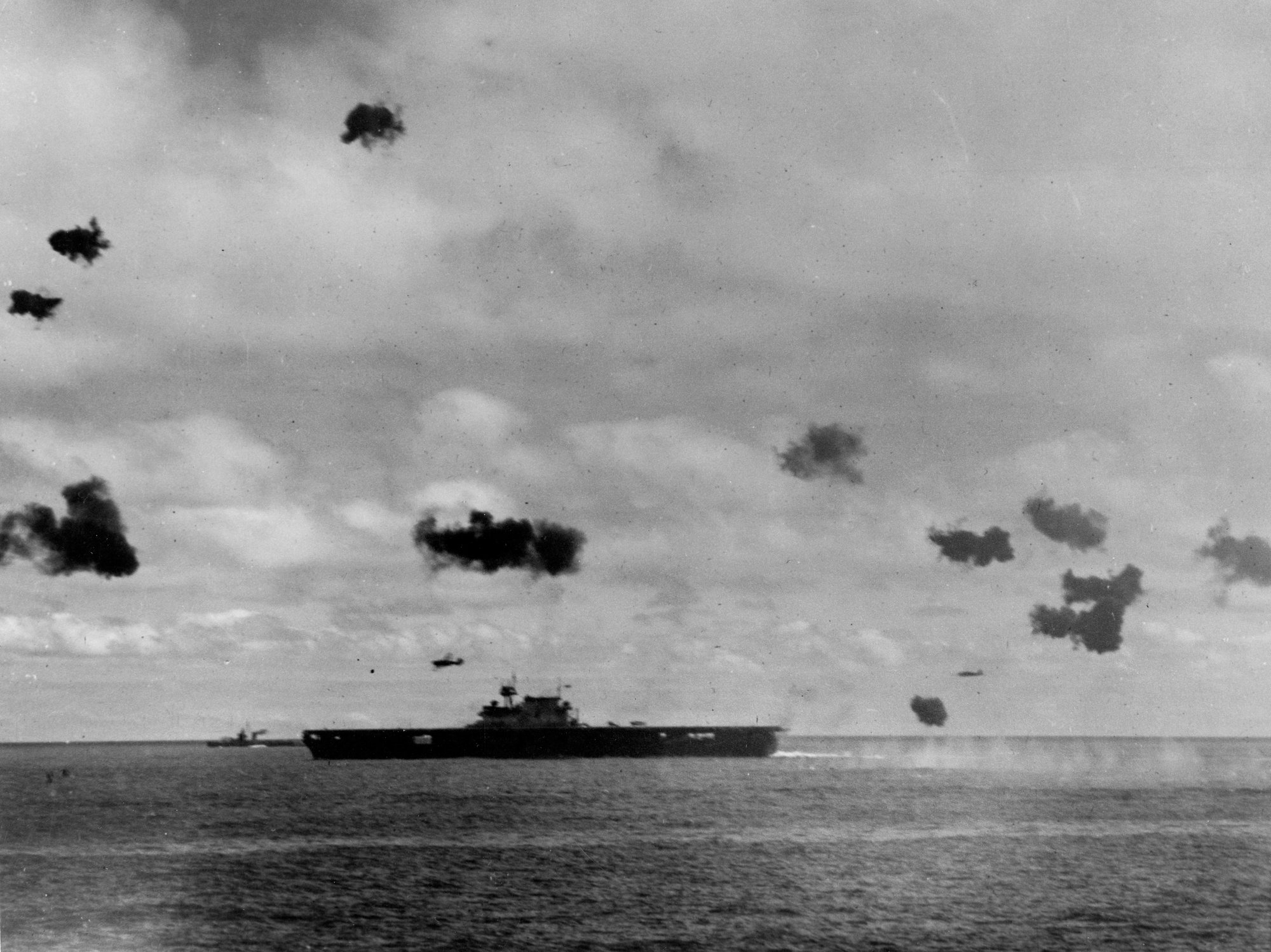
The Battle of Midway, fought in early June 1942, became one of the defining turning points of the Pacific War. It was not just a clash of fleets. It was a battle in which intelligence, timing, and preparation mattered as much as raw firepower. The result was a decisive American victory that sharply reduced Japan’s ability to keep expanding and helped shift momentum to the Allies.
Japan’s surge across the Pacific
To understand why Midway mattered so much, it helps to see how strong Japan looked beforehand.
Japan had planned to seize European colonies in Asia and create a vast defensive perimeter reaching into the Central Pacific. The goal was to exploit the resources of Southeast Asia while forcing the Allies into a long, exhausting struggle. In the months after Pearl Harbor, that strategy appeared to be working.
Japanese naval forces won victories in the South China Sea, Java Sea, and Indian Ocean, and even bombed the Allied naval base at Darwin in Australia. In the Philippines, resistance by Filipino and US forces was ultimately overcome in May 1942. Across the region, Japanese advances were accompanied by major atrocities, including the Sook Ching Massacre in Singapore and the Bataan Death March after the fall of Bataan.
These rapid successes left Japan in a position of enormous apparent strength. But they also created risk. Fast conquest can stretch supply lines, scatter forces, and create overconfidence. By 1942, Japan had expanded quickly over a massive area, and that scale made its next decisions especially important.
Midway: the trap that failed
In early May 1942, Japan had already tried to capture Port Moresby by amphibious assault. That effort was thwarted when Allied naval forces fought the Japanese to a draw in the Battle of the Coral Sea.
Japan’s next move was even more ambitious. It planned to seize Midway Atoll and lure American aircraft carriers into battle so they could be destroyed. Midway Atoll is a small island outpost in the central Pacific, but its location gave it strategic value. Controlling it would strengthen Japan’s defensive perimeter and help weaken the American position in the Pacific.
There was also a diversionary move planned against the Aleutian Islands in Alaska. A diversion is a secondary attack meant to distract the enemy from the main objective. The hope was that American forces would be pulled in different directions.
But the plan unraveled before the battle even began.
Codebreaking and the meaning of “order of battle”
The United States had broken Japanese naval codes in late May 1942. That single advantage changed everything.
A naval code is a system used to conceal military messages so the enemy cannot understand them. Breaking a code means deciphering those messages and learning what the opponent intends to do. In this case, American forces were able to discover Japanese plans and their order of battle.
“Order of battle” is a military term for the structure of a fighting force: which units are involved, how strong they are, and how they are arranged. Knowing an enemy’s order of battle means knowing far more than just a target. It gives insight into the scale of the attack and how it is meant to unfold.
Because American planners had this knowledge, they were not reacting blindly. They were waiting for a move they already understood. That allowed them to meet the Japanese attack with preparation rather than surprise.
In early June, when Japan launched the Midway operation, the Americans used this intelligence to achieve a decisive victory over the Imperial Japanese Navy.
Why Midway mattered so much
The battle did more than produce a dramatic headline. It altered Japan’s strategic position.
After Midway, Japan’s capacity for aggressive action was greatly diminished. That phrase means more than simply losing one battle. It meant Japan was less able to launch major new offensives and impose its will across the Pacific as it had in the war’s opening months.
Before Midway, Japan had been dictating the pace. After Midway, the balance shifted. Japan still controlled vast territories, but it had lost the freedom to expand with the same confidence and force.
This is why Midway is remembered as a turning point: not because the war ended there, but because the direction of the war changed there.
From Midway to Guadalcanal
The consequences of Midway were felt almost immediately.
With Japan’s ability for large-scale offensive action reduced, it attempted instead to capture Port Moresby through an overland campaign in Papua. At the same time, the United States began planning a counterattack against Japanese positions in the southern Solomon Islands, especially Guadalcanal. This was meant to be the first step toward isolating Rabaul, the main Japanese base in Southeast Asia.
By mid-September 1942, the struggle for Guadalcanal had become the priority. The island turned into a brutal contest of endurance, with both sides committing heavy numbers of troops and ships.
This is where another key shift occurred. Japanese forces suffered massive losses in the attritional fighting on and around Guadalcanal, especially among their elite pilots.
Attrition means wearing down an enemy over time through repeated losses in people, equipment, and resources. A war of attrition is not won by one dramatic blow alone, but by steadily reducing the other side’s ability to continue fighting. Guadalcanal became exactly that kind of battle.
By the start of 1943, the Japanese had been defeated on the island and withdrew their troops.
Why the loss of elite pilots was so serious
Not every military loss is equal. Ships can sometimes be replaced faster than highly trained personnel. The losses Japan suffered at Guadalcanal were especially damaging because they included elite pilots.
These were not ordinary replacements. They were highly skilled aviators whose experience mattered in complex naval and air operations. When a country loses its best pilots, it loses not only individuals but also accumulated skill, combat judgment, and training value.
That helps explain why the period after Midway was so important. Midway reduced Japan’s ability to attack aggressively. Guadalcanal then deepened the damage by imposing heavy losses in a grinding struggle. Together, these battles marked the end of Japan’s early-war momentum.
The wider shift in the Pacific
After Guadalcanal, the Allies increasingly seized the initiative.
They launched operations to isolate major Japanese positions such as Rabaul and pushed through key island groups in the Central Pacific. By the end of March 1944, Allied forces had achieved major objectives in that campaign. Later in 1944, American forces began their offensive against the Mariana and Palau islands and decisively defeated Japanese forces in the Battle of the Philippine Sea. In late October, Allied naval forces won another huge victory at the Battle of Leyte Gulf, one of the largest naval battles in history.
Those later victories did not spring from nowhere. They followed the earlier moment when Japanese expansion had first been halted and then reversed. Midway was the hinge. Guadalcanal was the grind that followed.
Midway’s real legacy
The popular image of Midway is often simple: one battle changed everything. The truth is slightly more interesting.
Midway mattered because it combined intelligence success with battlefield success. The Americans did not win by chance. They had broken Japanese naval codes, understood the plan, knew the order of battle, and used that knowledge to set the conditions for victory.
That victory did not finish the Pacific War, but it damaged Japan’s offensive power at a critical moment. Then the long attritional struggle at Guadalcanal compounded the effect, costing Japan ships, troops, and especially elite pilots.
So when people say Midway “turned the tide,” they are pointing to a real shift. Japan’s surge across the Pacific was halted. The initiative began to move to the United States and its Allies. From there, the Pacific War became less a story of unstoppable Japanese expansion and more a story of Allied pressure, Japanese overextension, and a balance of power that had decisively changed.
Midway was the battle where surprise failed, codebreaking paid off, and the Pacific war started moving in a different direction.
Sources
Based on information from World War II.
More like this
Crack the code on history’s biggest turning points — download DeepSwipe and turn quick swipes into strategic knowledge.