Full article · 9 min read
World War II: Why Its Start and End Dates Are Still Debated
World War II is often taught as if it has perfectly clear bookends: a start on 1 September 1939 and an end in August or September 1945. That timeline is widely used for good reason. Yet the closer you look, the less simple it becomes.
Many historians agree that the war began when Germany invaded Poland on 1 September 1939, followed by British and French declarations of war two days later. But others argue that this date captures only the outbreak of the European war, not the full global conflict that would become World War II. The same uncertainty appears at the other end. Some people point to V-J Day, the armistice of 15 August 1945, while others insist the war ended only with Japan’s formal surrender on 2 September 1945. Beyond that, later treaties and declarations show that the legal and diplomatic aftermath stretched on for years.
That makes World War II unusual: it was one war, but its opening and closing moments depend on whether you mean the first major invasion, the point when it became global, the military end of fighting, or the final settlement of wartime relationships.
The most common starting date: 1 September 1939
The standard date used for the beginning of World War II is 1 September 1939. On that day, Nazi Germany invaded Poland. Britain and France responded by declaring war on Germany on 3 September. For many historians, this is the clearest moment when a European crisis became a full-scale war among major powers.
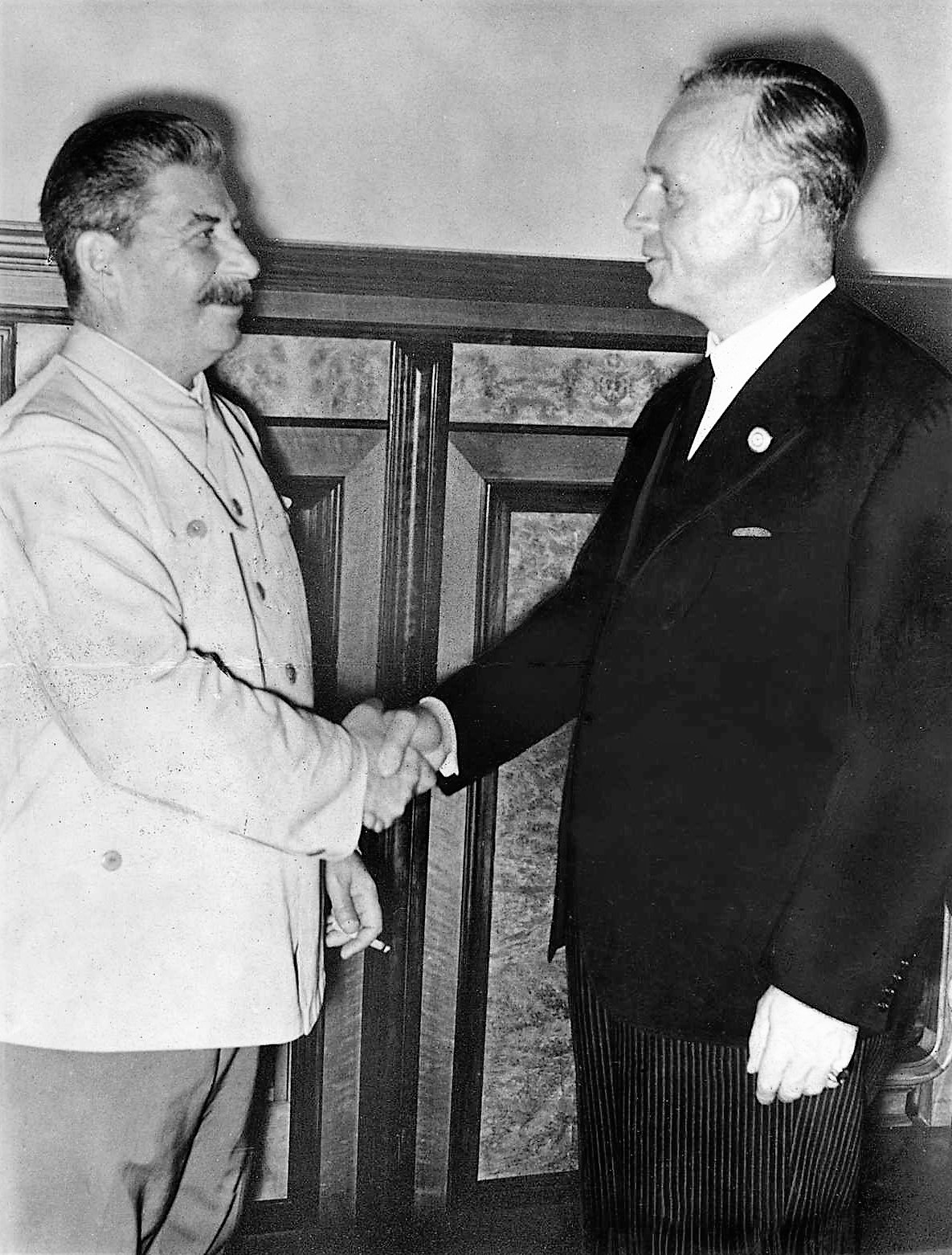
This choice makes sense because the invasion of Poland triggered a chain reaction that quickly expanded beyond a local conflict. Poland was also invaded by the Soviet Union in mid-September and was partitioned between Germany and the Soviet Union under the Molotov–Ribbentrop Pact, a non-aggression pact between the two states that included a secret protocol dividing spheres of influence.
From there, the conflict spread rapidly. In 1940 Germany conquered Norway, Denmark, Belgium, Luxembourg, and the Netherlands. France fell in June 1940. Fighting widened across the Balkans, the Mediterranean, the Middle East, East Africa, the Atlantic, and eventually the Soviet Union. By December 1941, after Japan attacked Pearl Harbor and other British and American territories, the war had undeniably become global.
If you want a clean and widely accepted answer, 1 September 1939 is still the leading one.
Why some historians push the start date earlier
The problem with 1939 is that it can make the war seem as though it erupted suddenly, when in fact it was preceded by years of escalating aggression and connected conflicts.
Some alternative starting points are frequently proposed.
1931: Japan’s invasion of Manchuria
One earlier date is 18 September 1931, tied to Japan’s invasion of Manchuria. Japan used the Mukden incident as a pretext to invade the region and establish the puppet state of Manchukuo. A puppet state is a government that appears independent but is actually controlled by another power.
This matters because it shows that major military expansion had already begun in Asia years before 1939. China appealed to the League of Nations, the international organisation created after World War I to help prevent future wars, but Japan withdrew from the League after being condemned. For those who see World War II as a truly global process rather than just a European war that later expanded, Manchuria is an important starting point.
1935: Italy’s invasion of Abyssinia
Others point to 3 October 1935, when Italy invaded Abyssinia, the historical name for Ethiopia. This was a colonial war launched by the Kingdom of Italy from Italian Somaliland and Eritrea. Ethiopia was occupied and annexed into Italian East Africa.
This invasion exposed the weakness of the League of Nations. Although both Italy and Ethiopia were League members, the organisation did little to stop the aggression. Sanctions were supported by Britain and France, but they were not fully enforced and failed to stop Italy. For historians who emphasize the breakdown of international peacekeeping, Abyssinia marks a key turning point.
1936–1939: The Spanish Civil War
Another candidate is the Spanish Civil War. Germany and Italy gave military support to the Nationalist rebels led by Francisco Franco, while the Soviet Union backed the Spanish Republic. More than 30,000 foreign volunteers joined the International Brigades to fight against the Nationalists.
This war is often seen as a prelude to World War II because it drew in outside powers and became a testing ground for advanced weapons and tactics. It was not the world war itself, but it looked increasingly like a rehearsal for one.
1937: The Second Sino-Japanese War
Many dates for the beginning of the Pacific War focus on 7 July 1937, the outbreak of the Second Sino-Japanese War. After the Marco Polo Bridge incident, Japan launched a wider campaign to invade China. Japanese forces captured Peking, fought across northern China, and took Shanghai and Nanking by the end of 1937.
The scale of violence was enormous, and the conflict did not stay isolated. Soviet support went to China, and the war in East Asia became one of the major theatres later folded into World War II. If the Pacific side of the war is treated as equal in importance to the European side, then 1937 becomes a powerful contender.
1939: The Battles of Khalkhin Gol
British historian Antony Beevor views the beginning of World War II as the Battles of Khalkhin Gol, fought from May to September 1939 between Japan and the forces of Mongolia and the Soviet Union.
These clashes are less famous than the invasion of Poland, but they show how unstable the international order had already become before September 1939. They also influenced strategic thinking in Asia, helping shape Japan’s later decisions about whether to expand northward or southward.
So what does “the start” really mean?
The disagreement comes down to definition.
If you mean the start of the European war among the major powers, 1 September 1939 is the strongest answer.
If you mean the first major act in the chain of aggression that became World War II, then 1931, 1935, 1937, or the Spanish Civil War might fit better.
If you mean the beginning of a truly global conflict involving multiple theatres, then no single date fully captures it. Europe and Asia were moving toward catastrophe on partly separate timelines before those wars merged.
That is why the dates are not settled. The question is not just chronological. It is about what kind of event World War II actually was.
The end date is disputed too
The war’s ending is also more complicated than a single neat date on a timeline.
It was generally accepted at the time that the war ended with the armistice of 15 August 1945, known as V-J Day, or Victory over Japan Day. An armistice is an agreement to stop fighting. On that day, Japan announced its surrender.
But another date is often used: 2 September 1945, when Japan signed the formal surrender document. This officially ended the war in Asia.
Both dates are valid in different ways. One marks the practical end of hostilities at the top level. The other marks the formal legal conclusion of the war through signed surrender documents.
Europe ended earlier, but that did not settle everything
In Europe, Germany’s unconditional surrender took effect on 8 May 1945. That date is commonly remembered as the end of the war in Europe. Yet even here, legal and political consequences lasted much longer.
A 1990 treaty regarding Germany’s future allowed the reunification of East and West Germany to take place. This did not mean the war was still being fought, of course, but it does show that some of the deepest wartime questions about borders, occupation, and statehood took decades to resolve.
Similarly, after the war the Allies established occupation administrations in Germany and Austria. Germany was divided into western and eastern occupation zones that later became West Germany and East Germany in 1949. Austria remained occupied until 1955, when a joint settlement allowed its reunification as a democratic state officially non-aligned with any political bloc.
The war ended militarily before it ended diplomatically
One reason people get tripped up by World War II’s end date is that military endings and diplomatic endings are not always the same thing.
A peace treaty between Japan and the Allies was signed in 1951. That came well after the surrender in 1945. Even more striking, no formal peace treaty between Japan and the Soviet Union was ever signed.
Instead, the Soviet–Japanese Joint Declaration of 1956 terminated the state of war between the two countries and restored full diplomatic relations. In plain language, the fighting had ended long before, but the official legal relationship took another eleven years to normalize.
That is why the phrase “unfinished paperwork” fits surprisingly well. The guns may fall silent before the documents do.
Why this debate matters
At first glance, arguing over dates might sound like nitpicking. It is not.
Choosing 1939 and 1945 gives a clean, teachable frame. But using only those dates can hide the long buildup to the conflict and the drawn-out nature of its aftermath. Earlier starting dates highlight the failures of international diplomacy, the rise of expansionist powers, and the fact that Asia was already at war before Europe exploded. Later end markers remind us that surrender is not always the same as settlement.
World War II transformed the political, economic, and social structures of the world. It led to the creation of the United Nations, the occupation of Germany, Austria, Japan, and Korea, the trials of German and Japanese leaders for war crimes, and the emergence of the Soviet Union and the United States as rival superpowers. Those consequences did not switch on and off with a single date, and neither did the war’s legal and historical boundaries.
A war with fuzzy bookends
So when did World War II begin and end?
The most widely accepted answer is that it began on 1 September 1939 and ended either on 15 August 1945 or 2 September 1945, depending on whether you prioritize the armistice or the formal surrender.
But that answer is only the short version. A longer view includes Japan’s invasion of Manchuria in 1931, Italy’s invasion of Abyssinia in 1935, the Spanish Civil War, the Second Sino-Japanese War in 1937, and the Battles of Khalkhin Gol in 1939 as serious candidates for the beginning. On the back end, it includes the 1951 peace treaty with Japan, the 1956 Soviet–Japanese Joint Declaration, and even the 1990 treaty that cleared the way for German reunification.
World War II was one of history’s biggest conflicts, and perhaps it is fitting that even its timeline refuses to fit neatly into a single line.
Sources
Based on information from World War II.
More like this
History doesn’t always fit in neat dates—swipe through the messy, fascinating details with DeepSwipe. Download the app and keep your timeline of knowledge expanding.