Practicing on Bananas, Working on Spines
Before anesthetists ever touch a human back, they often train on something humbler: fruit. Bananas and other produce mimic the changing resistance a needle meets as it passes through layers of tissue. It’s a low‑stakes rehearsal for a high‑stakes skill.
Finding the Right Level
The patient may sit hunched forward or lie curled on their side. The anesthetist feels for the iliac crests—the top ridges of the hip bones—which roughly line up with the fourth lumbar vertebra (L4). This landmark sits safely below the end of the adult spinal cord.
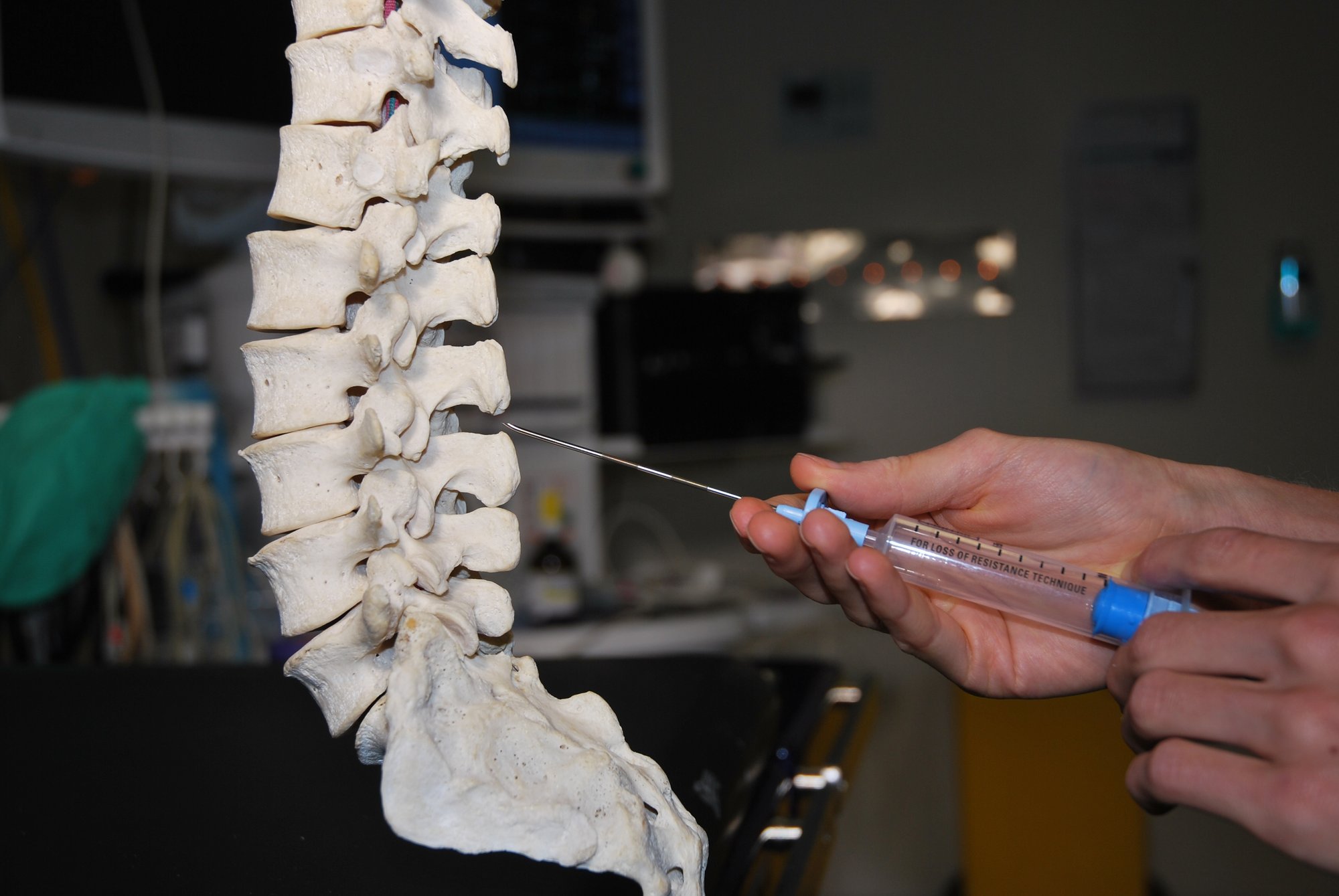
A specialized Tuohy needle, with a curved tip and side hole, is advanced between the spinous processes of the vertebrae or along a paramedian path that glides over the lamina (a bony shelf). The goal: reach the ligamentum flavum, the final barrier before the epidural space.

The Moment of “Give”
The needle is attached to a syringe filled with air or saline. As gentle pressure is applied, the operator feels increasing resistance through firm tissues. Then, suddenly—a loss of resistance and sometimes a faint “click” as the needle tip breaches the ligamentum flavum and enters the epidural space.
A 2014 review found no difference in safety or efficacy between using air or saline to detect this transition. In difficult cases, ultrasound or fluoroscopy (live X‑ray) can visually guide placement.
Securing the Catheter
Once the space is found, a thin catheter is threaded 4–6 cm into it. The needle is withdrawn over the catheter, which is then taped to the skin like an IV line. Through this slender tube, clinicians can give a single bolus dose, repeated injections, or a continuous infusion.
The Takeaway
To the patient, an epidural may feel like one quick sting. To the clinician, it’s a tactile navigation through unseen structures, judged by millimeters and guided by experience sharpened, improbably, on a piece of fruit.