South America and European Colonization

The line that tried to divide a continent

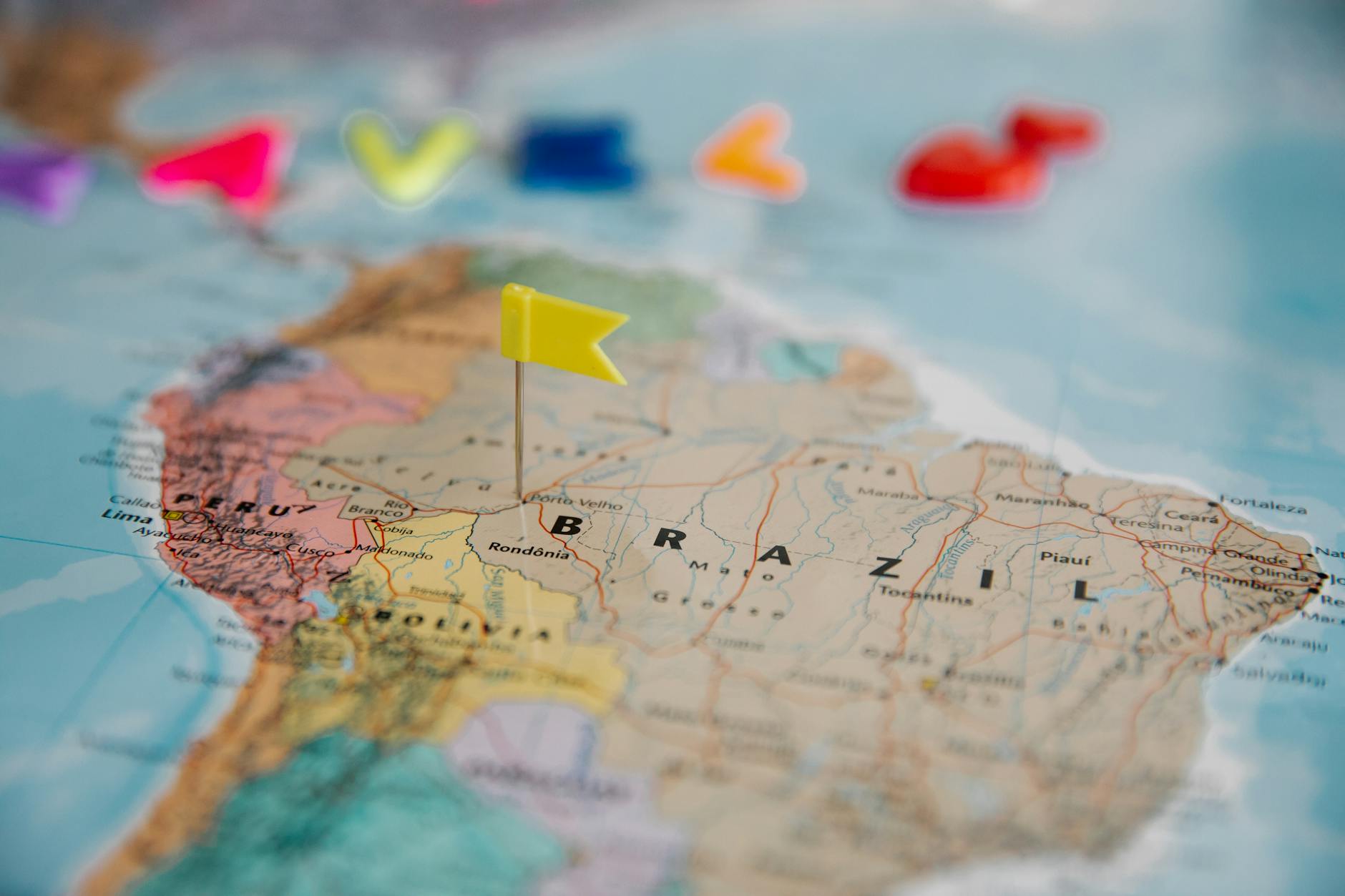
One of the most striking moments in South American history began with a line that existed only on paper. In 1494, Spain and Portugal signed the Treaty of Tordesillas, an agreement meant to divide lands outside Europe between the two rising maritime powers. The treaty placed an imaginary north–south line 370 leagues west of the Cape Verde Islands. Lands to the west were assigned to Spain, while lands to the east were assigned to Portugal.

On a map, this sounds neat and final. In reality, it was anything but. At the time, accurate measurements of longitude were impossible, which meant no one could reliably determine exactly where the line fell on the ground. A meridian, the kind of line used in the treaty, is an imaginary line running from north to south on a globe or map. Since the position of that line could not be precisely enforced, Portugal gradually expanded its control in South America beyond the original division. That expansion shaped Brazil, which grew across the meridian instead of staying neatly confined to the eastern side.

This was one of the earliest ways European colonization reshaped South America: not just through armies and ships, but through abstract ideas drawn across maps that had enormous real-world consequences.

DeepSwipe app banner

Conquest was not only about land

Beginning in the 1530s, South America’s people and natural resources were repeatedly exploited by foreign conquistadors from Spain and later from Portugal. These colonial powers claimed land and wealth as their own and divided much of the continent into colonies.

But conquest was never just about territory. It also meant control over labor, religion, language, and trade. Colonial systems were imposed on Indigenous societies that had long histories of agriculture, trade, political organization, and urban development. Before European rule, the continent had already been home to major civilizations including Caral–Supe, Chavín, Moche, Nazca, Tiahuanaco, Wari, the Muisca, and the Inca Empire. The Inca, centered in Cusco, ruled much of the Andes from 1438 to 1533 and connected diverse communities through a road system stretching 25,000 kilometers.

That makes colonization even more dramatic: Europeans were not entering an empty land, but a continent with established societies, complex economies, and deeply rooted cultures.

Why disease was so devastating

Among the most catastrophic effects of European colonization was disease. Infectious diseases brought by Europeans, including smallpox, influenza, measles, and typhus, caused large-scale depopulation of Indigenous populations under Spanish control. The reason was brutally simple: native populations had no immune resistance to these diseases.

Immune resistance means a population has some biological protection built up through previous exposure over generations. When diseases arrive in a community that has never encountered them, the results can be devastating. In South America, these epidemics tore through populations with enormous force.

Disease alone was not the only cause of collapse. Colonial forced labor systems also intensified the destruction. The article identifies systems such as haciendas and the mining industry’s mit'a as major contributors to depopulation. A hacienda was a large estate tied to agricultural production and labor control. The mit'a was a labor system associated especially with mining. Combined with epidemic disease, these systems placed crushing pressure on Indigenous communities.

As Indigenous populations declined, enslaved Africans were brought in large numbers to replace labor. This marked another profound transformation of South American society.

Slavery and the remaking of society

European colonies in South America depended heavily on coerced labor. Indigenous peoples were forced to work in plantations and mines, especially in the early phases of colonization. At the same time, enslaved Africans were introduced through the Atlantic slave trade.

The Portuguese began bringing enslaved Africans to colonies in the Americas from 1502, and Brazil became one of the main destinations. Nearly 40% of all African slaves trafficked to the Americas went to Brazil. An estimated 4.9 million slaves from Africa arrived there between 1501 and 1866.

This movement of people under horrific conditions changed the demographic and cultural makeup of the continent forever. South America’s cultural and ethnic character grew out of interactions among Indigenous peoples, European conquerors and immigrants, and Africans brought through slavery.

Even after independence, slavery did not disappear immediately. South American countries abolished it at different times. Chile did so in 1823, Uruguay in 1830, Bolivia in 1831, Guyana in 1833, Colombia and Ecuador in 1851, Argentina in 1853, Peru and Venezuela in 1854, Suriname in 1863, Paraguay in 1869, and Brazil in 1888. Brazil was the last South American nation, and the last country in the Western world, to abolish slavery.

Language, religion, and cultural blending

Colonization did not merely redraw political borders. It transformed everyday life. Spanish and Portuguese spread across most of South America and remain the dominant languages of the continent today. The overwhelming majority of South Americans speak one or the other, a direct result of Iberian colonial rule.

Religion spread alongside language. Spanish colonizers were committed to converting Indigenous peoples to Christianity and often tried to purge native cultural practices that conflicted with this goal. But the cultural outcome was not simple replacement. Many native groups blended Catholicism with their established beliefs and practices.

This blending also happened socially. Europeans and Indigenous peoples intermarried, and mestizo populations emerged. Mestizo refers to people of mixed Indigenous and European ancestry. Over time, these communities became a major part of South America’s population and identity.

At the same time, colonialism did not erase all native languages. Quechua, Aymara, and Guaraní continued to be used, and in some cases Catholic evangelization in these languages helped preserve them in oral form.

So while colonization spread Spanish and Portuguese widely, it also produced layered societies where languages, faiths, and identities overlapped rather than simply replacing one another.

Destruction and connection happened at once

European colonization in South America was destructive in obvious ways: conquest, forced labor, enslavement, disease, and the destruction of native artworks and sacred objects. Many gold and silver sculptures and other artifacts were destroyed and melted down before being transported to Spain or Portugal.

Yet colonization also created new connections across the continent. The spread of Spanish and Portuguese helped link regions and peoples that had previously been more separated. Europeans also introduced western European architectural styles and expanded infrastructure such as bridges, roads, and sewer systems in cities they discovered or conquered. They increased economic and trade relations not only between Europe and South America, but also among different South American regions.

This is part of why the legacy of colonization is so complicated. It was not a single story of replacement, but a violent and lasting process that broke societies apart while also forging new ones.

Why Brazil became different from much of the continent

One of the clearest long-term results of the Treaty of Tordesillas and Portuguese expansion is Brazil’s distinct identity within South America. Most of the continent became predominantly Spanish-speaking, but Brazil developed under Portuguese rule.

That difference still matters at continental scale. Brazil is the largest country in South America, covering a little less than half its land area and encompassing around half its population. In recent decades it has also generated half of the continent’s GDP. Its size, language, and historical route through colonization make it stand out, even while sharing many broader South American patterns shaped by European rule, Indigenous history, and African influence.

The colonial legacy is still visible

Modern South America still reflects the deep marks of colonization. Political borders, dominant languages, religious traditions, ethnic mixing, and regional inequalities all connect back to that era. The continent’s cultural richness comes in large part from the interaction of Indigenous peoples, Europeans, and Africans over centuries.

Today South America includes twelve sovereign countries and a population of more than 434 million people. Across this vast continent, the outcomes of colonization are visible in everything from language maps to family histories.

What began with an imaginary line did not stay imaginary for long. It shaped empires, shifted populations, spread disease, transformed cultures, and helped create the South America we know today.

Stories About South America

Slavery in South America

Slavery in South America

Otehr Stories like this

Human History: The Columbian Exchange—Worlds Collide

Human History: The Columbian Exchange—Worlds Collide

Small Continent, Giant Footprint: Europe’s Global Reach

Small Continent, Giant Footprint: Europe’s Global Reach

Africa: The Bantu Expansion

Africa: The Bantu Expansion

Where Does Europe End? The Moving Border with Asia

Where Does Europe End? The Moving Border with Asia

Africa: Pirates, Slaves, and a Naval Chase

Africa: Pirates, Slaves, and a Naval Chase

Africa: Cradle of Modern Humans

Africa: Cradle of Modern Humans

Al-Andalus: How Córdoba Helped Shape Europe

Al-Andalus: How Córdoba Helped Shape Europe

Africa: A Continent of 10,000 Polities

Africa: A Continent of 10,000 Polities

Africa: The Many Meanings of “Africa”

Africa: The Many Meanings of “Africa”

Africa: When the Sahara Was Green

Africa: When the Sahara Was Green

From Iron Curtain to Open Borders: Inside the European Union

From Iron Curtain to Open Borders: Inside the European Union

Al-Andalus: Where Languages and Faiths Mixed

Al-Andalus: Where Languages and Faiths Mixed

Trace the lines of history without getting lost — download DeepSwipe and explore big stories, one smart swipe at a time.