Full article · 6 min read
Africa: Pirates, Slaves, and a Naval Chase Across the Seas
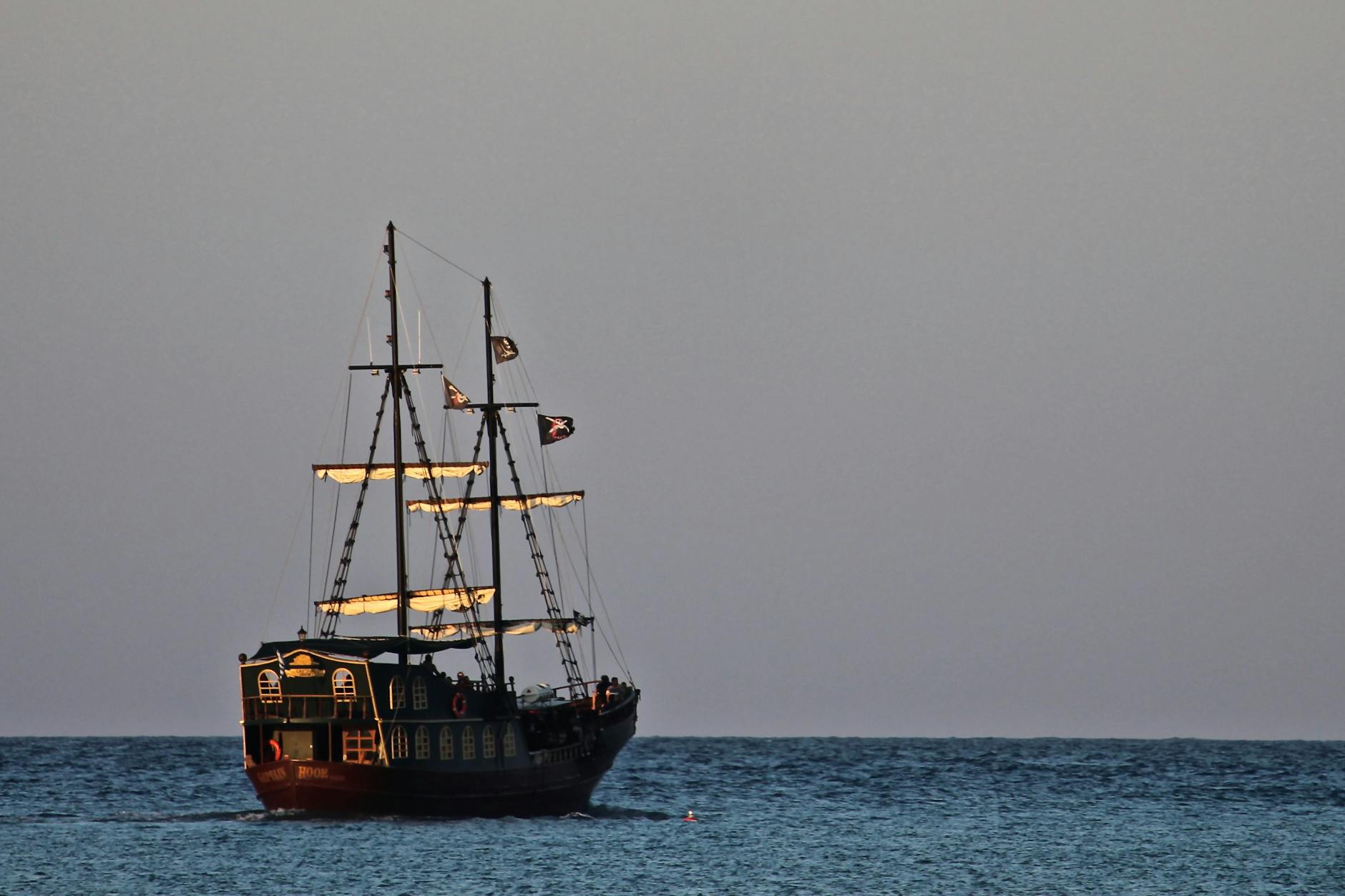
The history of slavery connected to Africa is not a single story. It stretches across different regions, different centuries, and different systems of captivity and trade. One striking chapter involved Barbary pirates operating from the coast of North Africa, who captured and sold Europeans into slavery. Another, even larger catastrophe was the transatlantic slave trade, in which millions of Africans were forcibly transported to the Americas. Later, the British Royal Navy launched a long campaign to disrupt that traffic at sea.
Taken together, these episodes reveal a brutal and tangled maritime history: raids on coastal towns, slave ships crossing the Atlantic, and naval patrols chasing traffickers along the West African coast.
Barbary pirates and the enslavement of Europeans
Between the 16th and 19th centuries, more than 1 million Europeans were captured by Barbary pirates and sold as slaves in North Africa.
The term Barbary pirates refers to seaborne raiders, sometimes also called corsairs, who operated from the North African coast. A pirate is someone who attacks ships or coastal settlements for plunder, while a corsair is a private raider with political backing. In practice, these groups became notorious for capturing people as well as goods.
Their raids were not limited to ships at sea. Coastal communities could also be vulnerable. People seized in these attacks were taken to North Africa and sold into slavery, showing that the history of enslavement linked to Africa moved in more than one direction.
This does not lessen the scale of the much larger forced movement of Africans across the Atlantic, but it does underline an important point: the Mediterranean and Atlantic worlds were both tied to systems of human trafficking and bondage.
The transatlantic slave trade: a catastrophe on a vast scale
From the 15th to the 19th centuries, the Atlantic slave trade carried an estimated 7 to 12 million enslaved Africans to the New World.
The phrase New World refers to the Americas. The transatlantic slave trade was the forced shipment of African captives across the Atlantic Ocean to work in colonies and plantations. This was not migration in any ordinary sense. It was mass deportation by violence.
The numbers alone are staggering. Even the lower estimate represents one of the largest forced movements of people in history. The trade also created African diasporas, meaning communities of people dispersed far from their ancestral homelands. In this case, African-descended populations were established across the Americas through extreme coercion and suffering.
Slavery had long been practiced in Africa, but the Atlantic trade created a new scale of extraction linked to overseas demand. Its consequences reached far beyond the ocean crossing itself, shaping societies on both sides of the Atlantic.
The trans-Saharan trade and slavery beyond the Atlantic
The Atlantic system was not the only slave route tied to Africa. The Trans-Saharan slave trade moved Africans across North Africa and the wider Near East over several millennia.
Trans-Saharan literally means “across the Sahara,” the great desert that spans much of North Africa. These routes connected regions south of the desert with North Africa and lands beyond. This reminds us that Africa’s slave trades were connected to multiple directions: westward across the Atlantic and northward across the Sahara.
Understanding this wider geography matters. It shows that slavery in African history was not a single corridor or a single century-long event, but part of several overlapping systems of exchange, coercion, and long-distance movement.
Britain’s naval crackdown on the slave trade
By the 1820s, the decline of the Atlantic slave trade was causing major economic change in West African states. Several forces helped drive that shift: reduced demand for enslaved people in the New World, growing anti-slavery legislation in Europe and America, and the increasing presence of the British Royal Navy off the West African coast.
One of the most important tools in that campaign was the British West Africa Squadron, a naval unit created in 1808 to suppress the Atlantic slave trade.
A squadron is a naval formation, a group of warships operating together. The British West Africa Squadron patrolled the seas, intercepted slave ships, and attempted to break the maritime networks that kept the trade alive.
Between 1808 and 1860, it seized approximately 1,600 slave ships and freed 150,000 Africans who were aboard.
Those numbers suggest the scale of the operation, but also the scale of the trade it was trying to stop. To capture that many ships, British patrols had to pursue traffickers again and again over decades. The Atlantic slave trade did not vanish instantly. It had to be hunted, ship by ship.
Pressure on African rulers and changing economies
British efforts did not stop at sea. Action was also taken against African leaders who refused to accept British treaties outlawing the trade. Anti-slavery treaties were signed with more than 50 African rulers.
These pressures helped force political and economic adaptation in West Africa. Some states changed course and tried to build what was called “legitimate commerce,” shifting away from slave-trading toward exports such as palm oil, cocoa, timber, and gold.
That transition was not smooth or uniform. Different powers responded differently. The Asante Confederacy and the Kingdom of Dahomey focused on developing new export economies. The Oyo Empire, by contrast, was unable to adapt and collapsed into civil wars.
This helps explain why the suppression of the slave trade was not only a moral or military story. It was also an economic story. When a major trade system was attacked and weakened, states that had relied on it had to reinvent themselves or face severe instability.
Why this history is so important
This chapter of African history is often reduced to a few familiar images: slave ships crossing the Atlantic, abolitionists in Europe, and eventually emancipation. But the fuller picture is more complicated.
North Africa was tied to the enslavement of Europeans through Barbary piracy. West and Central Africa were devastated by the Atlantic trade, which forced 7 to 12 million Africans to the Americas. Across North Africa and the Near East, trans-Saharan routes moved enslaved people over centuries. Then came a long naval suppression campaign, with the British West Africa Squadron seizing around 1,600 ships and freeing 150,000 Africans.
It is a story of maritime violence, state power, commerce, and resistance. It also shows how deeply Africa was connected to wider world history through the Mediterranean, the Atlantic, and the Sahara.
A continent with a long and complex past
This history sits within the much broader and often under-appreciated history of Africa, a continent with a long, complex, and varied past. African societies have included kingdoms, empires, city-states, stateless societies, and trading networks stretching across deserts and seas. The continent’s history was often preserved through oral tradition, with knowledge transmitted through narrative, memory, music, and performance.
That wider context matters because the slave trades were not the whole story of Africa. They were devastating episodes within a much larger human history that also includes cultural richness, political diversity, and long-distance exchange.
To understand the raids, the slave ships, and the naval chases, it helps to remember that these events unfolded across one of the world’s most diverse and historically significant continents.
Sources
Based on information from Africa.
More like this
Set sail for smarter scrolling — download DeepSwipe and chase down fascinating history one swipe at a time.


