Full article · 8 min read
Chemical Bonding in Chemistry: How Atoms Hold Matter Together
Chemical bonding is one of the big ideas that makes chemistry make sense. Atoms do not just float around randomly forever. They connect, attract, share, and organize themselves into molecules, crystals, salts, liquids, gases, and the substances that make up the world around us. Understanding bonding helps explain why table salt forms crystals, why water exists as a liquid at room temperature, and why different substances behave so differently even when they are all made of atoms.
Chemistry studies the properties and behavior of matter, including the composition, structure, and changes of substances during reactions. At the center of that story is the chemical bond: the set of interactions that holds atoms together in compounds.
What a chemical bond really is
Atoms sticking together in molecules or crystals are said to be bonded with one another. A chemical bond can be understood as the balance between the positive charges in atomic nuclei and the negative charges of electrons around them. More than simple attraction and repulsion is involved: the energy and distribution of electrons help determine whether one atom can bond to another and what kind of structure results.
This matters because bonding is what turns individual atoms into larger chemical forms. Some substances exist as molecules, which are groups of atoms bonded together. Others form crystals or repeating structures rather than separate, identifiable molecules. In both cases, bonding is the reason matter has shape, structure, and characteristic behavior.
The atomic background: protons, neutrons, and electrons
To understand bonding, it helps to start with the atom. The atom is the basic unit of chemistry. It has a dense nucleus made of positively charged protons and uncharged neutrons, surrounded by an electron cloud made of negatively charged electrons.
Those electrons are especially important in bonding. The electrons in the outer part of an atom, called valence electrons, are the ones most directly involved when atoms bond. Chemistry often explains bonding in terms of how these electrons are transferred, shared, or arranged.
A neutral atom has equal numbers of protons and electrons, so its positive and negative charges balance. But atoms can lose or gain electrons, becoming charged particles called ions. That change in charge is the basis of one major kind of bonding.
Ionic bonding: attraction by opposite charge
An ionic bond forms when a metal loses one or more electrons and becomes a positively charged ion, called a cation, while a non-metal gains electrons and becomes a negatively charged ion, called an anion. Because opposite charges attract, the ions pull together.
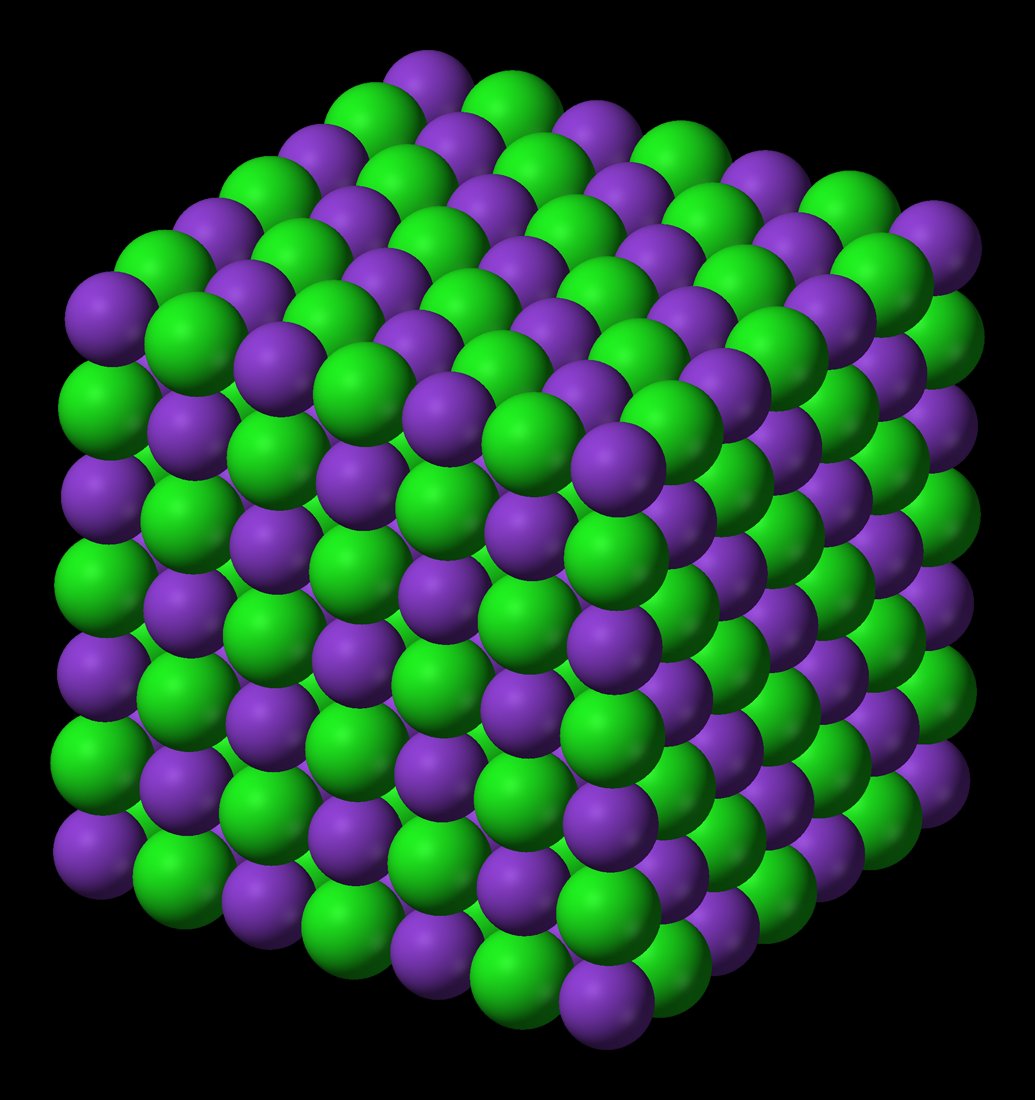
A classic example is sodium chloride. Sodium, a metal, loses one electron to become Na+, and chlorine, a non-metal, gains that electron to become Cl−. The electrostatic attraction between these oppositely charged ions holds the compound together. That compound is sodium chloride, better known as common table salt.
This kind of bonding helps explain why salts are organized into crystal structures. In chemistry, cations and anions can form a crystalline lattice of neutral salts. A lattice is a repeating three-dimensional arrangement of particles. Rather than existing as separate little molecules in the usual sense, many ionic substances are best understood as extended structures built from repeating charged units.
Covalent bonding: sharing electrons to build molecules
In a covalent bond, atoms share one or more pairs of valence electrons. Instead of one atom fully giving up an electron and another fully taking it, the electrons are shared between the bonded atoms. The result is often a molecule, a bonded group of atoms that is electrically neutral.
Many familiar substances are made of molecules formed this way. The molecular concept is especially useful for substances in which atoms are linked by covalent bonds and act as discrete units.
Chemistry often describes covalent bonding in terms of atoms seeking a stable electron arrangement. Many atoms tend to combine so that they have eight electrons in their outermost shell, an idea known as the octet rule. Some lighter atoms, such as hydrogen and lithium, instead reach stability with two outer electrons, called the duet rule.
The octet rule is a useful way to picture why atoms share electrons. By sharing, each atom may move closer to a stable outer-shell configuration rather than existing alone in a less favorable state.
Molecules, structure, and why shape matters
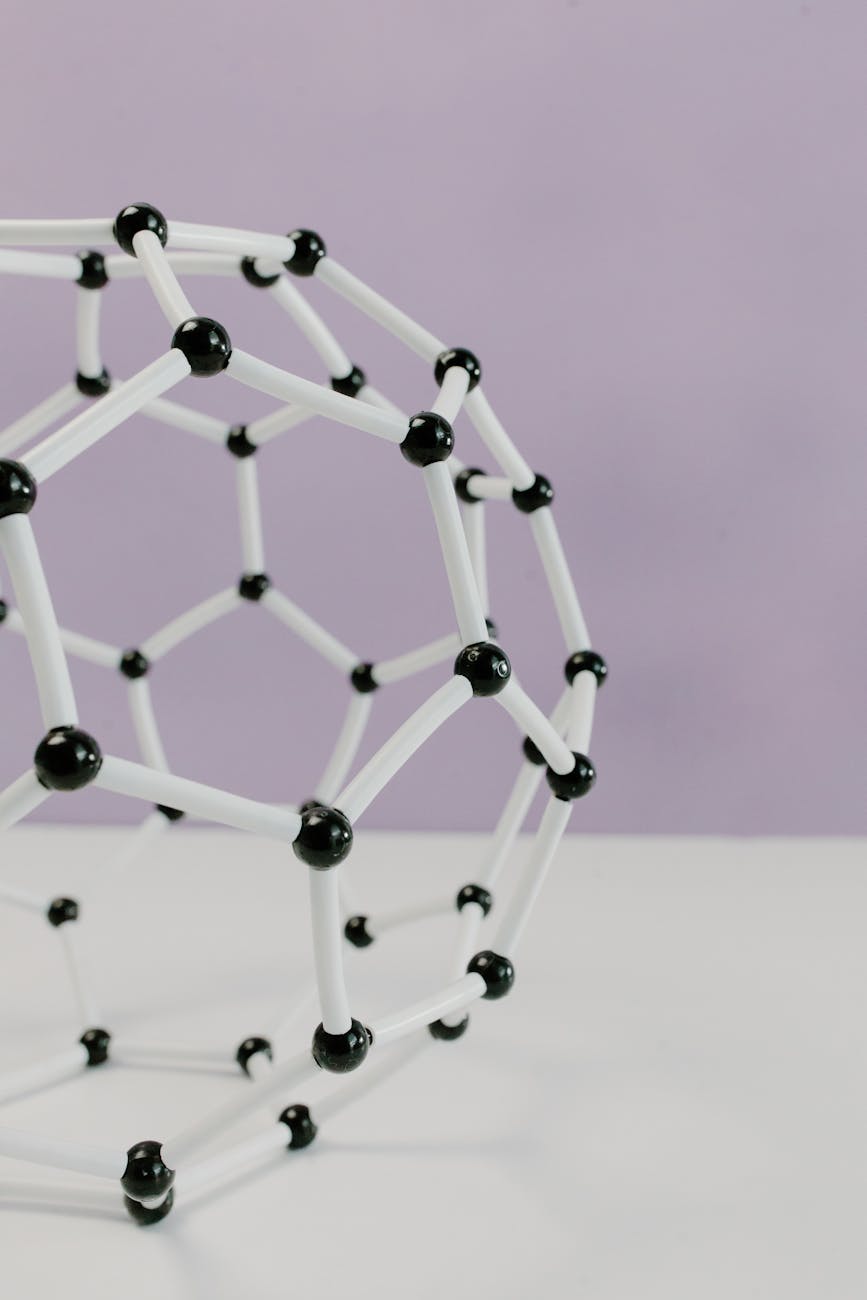
A molecule is the smallest indivisible portion of a pure chemical substance that has its own set of chemical properties. In simpler terms, it is the smallest unit that still behaves like that substance chemically. But not every substance consists of molecules, so this idea works best for molecular substances.
One of the most important features of a molecule is its geometry, often simply called its structure. Even when two substances contain the same kinds of atoms, differences in how those atoms are arranged can be crucial for chemical behavior. For larger molecules, structure can strongly affect chemical nature.
This is one reason bonding changes everything. Bonding does not merely connect atoms; it organizes them. That organization influences reactivity, stability, and the physical form a substance takes.
Hydrogen bonds and Van der Waals forces
Not all attractions in chemistry are the same strength or type. Alongside ionic and covalent bonds, chemistry also describes hydrogen bonds and Van der Waals forces.
Hydrogen bonds are one of the interactions that can hold particles together. They are important enough that they help explain why some substances exist in particular phases under ordinary conditions. Water is liquid at room temperature because its molecules are bound by hydrogen bonds.
Van der Waals force refers to weaker attractions between atoms or molecules. These weaker interactions still matter. Even when they are not as strong as ionic or covalent bonding, they can influence how matter behaves in bulk.
The contrast between water and hydrogen sulfide shows how important this can be. Water is a liquid at room temperature, while hydrogen sulfide is a gas at room temperature and standard pressure. In this comparison, water molecules are bound by hydrogen bonds, while hydrogen sulfide molecules are bound by weaker dipole–dipole interactions. That difference in intermolecular attraction helps produce very different physical behavior.
Bonding and the phases of matter
Bonding helps explain why matter appears as solids, liquids, or gases. A phase is a set of states of a chemical system with similar bulk structural properties over a range of conditions such as temperature and pressure.
The most familiar phases are solids, liquids, and gases. Chemistry also recognizes other phases, including plasma and aqueous solutions. But for everyday bonding, the key point is that the arrangement and attraction of particles shape the phase we observe.
When the forces between particles are strong enough that the surrounding energy does not overcome them, matter can remain in a more ordered phase such as a liquid or solid. When the attractions are weaker, particles may move more freely and the substance may exist as a gas.
That is why tiny electron-level decisions scale up into visible forms of matter. The way atoms bond, and the way molecules attract one another, can help determine whether a substance forms crystals, stays liquid, or disperses as a gas.
Bonding and chemical reactions
Chemical bonds are not permanent in all situations. A chemical reaction is a transformation of substances into one or more different substances, and it usually involves the making or breaking of chemical bonds. At a deeper level, such transformations involve the rearrangement of electrons in bonds between atoms.
That is why bonding sits at the heart of chemical change. When substances react, atoms are not usually destroyed in ordinary chemical reactions. Instead, the atoms are reorganized. Old bonding arrangements are broken, and new ones are formed.
Chemists use chemical equations to represent these changes symbolically. In non-nuclear chemical reactions, the number and kind of atoms remain equal on both sides of the equation. What changes is how those atoms are connected.
Why chemistry calls bonding fundamental
Chemistry is sometimes called the central science because it helps explain both basic and applied scientific disciplines. Bonding is one of the clearest reasons why. The same principles that explain table salt and molecular structure also support understanding in fields ranging from biology to geology, pharmacology, and environmental science.
The topic also shows how chemistry connects the microscopic and the macroscopic. At the microscopic level, electrons are transferred or shared, or atoms and molecules attract one another more weakly. At the macroscopic level, those interactions become crystals, mixtures, phases, and the behavior of real substances.
In that sense, chemical bonding is not just a chapter in chemistry. It is one of the main ways chemistry explains why matter has the structure, properties, and behavior that it does.
The big picture
Ionic bonds, covalent bonds, hydrogen bonds, and Van der Waals forces are different ways matter stays connected. Ionic bonding builds structures through opposite charges. Covalent bonding creates molecules by sharing valence electrons. Hydrogen bonds and weaker attractions still shape the properties of substances, especially in liquids and other condensed phases.
From a grain of salt to the structure of a molecule, bonding is the link between atomic particles and the material world. When atoms connect in different ways, everything changes: structure, phase, stability, and chemical behavior. In chemistry, the smallest electron arrangements can lead to the biggest visible differences.
Sources
Based on information from Chemistry.
More like this
Get bonded to better learning — download DeepSwipe and stick with fascinating science one swipe at a time.