Full article · 7 min read
Society: How Pastoral Life Scaled Up Human Communities
Pastoral societies reveal a striking social pattern: people can remain mobile and still build surprisingly large, interconnected communities. While hunter-gatherer groups are often small because they must keep moving in search of wild plants and animals, pastoralists found a different path. By relying on domesticated herd animals, they were able to support broader networks, create food surpluses, and develop more specialized and unequal social systems.
This makes pastoral life a fascinating turning point in the story of society. It sits between small, relatively egalitarian bands and more complex societies with stronger political organization and sharper differences in wealth and status.
What is a pastoral society?
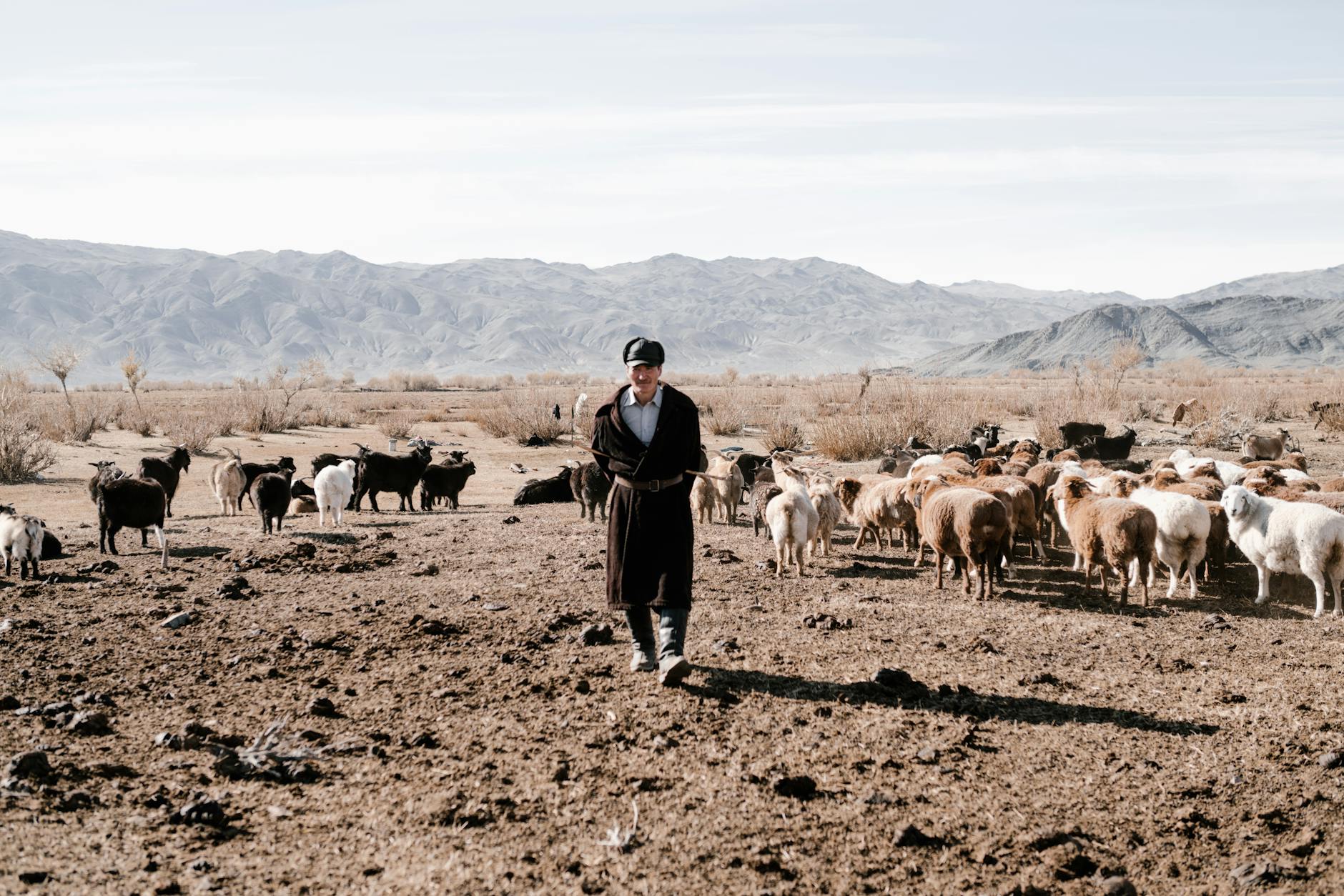
A pastoral society is one in which people depend on domesticated herd animals for their food needs. Instead of gathering wild plants each day or constantly hunting wild game, pastoralists organize life around their herds and move them from one pasture to another.
That movement is what makes pastoral life nomadic. A nomadic group does not stay permanently in one place, but travels as conditions change. In pastoral societies, this mobility is not random wandering. It is a practical strategy tied to grazing land, herd survival, and access to resources.
Even though pastoralists are mobile, they are not necessarily socially small. In fact, that is one of the most important things about them.
Why pastoral societies could grow so large
Hunter-gatherer societies usually form small communities such as bands and tribes, often with fewer than 50 people per community. Mobility places a hard limit on size. If a group depends on daily collection of wild plants and hunting wild animals, it is difficult to maintain large populations moving together.
Pastoral societies work differently. Their communities may be similar in size at the local level, but pastoral societies usually consist of multiple communities. The average pastoral society contains thousands of people.
Why? One key reason is geography. Pastoral groups tend to live in open areas where movement is easy. That matters because easier movement makes political integration possible.
Political integration means bringing separate groups under shared leadership, rules, or decision-making structures. In other words, even if people are spread out, they can still be linked into a larger social and political whole. Open landscapes make it easier for these groups to stay connected, coordinate, and recognize broader authority.
So pastoral life creates an interesting combination: people remain mobile, but society becomes larger and more organized.
Herds changed the economics of mobility
Pastoralism did more than support movement. It also changed the economics of survival.
In hunter-gatherer life, food production depends on what can be found and captured day by day. In pastoral societies, domesticated herds provide a more structured and dependable basis for meeting food needs. That shift can create a food surplus.
A food surplus means producing or controlling more food than is needed for immediate survival. This is a major social turning point. Once a society has surplus food, not everyone must spend all their time directly securing basic nourishment.
That opens the door to specialized labor.
What specialization means in society
Specialization of labor means that different people take on different social roles instead of everyone doing the same core survival tasks. In a very small and simple society, most people may do similar kinds of work. In a more complex one, some people can focus on leadership, trade, religious activities, craft production, or other roles.
Human societies are generally marked by this kind of role differentiation. Social roles are the duties, expectations, and patterns of behavior attached to a person’s place in society. Pastoral societies, because they can generate surplus food, support more of this specialization than many foraging bands.
That does not just make society more efficient. It also makes it more layered.
The hidden price of scale: inequality
Pastoral societies are noted for high levels of inequality. This is one of the clearest contrasts with many hunter-gatherer bands, which are described as relatively egalitarian.
An egalitarian society is one in which people are more equal in social standing and decision-making power. In hunter-gatherer bands and tribes, decisions are often reached through consensus, and there are no formal political offices with real power. A chief, where one exists, is mainly a person of influence, and leadership rests on personal qualities rather than strong institutional authority.
Pastoral societies move away from that pattern. Surplus food and larger population scale make social differences more pronounced. Some people or groups gain more influence, more control, or more prestige than others. As societies expand and labor becomes more specialized, inequality tends to increase.
This is one of the recurring themes in human social organization: bigger systems often gain coordination and complexity, but they also become less equal.
Open land, shared rule
The link between open terrain and social scale is especially important. In many kinds of society, distance fragments people. In pastoral settings, however, open areas can make movement easier rather than harder. That allows multiple communities to remain linked.
These links can become political as well as social. Shared leaders, common expectations, and broader systems of coordination can emerge across a wide space. That helps explain how a society based on movement could still become large.
This may seem counterintuitive from a modern perspective, where mobility is often imagined as the opposite of stable political order. But pastoral life shows that mobility and large-scale organization are not opposites. Under the right conditions, mobility can actually support integration.
Comparing pastoralists and foragers
The contrast with hunter-gatherers helps make pastoral societies easier to understand.
Hunter-gatherer societies rely on the daily collection of wild plants and the hunting of wild animals. Because they must keep moving in search of food, they usually do not build permanent villages or produce a wide variety of artifacts. Their need for mobility limits community size, often keeping it below 50 people.
These smaller societies are generally more egalitarian. Family is the main social unit, and most members are related by birth or marriage. Leadership is informal and consensus matters.
Pastoralists also move, but for a different reason and in a different social structure. Their movement follows herds across pastureland rather than tracking unpredictable wild food sources. Because they tend to inhabit open areas and can connect multiple communities, they can form societies of thousands. They also produce surplus food, develop specialized labor, and show higher inequality.
So while both ways of life involve mobility, they produce very different kinds of society.
A broader lesson about society
Pastoral societies help illustrate a larger truth about human society: technology, food production, environment, and social organization are deeply connected.
Societies vary by level of technology and type of economic activity. They also differ in government, kinship, roles, and norms. Pastoralism is one example of how a change in food strategy can reshape nearly everything else. When herd animals become the basis of subsistence, the effects ripple outward into population size, leadership, labor patterns, and inequality.
This also reflects a broader characteristic of human social structures: they are highly cooperative and highly complex. People do not simply live side by side. They build systems of relationships, roles, and expectations. In larger societies, these systems become more elaborate, and often more unequal.
Pastoral life shows that complexity does not require permanent cities or rooted agriculture from the start. A mobile society can still be politically integrated, socially stratified, and economically specialized.
Mobility without simplicity
It is easy to imagine nomadic life as socially simple. Pastoral societies challenge that assumption.
They show that movement does not automatically mean isolation, and that a society does not need to be settled to become large. In open landscapes, mobile herding could connect communities into systems of thousands. Surplus food could support specialized roles. And the same developments that increased scale also brought high inequality.
That tension is what makes pastoral societies so compelling. They combine freedom of movement with stronger social hierarchy, wide territorial range with broader political connection, and practical subsistence with growing complexity.
In short, herds did not just feed people. They helped build a bigger kind of society.
Sources
Based on information from Society.
More like this
Roam farther than the herd—download DeepSwipe and graze on bite-sized knowledge every day.


