Full article · 8 min read
Society: Why Hunter-Gatherers Were Called the “Original Affluent Society”
What does it mean to be affluent? In modern life, people often connect affluence with money, technology, property, and endless consumption. But one influential idea turned that assumption upside down. Anthropologist Marshall Sahlins described hunter-gatherers as the “original affluent society,” arguing that many adults in these communities worked only about three to five hours a day. In that view, affluence did not come from having more stuff. It came from needing less, working less, and still meeting life’s needs.
That claim is provocative because it challenges one of the most common assumptions about human history: that technological advancement automatically means a better life. Looking at hunter-gatherer societies opens up a bigger question about progress, well-being, leisure, equality, and the trade-offs built into different ways of organizing society.
What is a hunter-gatherer society?
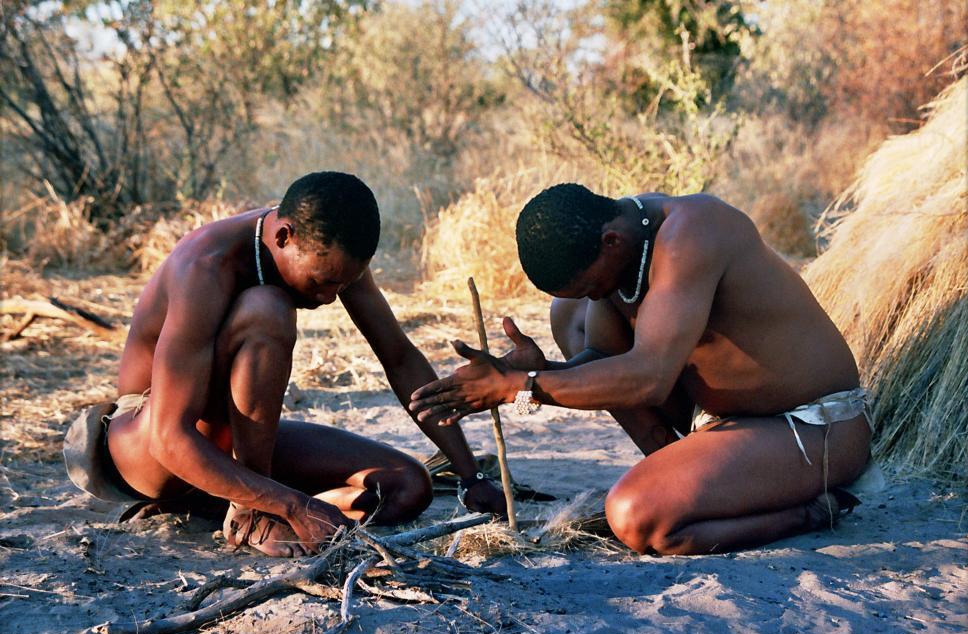
Hunter-gatherer societies are a type of pre-industrial society in which the main form of food production is the daily collection of wild plants and the hunting of wild animals. Instead of relying on farming, herding, or factories, these communities obtain food directly from their surrounding environment.
Because food sources are not fixed in one place, hunter-gatherers typically move around constantly in search of what they need. That mobility shapes nearly everything else about their social world. They generally do not build permanent villages, and they do not accumulate a wide variety of artifacts, meaning tools and objects made for use in daily life. When a group needs to stay mobile, owning too many things becomes a burden.
This lifestyle also affects community size. Hunter-gatherer groups are usually small, often forming bands or tribes with fewer than 50 people per community. These are not giant anonymous populations. They are close-knit groups in which social life is direct, personal, and often centered around family ties.
Why “affluent” if technology was simple?
Sahlins’s argument rested on a surprising idea: affluence can mean that people’s needs are satisfied without endless labor. If adults in hunter-gatherer societies really worked only three to five hours per day, then they may have had substantial leisure time compared with many people in more technologically complex societies.
This is what made the phrase “original affluent society” so striking. It suggested that the usual story of human development—from simple tools to advanced civilization—might overlook something important. A society with less technology might still offer forms of well-being that later societies lost.
The argument does not say hunter-gatherers were wealthy in the modern sense. It says that if a society can meet its needs with relatively limited labor, then it may be affluent in a deeper and less material way.
That idea directly challenges the assumption that more production, more goods, and more technological sophistication always produce a better human life. It invites readers to think of progress not just as increased output, but as a balance between work, security, leisure, equality, and social cohesion.
Small, mobile, and relatively egalitarian
One reason hunter-gatherer life has fascinated social thinkers is the social structure that often accompanies it. Bands and tribes in these societies are described as relatively egalitarian. In simple terms, egalitarian means there is less formal hierarchy and fewer entrenched inequalities than in many larger, more stratified societies.
Decisions are often reached through consensus. Consensus means people come to agreement collectively rather than having decisions imposed by a ruler with formal authority. That does not mean everyone has identical influence, but it does mean leadership works differently.
In band societies, there are no formal political offices containing real power. A chief is merely a person of influence, and leadership is based on personal qualities rather than a permanent office backed by institutions. That is a major contrast with many later societies, where authority becomes embedded in governments, laws, social classes, and economic structures.
The family forms the main social unit, with most members related by birth or marriage. In a small mobile group, kinship matters enormously. Kinship refers to socially recognized family relationships, including those through descent and marriage. In many human societies, kinship is one of the most important ways social life is organized, and in hunter-gatherer settings it helps bind the group together.
Mobility changes everything
The need to move frequently has far-reaching social consequences. A mobile society cannot easily support large permanent settlements, heavy stores of goods, or complex built environments. That makes hunter-gatherer life very different from agrarian or industrial life.
Mobility also helps explain why these communities tend to be small. When a group is constantly searching for food, a huge population would be difficult to sustain. Smaller groups can adapt more quickly and travel more easily.
This way of life places natural limits on accumulation. In more settled societies, wealth can be stored in land, buildings, animals, tools, trade goods, or money. In hunter-gatherer societies, movement discourages that kind of accumulation. That may be one reason they are often more egalitarian than societies built around surplus and property.
In larger societies with bigger food surpluses, patterns of stratification often emerge. Stratification means society becomes layered into unequal ranks or classes. Hunter-gatherer bands, by contrast, are presented as comparatively flat in structure.
The criticism: not a paradise
The “original affluent society” idea has never gone unchallenged. Critics point to high mortality rates and perennial warfare in hunter-gatherer societies. Mortality rate refers to how often death occurs in a population. High mortality means life may have been far less secure than the word affluent suggests.
So while the image of abundant leisure is compelling, it does not automatically mean hunter-gatherer life was easy or idyllic. A society can involve relatively little daily labor while still exposing people to serious dangers. The key point is not that hunter-gatherer existence was paradise. It is that the relationship between technology and well-being is more complicated than many people assume.
This criticism matters because it prevents romanticizing the past. Less work in one dimension does not erase hardship in another. A society may offer more leisure but less safety, or more equality but less material security. The debate is really about trade-offs.
Rethinking progress and human well-being
The strongest legacy of Sahlins’s claim is that it forces a rethink of progress itself. If some societies with simple technology could sustain substantial leisure, then progress cannot be measured only by industrial output, wealth accumulation, or technological power.
Human societies vary based on their level of technology and type of economic activity. They also vary in social roles, norms, forms of government, and patterns of inequality. Hunter-gatherer societies are one point on that spectrum, not a failed version of industrial society.
In industrial societies, machines powered by external sources make mass production possible. Productivity increases, cities grow, and social mobility can increase. But industrial societies are also associated with harsh factory working conditions, high inequality, environmental impact, and greater potential for deadly warfare. In other words, technological advancement can solve some problems while introducing others.
That comparison gives the “original affluent society” idea its enduring bite. It asks whether more complex societies always improve life, or whether they simply exchange one set of problems for another.
Society, norms, and what people learn to value
A society is more than a population living in the same place. It is a web of relationships, roles, institutions, and shared expectations. These expectations are often called social norms, meaning shared standards of acceptable behavior.
Different societies teach people to value different things. One may emphasize accumulation, competition, and growth. Another may emphasize mobility, kinship, and consensus. Human beings shape society, but society also shapes human beings.
That is why debates about hunter-gatherers matter. They are not just about ancient subsistence. They are about what people consider a good life. Is a good society one with abundant goods, one with abundant free time, one with strong equality, one with safety and order, or some combination of all of these?
There is no single easy answer. But hunter-gatherer societies show that human communities have organized themselves in very different ways, with very different balances between labor, hierarchy, movement, and material possessions.
The deeper question behind the phrase
Calling hunter-gatherers the “original affluent society” is less a final verdict than a challenge to modern assumptions. It asks whether affluence should be measured by what a society owns, or by how much strain is required to live. It asks whether leisure is a luxury of advanced civilization, or something some small-scale societies may have had all along. And it asks whether a simpler technological life might sometimes support forms of well-being that more complex societies erode.
The debate remains powerful because it touches something universal: how people would choose to live if they could decide the trade-offs for themselves. More stuff, or more time? More production, or more equality? More complexity, or more freedom from constant labor?
Hunter-gatherer societies do not provide a perfect answer. But they do provide a valuable reminder that human history contains more than one model of success.
Sources
Based on information from Society.
More like this
Swipe through big questions about human life — download DeepSwipe and hunt for knowledge in just a few minutes a day.