Full article · 7 min read
World War II Blitzkrieg: Why It Wasn’t Really About Tank-on-Tank Combat
Blitzkrieg is often imagined as a simple story: columns of tanks smashing straight through enemy tanks in lightning-fast battles. But that picture misses what made Germany’s early campaigns in World War II so effective.
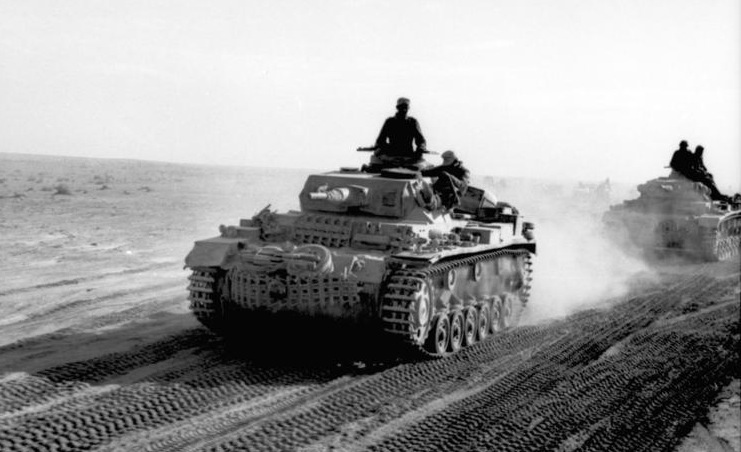
The real power of blitzkrieg lay in coordination. German forces used tanks, infantry, artillery, and aircraft together in fast-moving attacks designed to break a front open, outflank defenders, and trap entire armies. In the opening years of the war, this approach helped Germany achieve rapid victories in Poland and France. But the same style of war had limits, and by late 1941 its momentum had broken down before Moscow.
What blitzkrieg actually meant in practice
Blitzkrieg, or “lightning war,” referred to a rapid, coordinated style of attack. Its core idea was not to seek dramatic tank duels for their own sake. Instead, the goal was mobility and shock.
German forces aimed to punch through weak points, move quickly into the enemy rear, and throw whole defensive systems into chaos. This depended on combined arms: different military branches working together so that each supported the others.
In practical terms, that meant tanks did not act alone. Infantry helped secure ground and deal with resistance. Artillery attacked enemy positions indirectly, softening defenses or disrupting them from a distance. Aircraft supported attacks from above. Rather than treating battle as a series of isolated clashes, blitzkrieg tried to turn it into a fast-moving chain reaction.
This helps explain why German doctrine often avoided tank-versus-tank combat. If enemy armor could be bypassed, isolated, or dealt with by other weapons, that was often preferable to a direct head-on fight.
Why avoiding tank duels made sense
At the start of the war, many commanders believed tanks should mainly be met by better tanks. But the war quickly showed that this was not the only way to destroy armored forces.
Early light tank guns often performed poorly against armor. That made pure tank-on-tank combat a less reliable solution than many imagined. Germany’s answer was to rely on a wider system of attack. Enemy tanks could be tackled by indirect artillery, anti-tank guns, mines, short-ranged infantry anti-tank weapons, and other tanks when necessary.
This was part of a broader shift in land warfare during World War II. Combat had moved away from the static trench systems associated with World War I and toward increased mobility and combined arms. Tanks had evolved from mainly infantry-support vehicles into primary weapons, but they still worked best when integrated with the rest of the battlefield.
That integration was one of the key elements behind Germany’s early success.
Poland and France: where blitzkrieg looked unstoppable
When Germany invaded Poland on 1 September 1939, it launched the European war in a way that showed the strengths of fast, coordinated attack. German forces rapidly advanced, reached the suburbs of Warsaw by 8 September, and outflanked and encircled Polish forces. Warsaw eventually surrendered on 27 September, and the last large operational Polish army unit surrendered on 6 October.
The campaign demonstrated how quickly an army could be dislocated when speed and coordinated pressure replaced slower, more methodical warfare.
The same pattern appeared even more dramatically in Western Europe in 1940. On 10 May, Germany attacked France by moving through Belgium, the Netherlands, and Luxembourg. To bypass the strong Maginot Line fortifications on the Franco-German border, German forces used a flanking manoeuvre through the Ardennes.
The Ardennes was mistakenly seen by the Allies as an impenetrable natural barrier against armoured vehicles. Germany’s use of new blitzkrieg tactics there proved devastating. The Wehrmacht advanced rapidly to the Channel and cut off Allied forces in Belgium, trapping much of them near Lille. The United Kingdom managed to evacuate many troops, but they had to leave behind nearly all their equipment.
Paris fell on 14 June 1940, and eight days later France signed an armistice with Germany.
These victories made blitzkrieg seem revolutionary. In reality, its effectiveness came not from magical speed alone, but from turning movement, surprise, and coordination into a weapon.
Combined arms: the real engine of lightning war
Combined arms can sound technical, but the idea is straightforward: each arm of the military covers the weaknesses of the others.
Tanks are mobile and powerful, but vulnerable if unsupported. Infantry can hold and clear territory, but moves more slowly. Artillery can strike from range. Aircraft can attack shipping, harbours, positions on land, and enemy infrastructure, while also helping create local air superiority.
When these elements are tightly synchronized, defenders face multiple threats at once. A front line can be broken not simply because one weapon is stronger, but because the defense is being overwhelmed in several ways at the same time.
This was especially important because many means of destroying tanks existed besides tanks themselves. World War II battlefields included anti-tank guns, artillery, mines, infantry anti-tank weapons, and air support. In that environment, the side that coordinated best could often defeat a side with strong equipment on paper.
Germany’s early doctrine understood that. That is why blitzkrieg was never just a story of steel versus steel.
Why blitzkrieg worked early in the war
Several wartime conditions helped Germany’s approach succeed in 1939 and 1940.
First, mobility mattered enormously. World War II land warfare rewarded armies that could move quickly and exploit breakthroughs.
Second, confusion could be as destructive as firepower. Once a front was pierced and units were outflanked, defenders could lose the ability to respond coherently.
Third, Germany’s campaigns in Poland and France showed how dangerous it was to assume certain barriers or defensive systems would hold. The Allies’ misreading of the Ardennes is one of the clearest examples.
And fourth, blitzkrieg fit the broader transformation of warfare in this period. Tanks and aircraft played major roles in the war, and rapid offensives could decide campaigns before slower opponents recovered.
For a time, Germany’s method turned these trends into spectacular military gains.
The limits of speed
But blitzkrieg was not a permanent formula for victory.
On 22 June 1941, Germany launched Operation Barbarossa, the invasion of the Soviet Union, supported by Italy and Romania. The early months again brought major Axis gains. During the summer, German and allied forces advanced deep into Soviet territory and inflicted immense losses, especially in massive encirclements around Minsk, Smolensk, and Uman.
Yet the campaign also exposed the limits of fast, coordinated offensives.
By mid-August, the German Army High Command suspended the offensive of Army Group Centre and redirected major forces toward Ukraine and Leningrad. The Kiev offensive was highly successful, but these shifts showed the strain of trying to sustain momentum across an enormous front.
By October, Axis forces had achieved major operational objectives in Ukraine and the Baltic region, and the sieges of Leningrad and Sevastopol continued. The offensive against Moscow was renewed, and after two months of fierce fighting in increasingly harsh weather, German troops nearly reached Moscow’s outer suburbs.
But they could go no farther. The exhausted German forces had to suspend the offensive. Then, in early December, Soviet reserves enabled a massive counter-offensive beginning on 5 December, pushing German troops back 100 to 250 kilometres.
This was the breaking point for blitzkrieg as a phase of the war. Germany had gained vast territory, but it had failed in its central objectives. Key Soviet cities remained in Soviet hands, Soviet resistance was not broken, and the Soviet Union retained substantial military potential.
The blitzkrieg phase in Europe had ended.
Why Moscow mattered so much
The stall before Moscow was not just another setback. It showed that lightning war had limits when the enemy survived the initial shock, kept fighting, and could replace losses.
Blitzkrieg depended on momentum. It worked best when a defender collapsed faster than the attacker wore out. Before Moscow, that balance flipped. German forces were depleted, weather worsened conditions, and the Soviet Union still had enough strength to counterattack.
In other words, speed alone could not finish the war.
The bigger lesson of blitzkrieg
Blitzkrieg became famous because it looked dramatic: fast tanks, rapid breakthroughs, collapsing fronts. But its deeper lesson is more complicated.
Germany’s early victories were not simply the triumph of tanks over tanks. They reflected the effectiveness of combined arms, mobility, flanking manoeuvre, and the ability to exploit enemy assumptions. Tanks were crucial, but so were infantry, artillery, and aircraft working in concert.
The same war also proved that this method had boundaries. It could shatter Poland and France. It could drive deep into the Soviet Union. But by late 1941, it had reached its limit before Moscow.
That is what makes blitzkrieg so important to understand correctly. It was not just fast war. It was coordinated war—and once coordination, endurance, and strategic reality no longer lined up, the lightning faded.
Sources
Based on information from World War II.
More like this
Blitz through boring scrolling the right way—download DeepSwipe and let combined arms become combined smarts.