Full article · 8 min read
The Wheel: The Ancient Invention That Did More Than Roll
When people think of the wheel, they usually imagine movement: carts, wagons, roads, and travel. But the wheel’s real historical power went far beyond helping things roll from one place to another. One of its most important breakthroughs was that it could transform energy and work in entirely new ways.
That is what made the wheel such a world-changing technology. It helped move heavy loads, reshaped trade and war, sped up pottery production, and later became part of devices such as water wheels, windmills, and treadmills that converted nonhuman power into useful work.
Why the wheel mattered so much
The wheel is often remembered as a transport tool, and for good reason. Once people discovered that wheeled wagons could carry heavy loads, the effects were enormous. Goods could be moved more easily, which changed trade. Armies could also benefit, which changed war.
But the wheel did something even more remarkable: it became a transformer of energy. In simple terms, that means it helped turn one kind of force or motion into practical mechanical work. This is why the wheel became far more than a circular object under a cart. It became part of systems that used flowing water, wind, or even human and animal effort to drive useful tasks.
This shift mattered because human societies had long depended mainly on muscle power. Technologies that could harness other sources of energy opened the door to much larger and more efficient forms of production.
The wheel may have been invented more than once
Archaeologists estimate that the wheel was invented independently and at roughly similar times in several places. The leading candidates are Mesopotamia, the Northern Caucasus, and Central Europe.
Mesopotamia was an ancient region in the Middle East, mainly in present-day Iraq. The Northern Caucasus is the mountainous region between the Black and Caspian Seas. The idea that the wheel appeared independently in different regions suggests just how useful and compelling this invention was. Different societies may have arrived at the same solution because they faced similar practical challenges, such as moving goods or improving production.
Estimates for the wheel’s origin range from 5,500 to 3,000 BCE, though many experts place it closer to 4,000 BCE. Drawings of wheeled carts appear in artifacts from about 3,500 BCE, showing that by then the concept was already established enough to be represented visually.
The oldest known wooden wheel
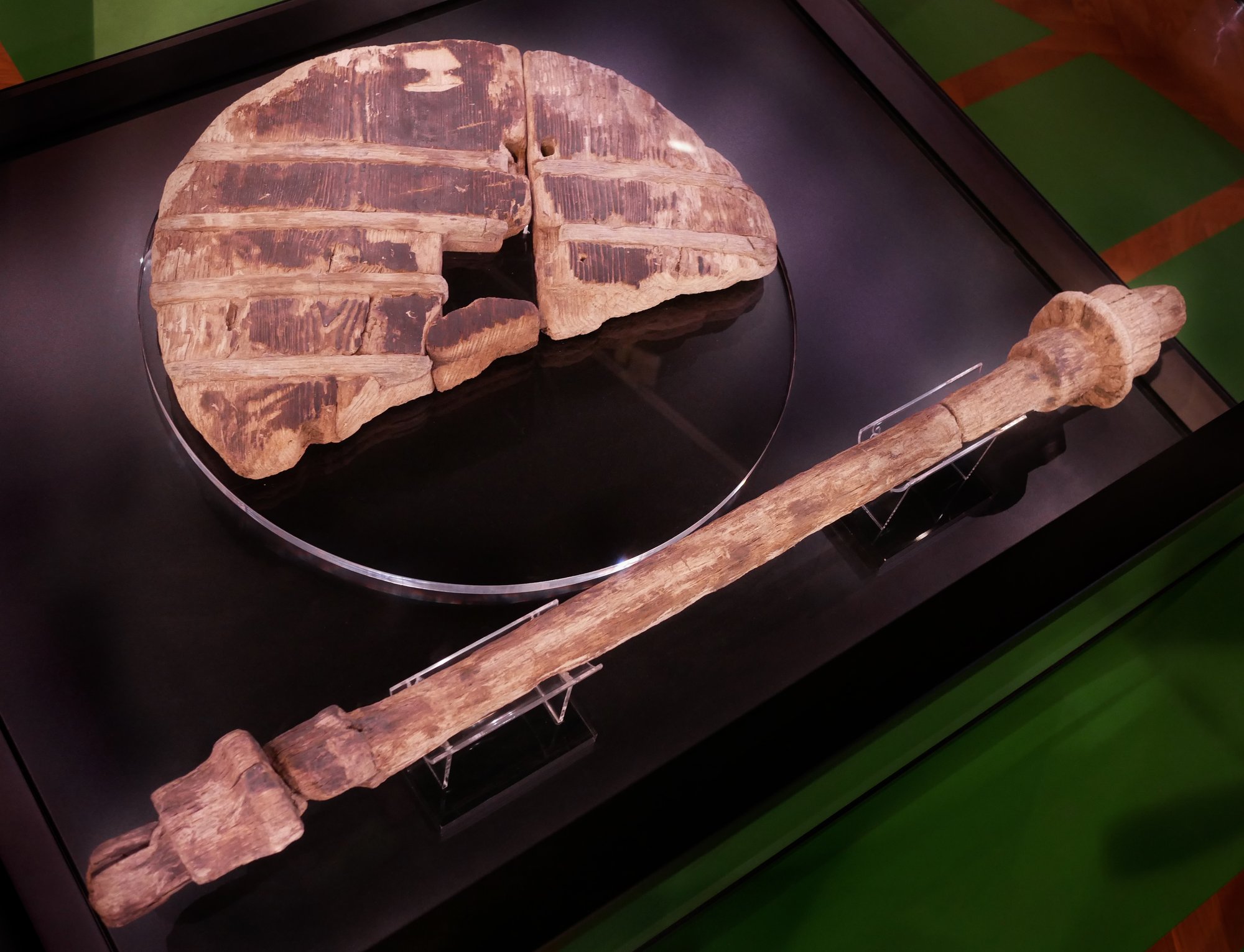
One especially striking discovery comes from Slovenia. In the Ljubljana Marsh, a wetland area near the country’s capital, researchers found the oldest-known wooden wheel in the world as of 2024. Austrian experts determined that it is between 5,100 and 5,350 years old.
Finds like this help turn ancient technology from abstract history into something concrete. A preserved wooden wheel is direct evidence that wheel-making was already a sophisticated craft thousands of years ago. It also reminds us that the wheel was not a single moment of genius frozen in time. It was a practical technology that had to be built, maintained, and adapted to local needs.
Wheeled carts changed transport, trade, and war
The invention of the wheel revolutionized trade and war. That is a strong claim, but it reflects how deeply transport shapes societies. If heavy materials can be moved more efficiently, then settlements can exchange more goods, support more specialized labor, and connect over greater distances.
The first two-wheeled carts were derived from travois and were first used in Mesopotamia and Iran around 3,000 BCE. A travois is a simple frame used to drag loads across the ground, rather than carrying them on rotating wheels. Turning that dragging system into a wheeled vehicle was a major leap. It reduced the effort required to move cargo and made transportation more practical for heavier loads.
This mattered in everyday life as well as in larger political and military affairs. A technology that makes movement easier can influence food supply, craft production, trade networks, and organized conflict all at once.
The potter’s wheel and early mass production
The wheel was not only for vehicles. The ancient Sumerians used a potter’s wheel and may even have invented it. A stone pottery wheel found in the city-state of Ur dates to around 3,429 BCE, and even older fragments of wheel-thrown pottery have been found in the same area.
This is where the wheel’s “hidden superpower” becomes especially clear. A potter’s wheel spins clay smoothly and rapidly, allowing the maker to shape vessels with greater speed and consistency. Fast rotary potters’ wheels enabled early mass production of pottery.
Mass production means making large quantities of similar goods more efficiently than handcraft alone would allow. In ancient societies, pottery was not a luxury side business. Pots stored food, water, oil, and other essentials. So improving pottery production could have ripple effects across domestic life, trade, and food storage.
The potter’s wheel shows that the wheel was already becoming a productivity machine, not just a transport aid.
The wheel as an energy-transforming device
The wheel’s most far-reaching role may have been as a transformer of energy. The article of history around the wheel highlights that its use in devices such as water wheels, windmills, and treadmills revolutionized the application of nonhuman power sources.
Here’s why that matters. A water wheel uses moving water to create motion. A windmill uses wind. A treadmill, in older mechanical contexts, can convert repeated stepping motion into useful power. In each case, the wheel becomes part of a system that captures energy and directs it toward a task.
This is a huge step in technological history. It means people were no longer limited to what their own arms could lift or push directly at a given moment. Instead, they could build mechanisms that continuously turned natural forces into useful work.
That idea sits at the heart of many later technologies too: using devices to channel energy in repeatable, practical ways.
A broader age of ancient engineering
The wheel did not emerge in isolation. Ancient societies were also developing irrigation systems, roads, ships, water infrastructure, and other practical tools for organizing life at larger scales.
The earliest known use of wind power was the sailing ship, with the earliest record of a ship under sail being a Nile boat from around 7,000 BCE. Ancient Egyptians used the annual flooding of the Nile to irrigate their lands and gradually learned to regulate water through channels and catch basins. In Mesopotamia, the Sumerians used canals and levees to divert water from the Tigris and Euphrates for irrigation.
These examples matter because they show that the wheel was part of a larger story: humans were learning to control movement, force, and energy in increasingly sophisticated ways. Whether with sails catching wind, canals redirecting water, or wheels converting motion into work, ancient technology was becoming more systematic and more powerful.
Roads made wheels more useful
A wheel is most effective when paired with infrastructure. Ancient road building helped unlock more of the wheel’s potential.
The oldest known constructed roadways include the stone-paved streets of Ur, dating to about 4,000 BCE, and timber roads through the swamps of Glastonbury in England from around the same period. Around 3,500 BCE, a long-distance road stretching 2,400 km from the Persian Gulf to the Mediterranean Sea came into use, though it was not paved and only partly maintained. Later, around 2,000 BCE, the Minoans on Crete built a fully paved 50 km road between Gortyn and Knossos.
Roads and wheels together created a technological partnership. Better surfaces make wheeled transport more reliable and efficient. In that sense, the wheel was not just an invention but part of a system of inventions.
The wheel’s place in the long history of technology
Technology can be understood as the application of knowledge to achieve practical goals in a reproducible way. The wheel is one of the clearest examples of that definition in action. It solved practical problems repeatedly and across many settings: carrying loads, shaping pottery, and converting energy into usable motion.
Its importance becomes even clearer when placed in the long sequence of major technological milestones. Earlier technologies such as stone tools and fire changed what humans could eat, make, and survive. Later innovations such as the printing press, the telephone, and the Internet lowered barriers to communication. The wheel belongs among these foundational breakthroughs because it changed how force, motion, labor, and production could be organized.
It also illustrates a key theme in the history of technology: a single invention can have many lives. First, the wheel helped things roll. Then it helped workshops produce pottery more quickly. Then it helped societies apply nonhuman power sources more effectively. Its impact grew because people kept finding new ways to use the same underlying idea.
More than a circle
The wheel looks simple, which may be why its deeper significance is easy to miss. But historically, it was much more than a circular tool. It was a platform for transport, production, and power.
From wheeled carts in Mesopotamia and Iran, to Sumerian potters’ wheels, to the oldest known wooden wheel in Slovenia, the evidence shows how ancient this technology is and how transformative it became. Its greatest legacy may not be that it helped people move. It is that it helped civilizations do more work, more efficiently, by channeling energy in smarter ways.
That is the wheel’s hidden superpower — and one of the reasons it stands among humanity’s most important technologies.
Sources
Based on information from Technology.
Give your curiosity a spin — download DeepSwipe and roll through world-changing ideas one swipe at a time.